
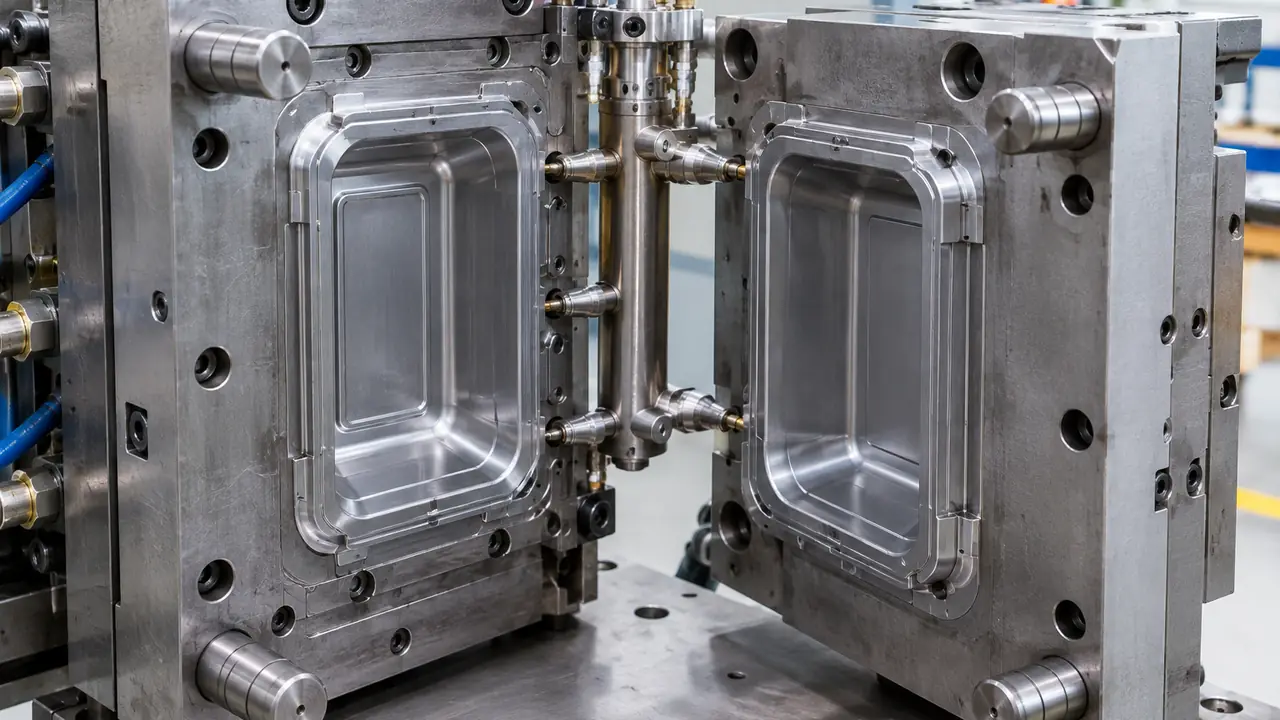
How injection molding works
An injection molding machine dries and melts resin pellets in a heated barrel, pushes the melt through a nozzle and a runner into a closed steel mold, holds it under pressure while it cools, then opens the mold and ejects the part. One complete loop is a cycle. The plant controls four groups of settings: melt temperature along the barrel, injection speed and pressure, holding pressure and holding time, and mold temperature with cooling time. Clamp force keeps the two halves shut against the injection pressure. Each container is run inside a process window: a band of settings that gives a full, stable part. The window is set at the T1 trial and written down so later lots run the same way.
Lidwell does not quote fixed machine settings. They depend on the resin grade, the mold, the press and the part, and a value copied from one plant does not transfer to another. What the desk asks for is a recorded window for each mold, and a check that the part from each lot matches the golden sample in size, weight and fit.
What injection molding is best at
Injection molded parts have walls that are even and relatively thick, sharp corners, crisp text and logos, and features that thermoformed sheet cannot carry: integral hinges, snap clips, threads, ribs, handles and the valve seats of vacuum lids. That is why the storage and organizer lines are injection molded: fridge organizer bins, vacuum food containers, collapsible storage boxes with their hinged walls, and drawer and tray organizers. Takeout ware is mostly thermoformed, but some reusable meal prep boxes and cups are injection molded; one partner plant describes its injection molded cup body as food contact grade PP tolerating -10 to 120 degrees C, a supplier statement to be confirmed by test.
From drawing to golden sample
- Design. The part drawing fixes wall section, draft angles, ribs, radii, the gate position, the parting line and ejector marks. A mold flow review is common for large boxes to predict filling and warpage.
- Steel. The mold maker chooses the steel grade, cavity count, hot runner or cold runner, and the cooling channel layout. These choices set the tooling cost, cycle and service life.
- T1 trial. First shots are made on the press. Parts are measured against the drawing, weighed, assembled with lids and tested. Corrections are made to the steel and further trials run as needed.
- Golden sample. The approved part is signed off by the buyer and kept as the reference for every production lot.
For a new mold, the T1 trial typically comes 25-45 days after the design is frozen, and a first order with the mold typically takes 45-60 days, both reference ranges confirmed in writing for each program.
Mold choices and what they change
| Decision | Options | What it changes |
|---|---|---|
| Mold type | Sample mold or production mold | Tooling cost, number of parts before rework, finish |
| Steel grade | Pre-hardened or hardened steel | Service life, polish, cost |
| Cavity count | Single cavity or multi-cavity | Output per cycle, lot-to-lot spread between cavities |
| Runner | Cold runner or hot runner | Material waste, gate mark, cycle |
| Surface | Polished, textured, matte | Clarity, scratch visibility, logo contrast |
| Inserts | Interchangeable logo or text inserts | Private label options on one mold |
Cost drivers are covered in detail in the note on mold cost and ownership. Mold ownership, storage and the right to move the mold are agreed in writing before steel is cut.
Defects buyers should know
Sink marks appear as shallow dips over thick sections or ribs. Warpage bows long walls and makes lids fit badly, especially on large storage boxes and fridge bins. Short shots leave corners incomplete. Flash is a thin fin of plastic at the parting line. Flow lines and weld lines show where melt fronts meet, which matters on clear PS and copolyester parts. Gate blush and ejector marks are cosmetic but visible on display faces. Each defect is listed with an acceptance level in the inspection plan, checked on the golden sample and again on each lot; see quality control.
Where the molds are made
Huangyan, in Taizhou, Zhejiang, is known in China as a home town of mold making. Zhejiang press reporting in 2025 counted 142 mold makers above the statutory size threshold in the district and put its share of national output at about 30 percent of injection molds. Taizhou's plastics plants, more than 12,000 in 2018, sit next to those mold makers, which is why household storage and fridge lines are sourced there. The desk shortlists the mold maker and the molding plant together, so the steel, cavity count and gate are designed for the press that will run the part. Send a drawing or a reference sample through the quote form.