
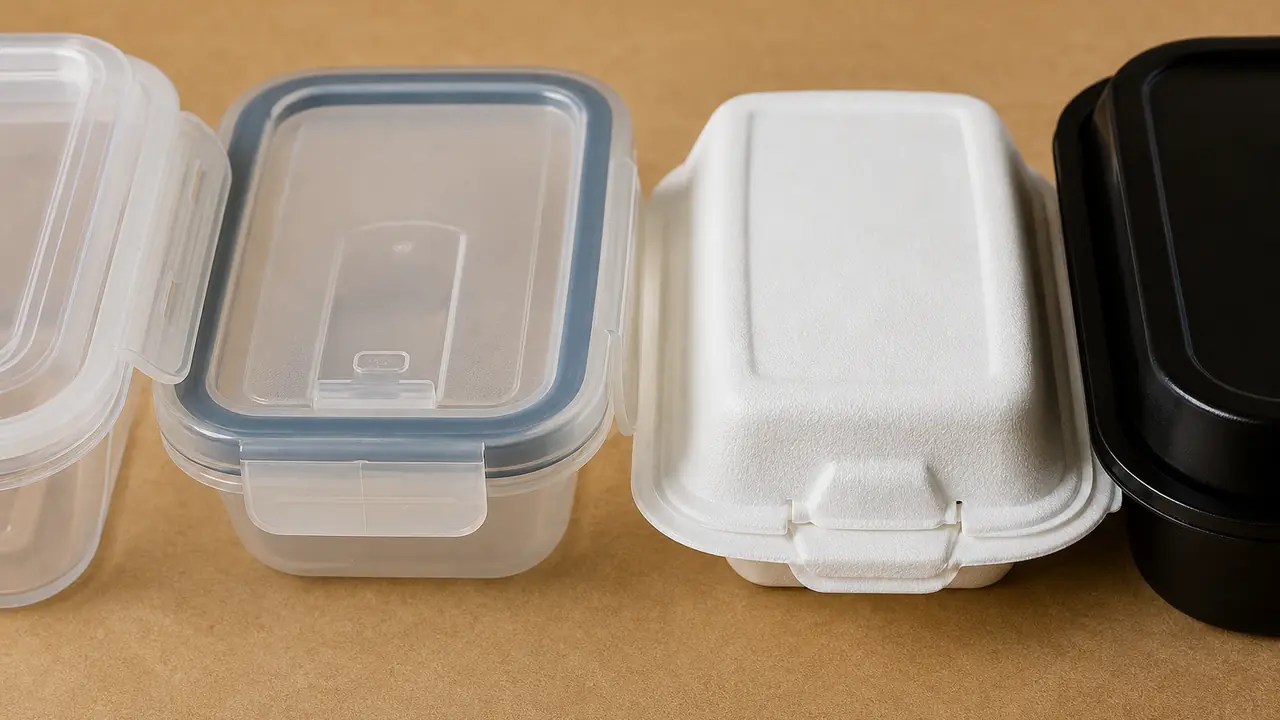
Why the lid decides the container
A base is a simple shape; a lid is a mechanism. It has to close with a predictable force, stay closed when a delivery bag is tipped, open without tearing, survive freezing and heating where the use calls for it, and fit bases that may come from a different cavity, lot or even plant. The rim profile, wall section and the tolerance between lid and base decide all of this. That is why the desk treats the lid as its own part on every cut sheet, with its own material, process and test plan.
Closure types in the range
| Closure | How it seals | Typical lines | Watch points |
|---|---|---|---|
| Snap-fit lid | Interference between lid skirt and base rim | PP takeout boxes, soup cups, bowls | Fit across cavities and lots, corner gaps |
| Hinged clamshell | One-piece hinge with a click lock at the front | PET fruit boxes, bakery and paper click-lock boxes | Hinge cracking, lock strength |
| Clip lid with gasket | Side clips press the lid onto a silicone ring | Reusable storage, pet food bins | Clip fatigue, gasket fit and cleaning |
| Vacuum valve lid | Pump draws air through a one-way valve | Vacuum food containers | Valve seat, gasket, slow air return |
| Friction or lift-off lid | Lid sits on a rim or ledge | Organizers, shoe boxes, collapsible boxes | Stacking load, dust ingress |
Snap-fit lids on takeout ware
A takeout lid seals by interference: the lid skirt is slightly smaller than the base rim, flexes over it and locks under a bead. Too little interference and the lid lifts in a bag; too much and it cracks at the corners or tears on opening. Thermoformed lids are thin, so rim design, sheet gauge and trim quality matter more than on molded parts. Sharing one lid across several depths, as on the 170x115 mm reference series from 500 to 1,000 ml at a partner plant in Huizhou, means the rim has to be identical on every base in the series. Round tubs and soup cups seal more evenly than rectangular boxes because there are no corners where pressure drops. See PP food containers.
Gaskets and vacuum valves
Reusable storage containers usually seal with a silicone gasket seated in a groove in the lid, pressed down by clips or a screw ring. The gasket has to be removable for cleaning and must not twist when refitted. Vacuum containers add a one-way valve: a hand or electric pump draws air out through the valve, and the valve stops it coming back. The valve seat is injection molded, so its finish and the gasket fit decide how long the vacuum holds. Lid, base, gasket and valve are each named with their material, usually PP or copolyester for the body and silicone for the seals. See vacuum food containers and the note on how a vacuum container works.
Why lids crack and stop fitting
Lid cracking usually starts at a corner or at the hinge, where the material is thinnest and the strain highest. Common causes are a sheet gauge or wall section that is too thin, a sharp radius, a PET lid used in the freezer or with hot food, or stress from repeated opening. Lids that fit at the plant and not on arrival have usually deformed in a hot container or under carton compression, or the lid and base came from mismatched lots. The fixes are in the specification: material for the use, minimum gram weight, rim and hinge radii, matched lots in each carton and a carton spec that carries the stacking load. Details in the notes on lid cracking and lids not fitting after shipping.
The tests behind a leak-resistant description
- Lid fit and opening force checked against the golden sample.
- Tilt and inversion test with water or the buyer's liquid, held for an agreed time.
- Drop test of a filled, closed container from an agreed height.
- Freezer test at -18 degrees C, then opening and closing.
- Heating test per supplier marking, with the lid removed or vented where marked.
Number of samples, hold times, heights and pass criteria are a stated working default, confirmed per order. A container that passes is described as leak-resistant in the standard tilt test, confirmed per order, never with an absolute claim. Results go into the program file and are repeated on each lot; see testing and inspection. Send your lid requirements with the quote form.