
What this line covers
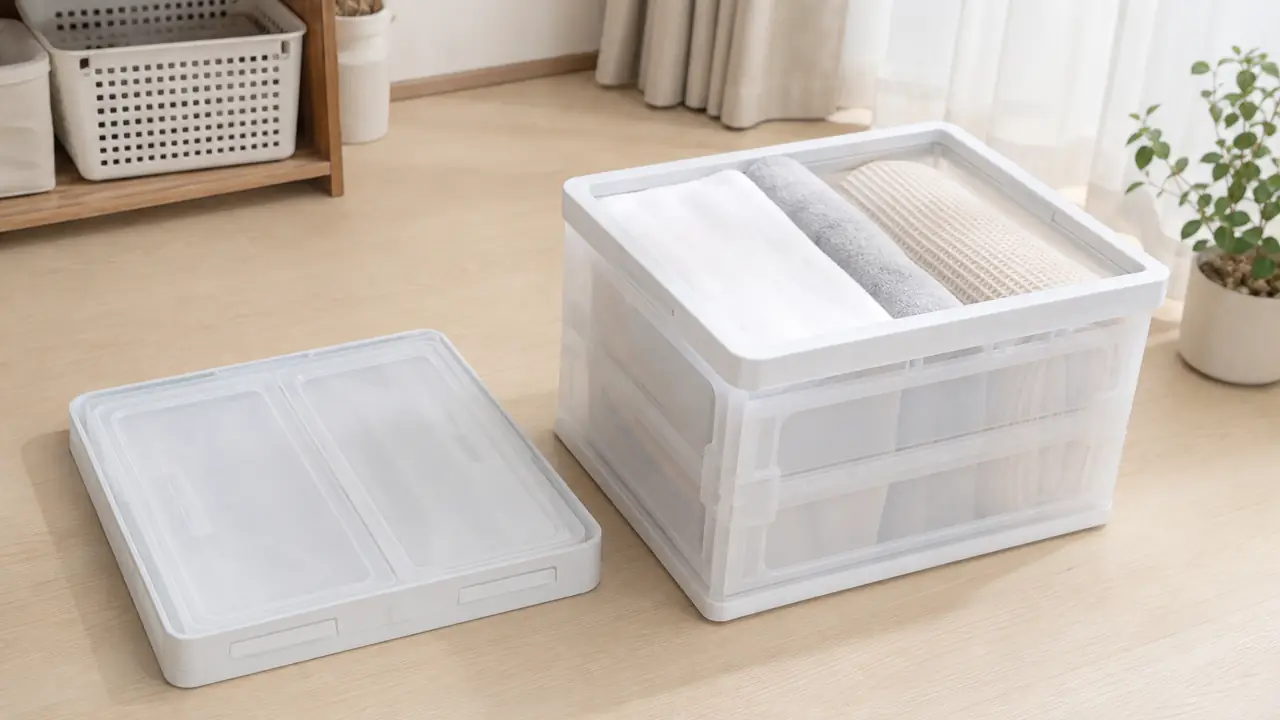
Collapsible storage boxes are crates whose four walls fold down onto the base on molded hinges. Open, they work like a rigid storage bin for a wardrobe, a garage, a car boot or a pantry shelf; folded, they take up a fraction of the space, which matters to the end user with a small home and to the brand paying for freight by volume. The line includes open crates, crates with a loose or hinged split lid, vented versions for produce or laundry and crates with a drop-down side door for access when stacked.
The reference on the cut sheet is a public listing reference size, not a partner plant model: a 30 L folding crate at 17.3x13x9.1 inches, about 440x330x230 mm outside, which folds to about 47 mm. No partner reference model exists yet for this line, so the desk measures the partner plant's sample before an order is confirmed and puts that figure on the listing.
Reference sizes and folded height
| Format | Outer size | Folded height | Typical use |
|---|---|---|---|
| 30 L crate | 440x330x230 mm | About 47 mm | Wardrobe, toys, car boot |
| 45 L crate | About 525x355x300 mm | Per model, category 4-9 cm | Clothes, bedding, garage |
| Category range | Per model | Usually 4-9 cm | Shelf and closet storage |
Two numbers belong on every listing: the outer size, because it decides whether the box fits a shelf, and the inner size, because it decides what fits in the box. On folding crates the inner size is usually about 2-4 cm smaller than the outer size, since the walls, hinges and rim take up room. Listing only the outer size is a common cause of returns. The storage box buying guide covers how to state both.
The hinge is the product
A collapsible box is only as good as its hinges. They are made from PP (resin code 5) because PP can flex repeatedly without cracking when the hinge section is thin and the grade suits it. Two hinge designs are common: a living hinge molded in one piece with the wall, and a pin hinge where separate wall panels clip onto the base. Living hinges are simpler and lighter; pin hinges let a damaged wall be replaced and tolerate a stiffer grade. Either way the wall has to lock upright, or the box folds under load. The note on collapsible box hinge design explains the details a buyer should fix in the specification.
Material and documents
Bodies, walls and lids are PP in this line, colored in the mass or left natural. Recycled content can be discussed per program, but it changes color and stiffness and has to be stated per supplier declaration. For wardrobe and garage use, the usual file is a supplier material declaration and a lot inspection report covering size, weight, latch function and carton strength. Where a crate is sold for food, such as a pantry or produce box, it needs the food contact documents in the compliance guide, issued to the partner plant or your brand per project.
Packing and freight
Folding is the commercial point of this line. A crate that folds from 230 mm to about 47 mm takes roughly a fifth of its open height in a carton, so many more units fit in a container than with a rigid box of the same size. The desk agrees the carton count, the shelf label or sleeve and the pallet pattern with the partner plant before the quote is final, and checks folded height on the lot because a warped wall stops the stack closing. See packaging and palletizing.
Private label and ordering
Brands change the color, the surface texture, a logo emboss on the wall or a printed label in the label slot; a new footprint or hinge design needs a new mold. Typical starting quantities for storage lines are about 1,000-3,000 pieces per item, depending on size and mold, and a new mold takes 45-60 days to the first batch including a T1 trial, all confirmed in writing for each program. Send the sizes, the load the box must carry and the channel through the quote form.