
Materials
Which material is used for hot food containers? Polypropylene, resin code 5. PP keeps its shape with hot food and tolerates reheating where the supplier marking allows it. Both base and lid are PP in most takeout programs.
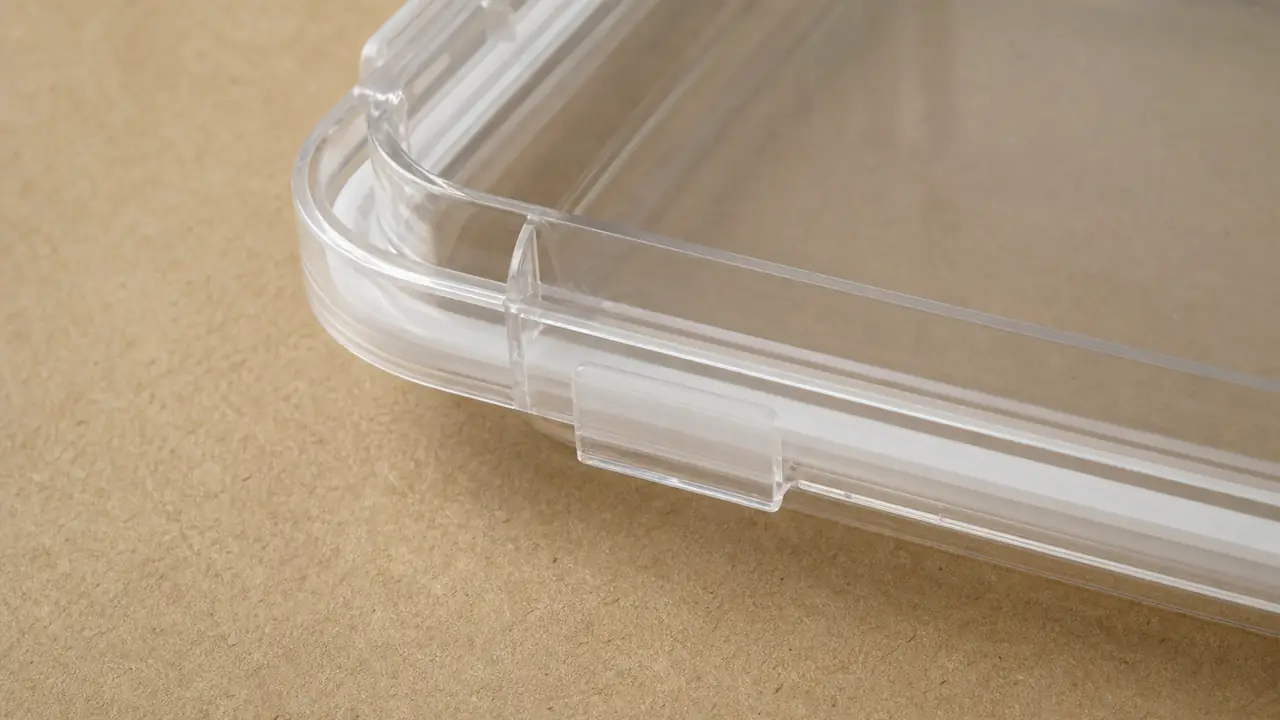
When is PET used? PET, resin code 1, is very clear and suits cold display: fruit boxes, salads, fridge bins and cold drink cups. It is not used for hot food or the microwave.
Where does PVC appear? Only in non-heated packaging and storage: clear windows and lids on paper boxes, clear folding boxes and soft pouches for small cosmetic items. PVC, resin code 3, is never used for a food container in this range, because migration risk rises with heat.
What are starch-based containers made of? Partner plant literature describes them as corn starch, and they sit in the plant's PP thermoforming range, so we describe them as starch blended with PP. The blend ratio is confirmed per project. See the material guide.
Food contact and claims
Which documents can a program include? For the US, a supplier declaration that the PP complies with FDA 21 CFR 177.1520 under the relevant conditions of use. For the EU, a declaration of compliance to Regulation 1935/2004 and Regulation (EU) 10/2011, with a migration report from a third-party lab. For China, GB 4806.7-2023 for plastics and GB 4806.8 for paper.
Who holds the documents? They are issued to the partner plant or to your brand per project and verified by the desk. Lidwell does not hold certificates itself.
Can containers be sold as biodegradable or compostable? Only with a named certification such as EN 13432 or ASTM D6400 and wording qualified in line with the FTC Green Guides, 16 CFR 260.7 and 260.8. Without it, we make no such claim. See the compliance guide.
Can plastic cutlery be sold in the EU? No. Directive (EU) 2019/904 has banned single-use plastic cutlery and plates since 3 July 2021, and PLA counts as plastic. For EU buyers the route is wooden cutlery.
Minimum order quantities
What is the smallest order? From stock molds, typically 1-10 cartons mixed, which is a few thousand pieces. Nested PP containers pack 200-300 sets per carton.
What changes the MOQ? Customization. Printed lids, cups or sleeves typically start at 10,000-50,000 pieces per item; printed paper boxes at 5,000-10,000 pieces per design; storage boxes at 1,000-3,000 pieces per item; a new food container mold from 50,000-100,000 pieces. All are typical reference ranges, confirmed in writing for each program.
Samples
How long do samples take? Stock samples typically 3-7 working days, printed samples 7-15 working days. A new mold needs a T1 trial, typically 25-45 days for the mold cycle.
What is checked on a sample? Outer size and gram weight, lid fit, a tilt and inversion test with liquid, freezer and microwave checks where the marking allows, odor, and for paper boxes print adhesion. The approved sample becomes the golden sample for the order.
How are samples sent? By express, typically 5-8 days in transit.
Printing and private label
What can be printed? Lids, cup walls, paper sleeves and labels on plastic containers; full print on kraft and white card boxes from the Longgang cluster; retail packaging and barcodes for storage lines.
Can I have my own mold? Yes, with your footprint or a logo emboss. The tooling, T1 trial and first order typically take 45-60 days, and the quantity starts higher than for stock molds. See OEM and private label.
Shipping
How are orders shipped? By sea, FCL or LCL. Typical transit is 15-25 days to the US West Coast and 30-45 days to Europe. Bulk production typically takes 7-15 days from stock and 15-30 days for printed orders.
Why does nesting matter? Containers are light and bulky, so freight is charged by volume. How tightly the pieces nest decides how many fit in a container, which is often a bigger cost factor than the piece weight. See logistics and shipping.
Which HS code applies? Plastic tableware and kitchenware usually fall under 3924.10, general storage boxes under 3924.90, plastic packaging under 3923 and paper boxes under 4819. Confirm the code with your customs broker, as rates and classifications change with policy.
For anything not covered here, write to the desk through the quote form with the lines, quantities and destination market.