
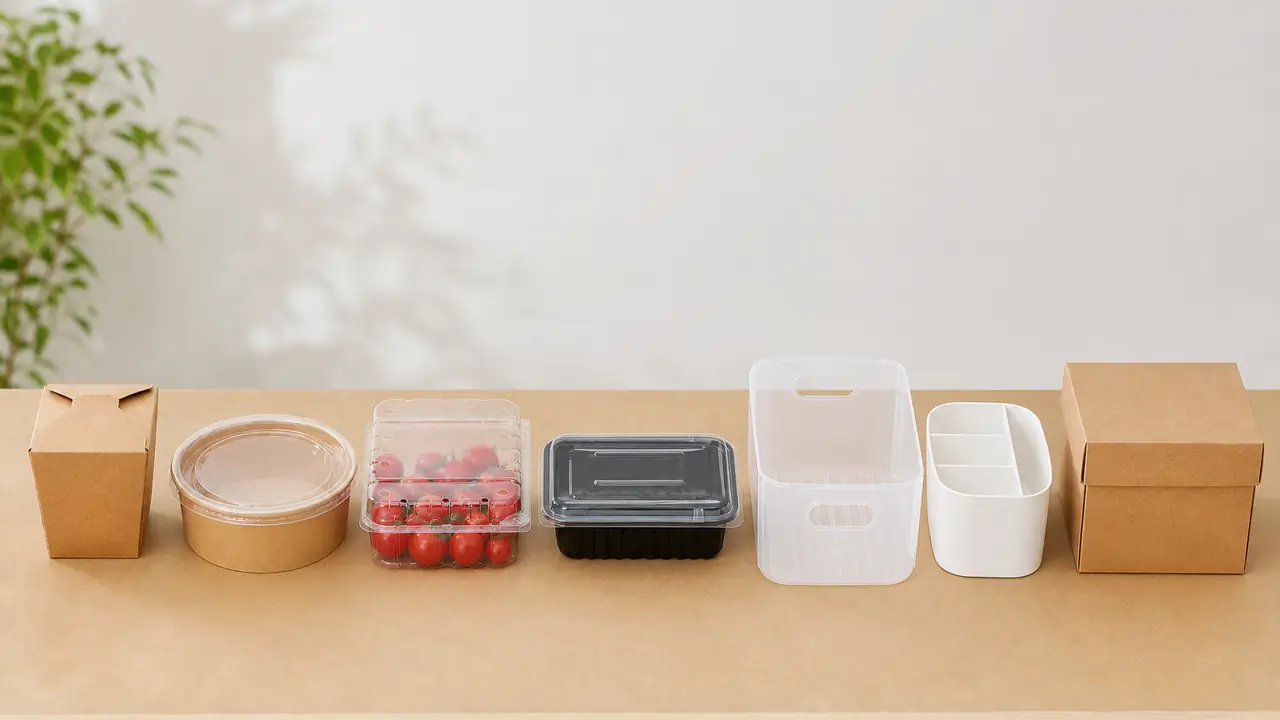
Three words, three different products
In a sourcing brief, container, box and storage box are often used as if they meant the same thing. In practice they describe three different products, with different materials, different documents and different plants behind them. A food container holds food directly: a PP takeout box, a soup cup, a divided fruit tray, a vacuum container. A packaging box carries or presents a product for a short time: a kraft bakery box with a clear lid, a folding gift box, a click-lock takeout carton. A storage box is bought to organize things at home for years: a collapsible crate, a shoe box, a drawer tray, a cosmetic organizer.
The difference matters because it decides three things before any size is discussed. First, whether food contact rules apply at all. Second, which materials are acceptable: PVC, for example, can be right for a clear folding box or a gift box window and is never used for a hot food container. Third, which cluster of partner plants is best placed to make the item. Getting the category right at the start avoids asking a storage plant for migration reports it has never needed, or asking a printing plant for injection molded lids.
How the categories differ
| Category | Typical materials | Food contact | Service life | HS reference |
|---|---|---|---|---|
| Food container (plastic) | PP for heat, PET for cold clarity, copolyester for reusable storage | Yes, direct | Single use or reusable | 3924.10 or 3923, per item |
| Packaging box (paper) | White card, kraft, white card with foil lining; PET or PVC window | Indirect or short contact, per design | Single use | 4819 |
| Plastic packaging container | PET, PP, PVC for non-heated items | Only where designed for food | Single use | 3923 |
| Storage box | PP, PS, PET, acrylic, ABS with PP | Usually none; yes for kitchen bins | Years of reuse | 3924.90, or 3924.10 for kitchen storage |
HS headings in the table are the references usually discussed, not a classification. Food storage containers commonly sit under 3924.10 (tableware and kitchenware of plastics), general household storage under 3924.90, plastic articles for the conveyance or packing of goods under 3923, and cartons and boxes of paper or paperboard under 4819. The final code depends on the exact item and the destination tariff, so confirm it with your customs broker before the first shipment.
The three families and twelve lines
Lidwell groups its range into three families, each with its own cut sheets, materials and partner plants.
Takeaway packaging
The volume family for restaurants, delivery and events: PP food containers with snap lids, starch-based food containers, disposable cutlery sets and folding gift boxes. The reference PP box is a real 750 ml model from a partner plant in Huizhou, 170x115x51 mm and 19.6 g. These items are made mostly in Guangdong for plastics and around Longgang near Wenzhou for paper and print. See takeaway packaging.
Food storage
Containers that keep food at home or on a retail shelf: divided fruit containers, vacuum food containers, fridge organizer bins and pet food storage containers. Here clarity, lid seal and stacking matter as much as gram weight, and documents still follow food contact rules because the food sits inside for days or weeks. See food storage.
Home organizers
Storage boxes that never touch food: collapsible storage boxes, cosmetic organizers, shoe and clothes storage boxes and desk organizer boxes. The household plastics cluster in Taizhou and Ningbo makes most of them, and the brief focuses on stacking load, hinge and door design, clarity and retail packaging. See home organizers.
Grey areas buyers ask about
- A fridge bin holding fruit. If food is placed in it directly, treat it as a food contact item and ask for the matching declaration, even though it looks like an organizer.
- A bakery box with a clear window. The board is the packaging; the window can be PET or PVC because it is not heated and does not touch hot food. For fibre packaging in the US, check state PFAS rules.
- A cosmetic organizer in PVC. Acceptable as a non-heated storage item, and described with its material, not as anything food related.
- A starch-based bowl. A food container in the takeaway family, usually starch blended with PP, so it is described as such rather than as biodegradable.
Why one desk covers all three
A foodservice program often needs PP boxes, a paper carrier box and cutlery in one shipment; a home brand may sell vacuum containers next to drawer organizers. Each comes from a different cluster, and China exported about 15.4 billion US dollars of plastic housewares in 2024, roughly 60 percent of world trade under HS 3924, according to OEC data. The desk shortlists partner plants in each cluster, keeps all items on one spec sheet with the right material named for every part, and consolidates them into one inspected order. The material guide explains the material choices; send a mixed list through the quote form and the desk splits it by family.