
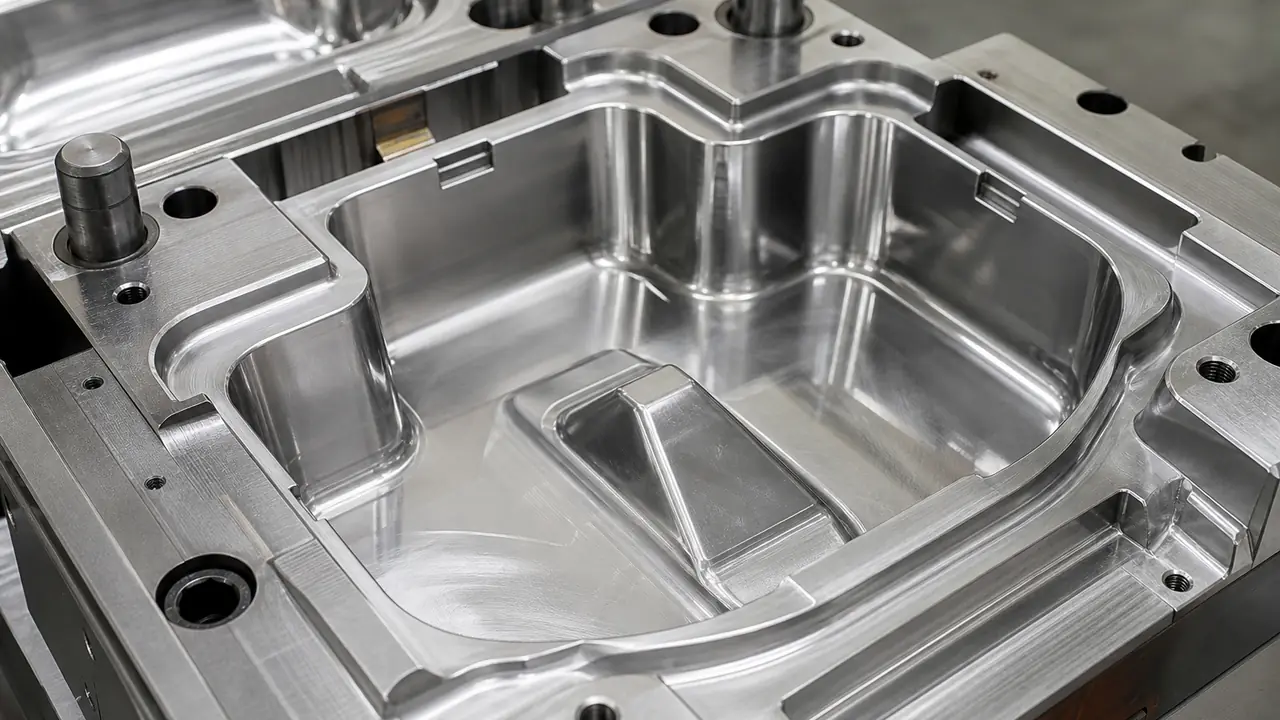
What injection molding is, in one paragraph
In injection molding, PP pellets are dried where needed, melted in a heated barrel and pushed by a screw into a closed steel mold. The melt fills the cavity, is held under pressure while it shrinks, cools against the water-cooled steel and is pushed out by ejectors when the mold opens. The part that comes out is finished: rim, corners, stacking lugs and any embossed logo are all formed in one shot. That is the main difference from thermoforming, where a sheet is heated and pulled over a form and the part is then trimmed out of the sheet. The injection molding page covers the tooling side; this note stays with the container.
For food containers the method matters because it sets the wall, the weight and the look. Injection molded boxes are thicker for their size, keep crisp corners, take a textured or polished finish and are the normal route for reusable storage and for parts with complex details such as hinges, clips and valve seats. Thermoformed boxes are lighter and nest more tightly, which is why single-use takeout leans that way. The two are compared in thermoformed vs injection molded containers.
The molding cycle, phase by phase
A plant quotes a container partly on its cycle: the time from one mold closing to the next. Each phase has a lever the plant controls and a consequence the buyer sees. The cycle is not a figure to argue about on the quote, but it is worth understanding, because most quality problems trace back to a phase that was shortened to save time.
| Phase | What happens | Parameters the plant sets | What the buyer sees if it is wrong |
|---|---|---|---|
| Fill | Melt enters through the gate and fills the cavity | Injection speed, melt temperature | Short shots at the rim, flow lines, burn marks |
| Pack and hold | Extra melt is pushed in as the part shrinks | Holding pressure and time | Sink marks, weak rim, gram weight below spec |
| Cooling | The part solidifies against the steel | Mold water temperature, cooling time | Warped walls, lids that do not fit, bowed bases |
| Open and eject | The mold opens and ejectors push the part off | Ejector layout, draft, release | Ejector marks, scuffs, stress whitening |
| Take-out and stack | Robot or operator removes and stacks parts | Gripper, stacking pattern | Scratches, dust, deformed rims in the stack |
Cooling is usually the longest phase, and it is the one under most pressure on a busy line. A container that left the mold too warm can look fine at the press and still shrink unevenly over the next day, which shows up later as lids that are hard to close. That is why the desk asks for lid fit to be checked on parts that have rested, not straight off the press.
Gates: where the plastic enters
The gate is the opening through which melt enters the cavity. Its type and position decide how the plastic flows, where the weakest point of the part sits and where a small mark remains.
- Centre gate on the base. The usual choice for tubs, cups and boxes: the melt spreads evenly from the middle of the base to the rim. A small round mark remains under the base, which is why it is often placed inside a recessed ring.
- Hot runner gate. The melt is kept molten up to the cavity, so there is no cold runner to trim or regrind. Common on high-output container molds; the gate mark is small and clean when the system is well maintained.
- Edge or side gate. Used on flat parts such as some lids and trays. It leaves a mark on the edge and can create a weld line where flow fronts meet on the far side.
Two buyer points follow. First, the gate area is where a container tends to crack under impact or after freezing, so a drop check and a freezer check should look at the base around the gate. Second, the gate mark is part of the appearance standard: agree on the sample what height and size of gate mark is acceptable, because a rough gate scratches the next part in the stack.
Walls: thickness, flow length and gram weight
For a buyer the wall is the most important hidden parameter. It decides stiffness, heat behaviour, lid fit and cost. Thin wall molding pushes melt a long way through a narrow gap, which needs fast injection and a well-designed mold; a wall that is too thin for its flow length will fill unevenly, and a wall that varies in thickness will shrink unevenly and warp.
Plants rarely state wall thickness on a quote, but they state the weight per piece, and weight is the best proxy a buyer has. For comparison, the thermoformed takeout series from a partner plant in Huizhou, Guangdong, puts a 750 ml box at 170x115x51 mm and 19.6 g; an injection molded box of similar capacity will normally weigh more, because the walls are thicker and the details heavier. When two quotes for the same capacity differ, compare the gram weights before the prices. The note on gram weight and wall thickness goes further.
Material and heat statements
Injection molded food containers are almost always PP, which keeps its shape with hot food and tolerates reheating where the supplier marking allows it. One partner plant's own literature describes its injection molded cup as food contact grade PP that tolerates -10 to 120 degrees C and boiling water; that is a supplier statement and is treated as such until a heating test on the sample confirms it for your use. Clear rigid parts for storage sometimes use copolyester; organizers use PS or acrylic, which are not food containers. Documents follow the material: a supplier declaration to FDA 21 CFR 177.1520 for PP in the US, or to EU 1935/2004 and 10/2011 with a migration report for Europe, verified per project. See food contact safety.
Where these containers come from
Household plastics and storage containers cluster in Taizhou, Zhejiang. Huangyan in Taizhou is known as a mold town: provincial press reporting in 2025 counted 142 mold makers above the statistical size threshold and put Huangyan at about 30 percent of national injection mold output. That matters for buyers because the mold maker and the molding plant are often close neighbours, so a mold change or a repair does not cross the country. The desk shortlists partner plants by part and process; see industry clusters.
What to fix in the specification
- Outer size and capacity from the reference model, with tolerances.
- Gram weight per piece and its tolerance.
- Material named per part: base, lid, seal, insert.
- Gate position and the accepted gate mark on the sample.
- Lid fit, tilt, drop and freezer checks on rested parts, confirmed per order.
- Packing: stack count per sleeve and pieces per carton, often 300-500 for injection molded cups.
Stock molds start from a few mixed cartons; a new mold typically starts from 50,000-100,000 pieces per item, with a T1 trial in about 25-45 days and a first order in about 45-60 days including the mold, all confirmed in writing per program. See MOQ and lead time or send drawings through the quote form.