
What this line covers
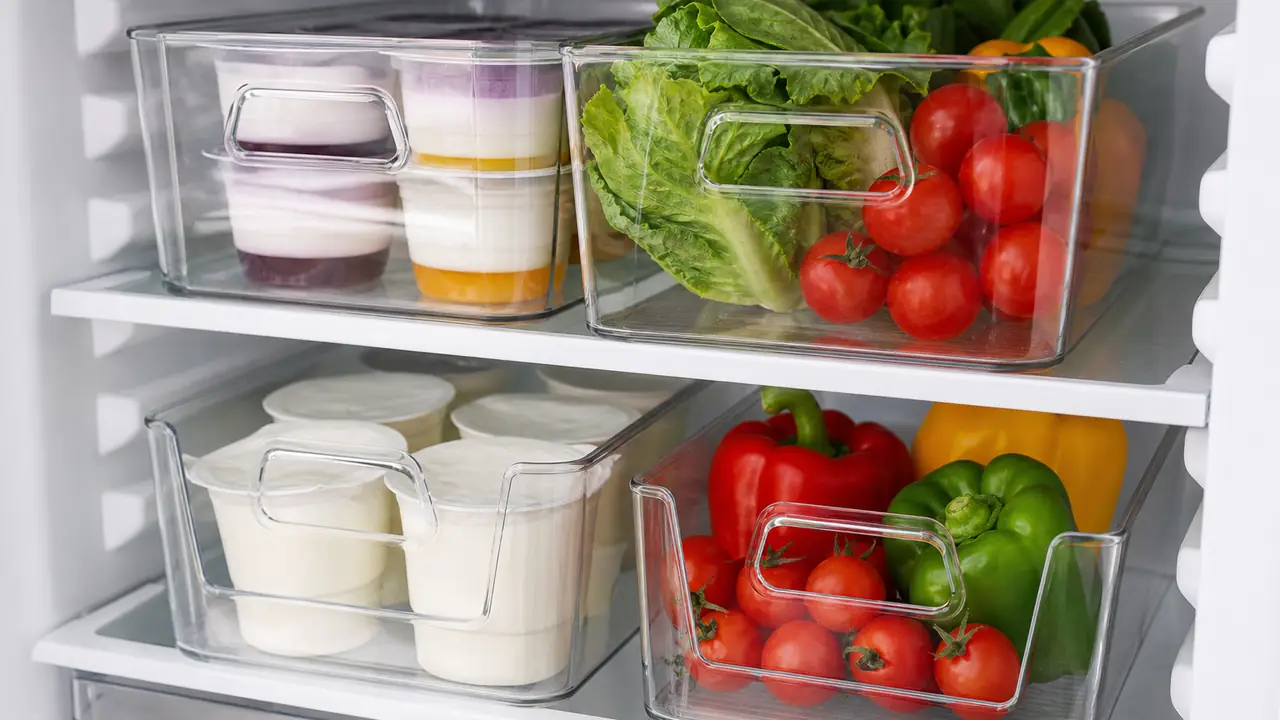
Fridge organizer bins are open or lidded clear bins that sit on refrigerator shelves and in door and drawer spaces. They group drinks, dairy, fruit, condiments and leftovers, make the back of the shelf reachable with a front handle, and stack where shelf height allows. The line sells mostly in sets of four to eight bins in mixed sizes, through home retail, kitchen brands and marketplace stores, where the photo of a neatly zoned fridge does much of the selling.
No partner plant reference model is on file for this line. The cut sheet uses the most common public listing reference size: a bin of 12.4x6.2x3.5 inches, about 315x157x89 mm, sold in eight-piece sets. The final size for your program is measured on the sample the desk shortlists, and inner and outer sizes are both written on the spec sheet, because shoppers compare listings by inches.
Sizes that fit real shelves
The size that sells is the one that fits. Public listings and shelf guides suggest that bins for a standard fridge shelf work best at a length of about 10-12.5 inches, roughly 254-318 mm, and a height of 3-4 inches, roughly 76-102 mm, so that a bin fits the shelf depth and still clears the shelf above. The table converts the common listing sizes to millimetres.
| Listing size | About in mm | Shape | Typical use |
|---|---|---|---|
| 12.4x6.2x3.5 in | 315x157x89 mm | Long, narrow | Drinks, yogurts, condiments |
| 12x8x4 in | 305x203x102 mm | Long, wide | Produce, leftovers |
| 12x6x4 in | 305x152x102 mm | Long, narrow, deeper | Bottles, jars |
| 14.5x8x4 in | 368x203x102 mm | Deep shelf | Large produce, meal prep boxes |
| 14.7x4.3x3.9 in | 373x109x99 mm | Slim | Cans, door gaps, side rows |
Inch figures are converted and rounded to the nearest millimetre. A set usually combines two or three of these footprints so the bins tile a shelf without gaps. See fridge organizer sizing for shelf, door and drawer planning.
Materials: clear PET or PP
Most fridge bins are clear, because shoppers want to see the food. Clear PET gives the best clarity and a glassy look; it is used cold, which suits a fridge. PP is slightly hazier and more flexible, and copes better with knocks and hot washing. Both are made by injection molding in the household plastics clusters of Taizhou and Ningbo in Zhejiang. Where a bin holds unpacked food such as loose fruit or cut vegetables, it is a food contact article and needs a declaration for its material; where it only holds packaged drinks and jars, the documents can be lighter. That choice is written on the spec sheet so the listing wording matches. PVC is not used for fridge bins in this range. The material guide compares the resins.
Details that sell the set
- Front handle: a molded cut-out or pull lip, so a bin can be drawn out from the back of a shelf.
- Stacking: rims or lids that let bins stack where shelf height allows; stacking is checked with filled bins.
- Inserts: removable dividers, egg trays and drain grids for produce, each priced and documented as a separate part.
- Labelling: embossed or printed zone names on the front, or blank label areas for the end user.
- Set packing: bins nest inside each other, which keeps the retail box and the master carton small.
Checks agreed per order
Fridge bins crack at the handle and at corners, mostly from cold and from being pulled out full. The desk agrees checks that match: a handle pull with a filled bin, a freezer cycle at -18 degrees C where the bin is sold for freezer use, a drop check at fridge temperature, a stacking check, and a visual check for clarity and flow marks on the long faces, which show most in photos. Results are written as tested per order. See container lid cracking for the material side and testing and inspection for the full test list.
Documents and ordering
For bins that hold unpacked food, supplier declarations to FDA 21 CFR 174-178 for the US, with 21 CFR 177.1520 for PP, and declarations of compliance to Regulation 1935/2004 and Regulation (EU) 10/2011 with a migration report for the EU. Documents are issued to partner plants or to your brand per project and verified by the desk. Storage lines typically start at 1,000-3,000 pieces per item, and a printed set box adds its own minimum, all confirmed in writing for each program; see MOQ and lead time. Send the set composition, sizes in inches or millimetres and target market through the quote form.