
What this line covers
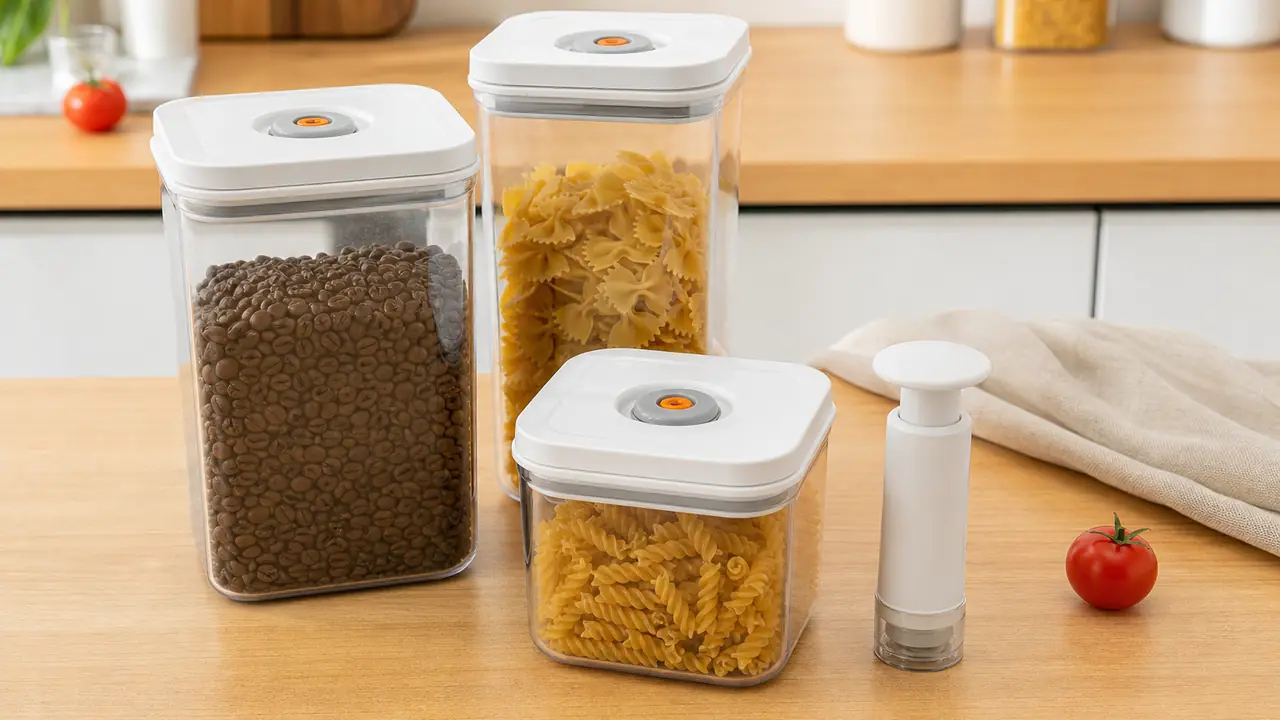
Vacuum food containers are reusable storage boxes with a sealed lid and a one-way valve. A hand pump or a small electric pump is placed on the valve and draws air out of the box; the valve stops air from flowing back, and the silicone seal ring keeps the lid closed against the lower pressure inside. The line is sold to home cooks for leftovers, marinating, coffee beans, dry goods and cut produce, usually as a set of three to five boxes with one pump.
No partner plant reference model is on file for this line. The cut sheet uses a public listing reference size: a 1.4 L rectangular copolyester box measuring 233x156x90 mm, sold as a single piece. A PP 1.4 L box on public listings measures about 232x152x73 mm. These sizes guide the range; the size, capacity and gram weight for your program are set from the sample the desk shortlists and measured on the physical part.
Sizes and sets
Most vacuum containers are sold in sets, so the range is planned as a set composition rather than single sizes. Single pieces typically run from 0.5 to 2.0 L. The table shows common set patterns on public listings.
| Set | Pieces | Typical use | Pump |
|---|---|---|---|
| Single 1.4 L | 1.4 L, about 233x156x90 mm | Leftovers, marinating | Sold with or without pump |
| Three-piece set | 0.7, 1.4 and 2.0 L | General kitchen storage | One hand or electric pump |
| Three-piece set | 0.5, 1.0 and 2.0 L | Dry goods, coffee, snacks | One hand or electric pump |
| Mixed set | Four to five pieces from 0.5-2.0 L | Gift and starter sets | One pump per set |
Keeping all sizes on one or two footprints lets the boxes stack and lets one lid size fit more than one depth, which reduces molds and keeps the retail box compact. The sizing guide explains how to set capacities.
Materials: PP or copolyester
The body and lid are either PP or copolyester. PP is lighter, slightly hazy and suits reheating where the supplier marking allows it, with the lid and valve removed. Copolyester is clearer and tougher, which is why it is common on premium sets where the food has to be visible; the heat rating of each grade is stated by the supplier and checked on the sample rather than assumed. On this site we write copolyester and do not use resin trade names. The seal ring is silicone; the valve has its own small parts, often silicone and PP. Every part is named with its material on the spec sheet, because each one touches food or air in the box. See copolyester food storage containers and the container materials page.
How the seal is checked
The selling point of the line is that the lid holds. That is decided by the flatness of the rim, the fit of the seal in its groove and the quality of the valve. The desk agrees checks per order: a hold test in which a pumped box is left for an agreed period and the lid is checked for release, repeated pumping and opening cycles, a freezer cycle at -18 degrees C where the set is sold for freezing, a tilt test with liquid where it is sold for marinating, and a drop check on the filled box. Results are written as tested per order. The pump, whether hand or electric, is checked for fit on every lid size in the set. See how vacuum containers work and lids and seals.
Electric pumps and set packaging
Hand pumps are simple molded parts. Electric pumps add a motor and a power source, which brings separate electrical, battery and shipping questions for the destination market; these are confirmed with the pump supplier and your test lab per project. The retail set box carries the brand, the set composition and the use instructions, including how to release the valve and which parts may go in a dishwasher or microwave per supplier marking. The carton is drop tested with the full set inside.
Documents and ordering
For the US, supplier declarations to FDA 21 CFR 174-178 for each material, with 21 CFR 177.1520 for PP. For the EU, declarations of compliance to Regulation 1935/2004 and Regulation (EU) 10/2011 for the plastic parts, with migration reports from a third-party lab, and LFGB test reports where German retail asks for them; silicone parts need their own test evidence. Documents are issued to partner plants or to your brand per project and verified by the desk. Storage lines typically start at 1,000-3,000 pieces per item, confirmed in writing for each program; see MOQ and lead time. Send the set composition, material preference and market through the quote form.