
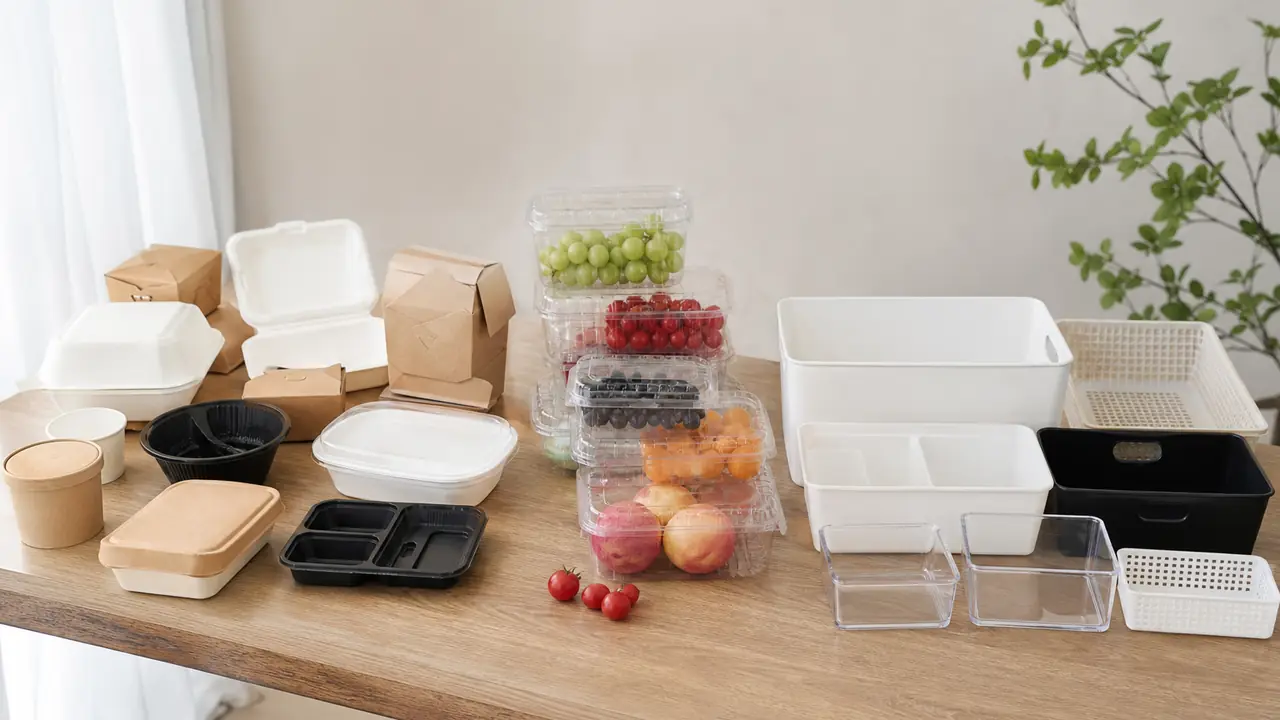
How to read these cases
Each case below is illustrative. It combines situations that buyers commonly bring to a sourcing desk into one anonymous program, so the decisions can be shown end to end. No case names a client, and none claims a measured saving, defect rate or sales result. Sizes and weights are the real reference models from partner plants or the public listing sizes used on this site; quantities and timelines are the typical reference ranges, which for a real program are confirmed in writing.
| Case | Buyer type | Lines | Key decision |
|---|---|---|---|
| A | Restaurant group | PP takeout boxes, soup cups | One footprint, shared lid |
| B | Meal prep brand | PP boxes, divided trays | Printed lid after a stock trial |
| C | Bakery chain | Kraft boxes with clear lids | Window material and PFAS check |
| D | Marketplace seller | Fridge bins, shoe boxes | Retail pack and carton size |
| E | EU distributor | Cutlery sets, starch-based bowls | SUPD-compliant cutlery, honest bowl wording |
Case A, illustrative: one footprint for a restaurant group
A restaurant group used five rectangular boxes from three suppliers, each with its own lid. Kitchens ran out of the right lid and stacked mixed sizes badly in delivery bags. The desk proposed the 170x115 mm PP series from a Guangdong partner plant, 500 to 1,000 ml on one footprint with one lid, plus round soup cups from the 350-950 ml export series for liquids. The decisions were to standardise on four depths, to run a tilt test with liquid on each sample, and to start from stock molds in mixed cartons before considering a printed lid. See restaurant takeout.
Case B, illustrative: a meal prep brand moves to printed lids
A meal prep brand wanted its logo on every container and a freezer-to-microwave routine for customers. The desk matched PP boxes and the three-compartment 218x188x42 mm tray, both with microwave use per supplier marking, and planned a freezer check followed by a heating test on samples with the lid vented as marked. The brand first ran stock boxes with a printed sleeve, then moved to a printed lid in the typical 10,000-50,000 piece range per item once the menu settled. The specification states microwave use per marking only. See meal prep and delivery.
Case C, illustrative: bakery boxes with a window
A bakery chain needed kraft boxes with clear lids in three sizes for the US market. The desk matched the 190x85x35 mm, 160x85x35 mm and 135x73x35 mm references from a paper packaging partner, printed in the Longgang cluster at the typical 5,000-10,000 boxes per design. The clear lid was specified in PET, which suits a non-heated window; PVC was also an option for a window that never touches hot food. Because the board is fibre packaging, the brief added a supplier statement on intentionally added PFAS for the states where the chain sells. See folding gift boxes.
Case D, illustrative: storage SKUs for a marketplace seller
A marketplace seller wanted to add fridge bins and clear shoe boxes. The desk matched a fridge bin near the common 315x157x89 mm listing size and a folding shoe box near 330x230x140 mm, both from Taizhou injection plants, on stock molds with a retail pack and barcode. The key decisions were exact outer and inner sizes on the listing, a pack that survives a parcel network, and a carton size planned against the container load. Starting quantities sat in the typical 1,000-3,000 pieces per item range. See marketplace sellers.
Case E, illustrative: an EU distributor and the cutlery switch
An EU foodservice distributor asked for PP cutlery sets and starch-based bowls described as compostable. The desk set out that the EU Single-Use Plastics Directive 2019/904 has banned single-use plastic cutlery and plates since 3 July 2021, with PLA counted as plastic, and proposed wooden cutlery sets instead. For the bowls, the 800 ml 175x125x56 mm reference is starch blended with PP, so the wording became starch-based with PP, with no compostable claim unless a named EN 13432 certificate applies. Food contact documents to EU 10/2011 were planned per project. See disposable cutlery sets.
What the cases have in common
In each case the first decision was the material for the use, the second was the route and quantity, and only then the plant. Every claim on the pack was traced to a document or a test confirmed per order. To see how your own brief would run, send it through the quote form.