
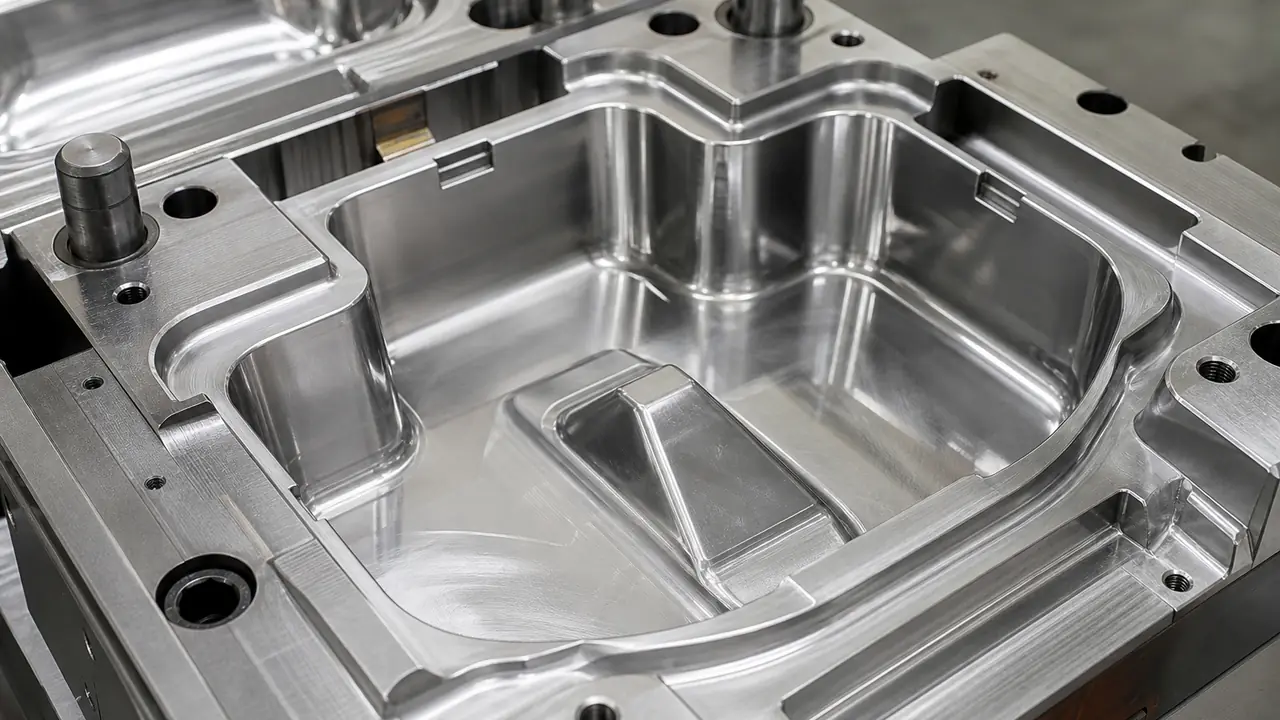
Output is a simple product
The output of a container mold comes down to four things multiplied together: the number of cavities, the number of cycles per hour, the hours the press actually runs, and the share of parts that pass inspection. A plant can raise output by adding cavities, by shortening the cycle, by running more shifts or by cutting scrap. Each route has a cost, and each has a limit. The steel decides how long the mold keeps doing this before it needs major repair.
Buyers rarely need to calculate output themselves, but they need to know which lever a quote is pulling. A low unit cost based on a short cycle that the part cannot sustain, or on a cavity count the press cannot run evenly, turns into lid fit problems or late deliveries later in the program.
Cavity count: more is not automatically better
A single-cavity mold makes one part per cycle; a multi-cavity mold makes several identical parts per cycle. More cavities raise output per press hour and usually lower the unit cost on long runs, but they also raise the tooling cost, need a larger press and make it harder to keep every cavity identical.
| Option | Strengths | Watch points | Fits |
|---|---|---|---|
| Single cavity | Lower tooling cost, easy to adjust, consistent parts | Lower output per press hour | Large storage boxes, low or uncertain volume |
| Multi cavity, same part | High output, lower unit cost on long runs | Cavity-to-cavity variation, larger press, higher tooling cost | Takeout boxes, cups, lids in steady volume |
| Family mold, base and lid | One tool for a set, matched quantities | Different parts fill differently; harder to balance | Small sets where volume is modest |
| Separate base and lid molds | Each part optimised; one lid can serve several bases | Two tools to maintain and schedule | Series sharing one footprint |
The family mold row deserves care. Putting a base and a lid in the same mold sounds efficient, but the two parts have different volumes and wall sections, so one tends to fill or cool differently from the other. For food containers, where lid fit is the main complaint, separate base and lid tools are often the safer choice. A series that keeps one footprint, like the 500-1,000 ml reference boxes on a 170x115 mm footprint from a partner plant in Huizhou, also lets one lid tool serve several bases.
Cavity balance and cavity marks
In a multi-cavity mold every cavity should fill at the same moment and produce the same part. When the runner is unbalanced, the cavities nearest the injection point fill first and pack harder, and the far cavities run light. The result is a carton of containers in which some lids fit and some do not. A hot runner system, which keeps the melt molten up to each gate, helps balance and cuts runner scrap; it is common on high-output container molds and adds tooling cost.
The practical check is a cavity number molded into every part, usually under the base. With cavity numbers, a fit problem can be traced to one cavity instead of the whole lot, and inspection can sample across all cavities. The desk asks for cavity marks on every multi-cavity container mold and samples each cavity at the T1 trial.
Mold steel: matching life to the program
Mold steel is chosen for hardness, toughness, polishability and corrosion resistance. Without going into grade numbers, container molds tend to use three families:
- Pre-hardened tool steel. Machined in a hardened state, quicker to build and adjust. Suits moderate volumes and parts whose design may still change.
- Through-hardened tool steel. Hardened after machining, harder wearing at the rim and parting line. Suits long runs of high-volume parts.
- Stainless tool steel. Resists corrosion from cooling water and humid storage, and polishes well. Often chosen for clear parts and for food contact items where a clean, polished cavity matters.
Thermoforming tools are a different case: they form sheet at low pressure and are commonly made of aluminium, with a separate steel cutting tool for trimming. Trim tool wear shows up as ragged edges and plastic hairs, so its maintenance belongs in the program file too. See thermoforming.
The steel grade should be named on the tooling quote. Two quotes for the same part with different steels are not comparable, and a mold built in a softer steel than the program needs will need repair sooner. The opposite mistake also happens: a hardened stainless mold for a seasonal item that will run for one or two orders ties up tooling budget that would have been better spent on print, inserts or a second size. The right steel is the one that matches the life the program can realistically expect, with a margin for repeat orders.
Cycle time and the press
Cycle time is set mostly by cooling, which depends on wall thickness and on how well the cooling channels are laid out in the steel. Thin, even walls cool quickly; thick sections and heavy ribs slow the whole cycle. Pushing the cycle shorter than the part allows produces warped rims and lids that close on the line but not a week later. The press must also suit the mold: enough clamp force for the projected area of all cavities, and enough shot size. A mold with too many cavities for the available presses either waits for a larger press or runs with blocked cavities. The injection molding page covers the press side.
Sizing a mold to the program
- Estimate the annual volume per item, with a realistic first year.
- Decide whether one lid will serve several bases.
- Ask for a quote at two cavity counts to see the trade-off.
- Match the steel to the expected program life.
- Require cavity numbers and a balanced runner on multi-cavity molds.
- Confirm the press the plant will run it on.
New molds typically start from 50,000-100,000 pieces per item, with a T1 trial in about 25-45 days, confirmed in writing per program. Read the related mold cost and ownership note, see MOQ and lead time, or send the drawing and volumes through the quote form.