
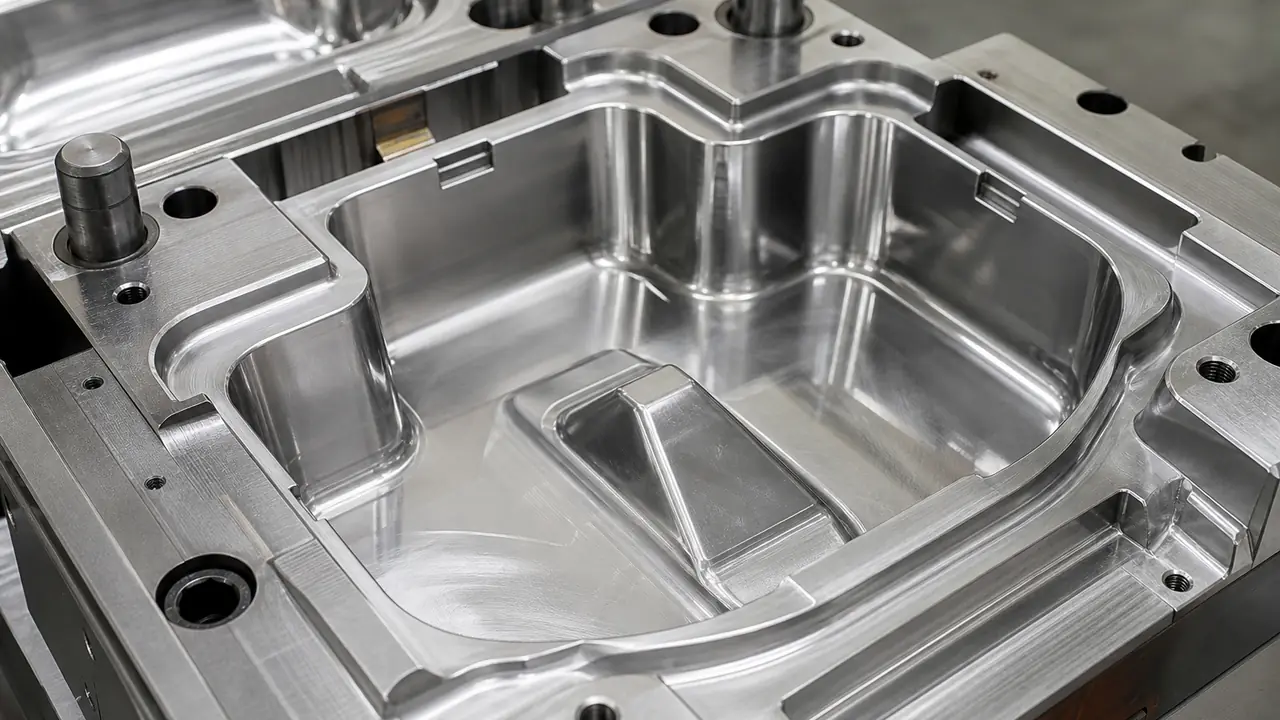
When a custom mold is worth it
Most container programs do not need a custom mold. Partner plants run large ranges of stock molds, also called public molds, and a brand can add a printed lid, a sleeve, a label or a carton without touching the tooling. A custom mold becomes worth considering when the footprint itself is the brand: a distinctive shape, an embossed logo in the base or lid, a compartment layout no stock mold offers, or a fit with another product that stock sizes miss.
The trade-off is quantity and time. Typical reference ranges put a new mold at 50,000-100,000 pieces per item for the first order, against a few mixed cartons from stock or 10,000-50,000 pieces for a printed stock item, and a first order with a new mold at about 45-60 days including tooling, all confirmed in writing per program. The ODM vs OEM note covers the decision in more detail.
What drives mold cost
A quote for a container mold is built from a small number of factors. Knowing them lets a buyer see why two quotes differ and where a design change would save money.
| Factor | Why it costs | Where a buyer has a lever |
|---|---|---|
| Part size and depth | Larger and deeper parts need larger steel blocks and presses | Keep the footprint close to the need; avoid extra depth |
| Cavity count | More cavities mean more steel and machining, but more parts per cycle | Match cavities to the real annual volume |
| Steel grade | Harder or stainless steels cost more and last longer | Match steel to the expected life of the program |
| Runner system | Hot runners add cost but cut scrap and gate marks | Ask for both options on high-volume items |
| Undercuts and moving parts | Clips, hinges and side holes need slides or lifters | Simplify details that do not earn their cost |
| Surface finish | Polish for clear parts and texture for matte parts add work | Specify finish only where the user sees it |
| Number of parts | Base, lid, seal and insert each need their own tool | Share one lid across several depths |
The last row is the one buyers can use most. A series that keeps one footprint and changes only the depth, as the reference series from a partner plant in Huizhou does with 500-1,000 ml boxes on a 170x115 mm footprint, can share one lid tool across four capacities. Each base still needs its own tool, but the lid count, stock and complexity drop.
Injection molds and thermoforming tools
The process changes the cost picture. Injection molds are machined steel blocks with cooling channels, ejectors and often hot runners; they are the larger investment and are built for long runs. Thermoforming tools form a sheet against one side and then need a separate cutting tool to trim the parts out, so the quote has two tool items, usually with lower cost each and a shorter build. Process choice follows the product, not the tool cost alone; the two routes are set out in injection molding and thermoforming.
Most container molds for household plastics are built in the Taizhou cluster. Huangyan is known as a mold town; provincial press reporting in 2025 counted 142 mold makers above the statistical size threshold there. Having the mold maker near the molding plant shortens repairs and changes, which matters over the life of a program. It also means the tooling quote and the molding quote can be reviewed together, so the desk can check that the cavity count, press size and cycle assumed by the mold maker match what the molding plant will actually run.
Ownership arrangements buyers meet
Paying for a mold and owning it are not automatically the same thing. Several arrangements are common, and each has consequences for exclusivity and for moving production later.
- Buyer-paid, buyer-owned. The buyer pays the tooling in full and owns the mold, which stays at the molding plant under a written agreement. This is the clearest arrangement for a private shape.
- Cost shared or offset. Part of the tooling is paid up front and part is recovered through the unit price or refunded after a set quantity. Ownership and the refund trigger have to be written down, or they become a dispute.
- Plant-owned private mold. The plant pays and owns the tool but agrees to make the part only for one buyer. Exclusivity depends entirely on the written terms.
- Stock or public mold. The plant owns the tool and sells the part to anyone. No tooling cost and no exclusivity.
What to put in writing
A mold agreement does not need to be long, but it has to be explicit. The desk asks for these points to be confirmed in writing before steel is cut. Legal effect depends on the contract and jurisdiction; confirm the wording with your counsel.
- Who pays, how much at which milestone, and who owns the mold.
- The approved drawing and the golden sample the mold must reproduce.
- Cavity count, steel and runner type as quoted.
- Exclusivity: the plant does not make the part for others.
- Marking: a plate or engraving on the mold with the owner and a mold number.
- Storage, maintenance and repair responsibility, and what happens after a period without orders.
- Transfer: the right to move the mold to another plant, and the notice required.
Maintenance and the life of a mold
A mold wears. Rims lose sharpness, vents clog, ejectors stick and cooling channels scale up, and each shows up in the parts: flash at the rim, burn marks, sticking or slower cycles. Routine maintenance is part of the plant's work, but major repairs and the end of a mold's useful life should be covered by the agreement. Keeping the approved golden sample from the T1 stage gives both sides a reference to judge wear against; see sample molds and T1 trials.
Next steps
If a custom shape is on the table, send the drawing or a reference part, the target capacity, the annual volume and the market through the quote form. The desk returns the stock alternatives first, then the tooling route, the factors behind the tooling quote, and the order quantities on MOQ and lead time.