
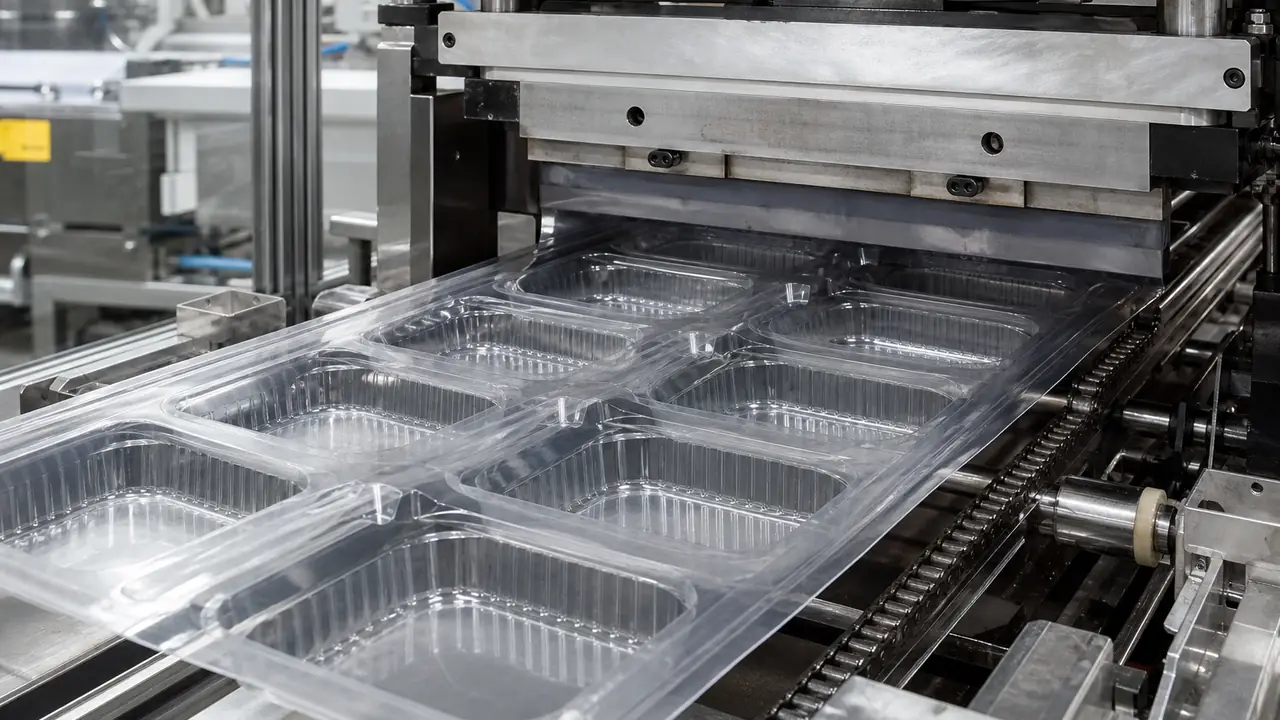
How thermoforming works
Thermoforming starts from plastic sheet rather than pellets. The sheet is heated until it softens, drawn or pressed over a forming mold with vacuum, compressed air or a plug assist, cooled in shape, and then cut out of the surrounding web. Because the mold only has to shape a sheet, not contain molten resin under high pressure, forming tools are lighter and quicker to make than injection molds, and a line can change between sizes more easily. The trade-off is wall thickness: the sheet stretches as it forms, so corners and the deepest points end up thinner than the flat areas.
The plant controls sheet gauge and grade, heater zones and heating time, forming pressure or vacuum, plug assist depth and timing, mold temperature and cooling, and the trim tool setting. Lidwell does not quote fixed settings; the desk asks for the gram weight of each part and checks it, with lid fit and a liquid test, against the golden sample on every lot.
Four steps from sheet to carton
- Sheet. PP or PET is extruded into sheet of a set gauge, either in the same plant or bought in rolls. Gauge and resin grade decide the final weight and stiffness.
- Forming. The heated sheet is shaped over a multi-cavity mold. Rim profile, ribs, compartments and molded text such as the resin code are formed here.
- Trimming. Parts are cut from the web by a steel rule or matched trim tool, in place or in a separate station. The trim edge decides how clean the rim feels and how well the lid snaps on.
- Nesting. Parts are stacked into each other, counted into sleeves and packed in cartons. Nesting depth decides how many fit per carton and per container load.
What thermoforming makes in this range
Most of the takeout line is thermoformed. A partner plant in Foshan, Guangdong, thermoforms PP takeout boxes at 650 and 750 ml, and 1,000 ml in plain, ribbed and two-compartment versions, packed 300 sets per carton. Export soup cups from a PP thermoforming catalog run from 350 ml at 116x99x45 mm to 950 ml at 117x82x141 mm, packed 200 sets per carton, with the PP code 5 and a microwave marking formed into the base by the supplier. Clear PP divided trays run from a three-compartment 218x188x42 mm tray at 1,000 ml to a five-compartment 232x232x47 mm tray at 1,500 ml. See PP food containers and divided fruit containers for the cut sheets.
| Part | Material | Reference size | Packing |
|---|---|---|---|
| Takeout box | PP | 650-1,000 ml, plain, ribbed or two compartments | 300 sets per carton |
| Soup cup | PP | 350 ml, 116x99x45 mm to 950 ml, 117x82x141 mm | 200 sets per carton |
| Three-compartment tray | Clear PP | 218x188x42 mm, 1,000 ml | 200 sets per carton |
| Five-compartment tray | Clear PP | 232x232x47 mm, 1,500 ml | 200 sets per carton |
| Cold drink cup or bowl | PET | 117 mm rim class bowls, 230-700 ml | About 1,000 per carton for cups |
PP or PET sheet
PP sheet is used where food is hot or reheated. It is slightly translucent and less stiff than PET at the same gauge. PET sheet gives the clearest parts and a crisp click on clamshell closures, which is why supermarket fruit and salad boxes are usually PET, but PET is used cold only. PVC sheet is not used for food containers in this range; where clear PVC appears it is in non-heated packaging such as gift box windows and folding boxes. A set that combines a PP base with a PET lid has to be labelled for cold use. The container materials page compares the sheets in detail.
Defects and checks
Thin corners are the typical weak point of a thermoformed part: a box that passes on the bench can split at a corner when filled with hot food. Webbing is a fold of sheet between two cavities. Hinge cracking on clamshells appears after repeated opening when the sheet is too thin or the hinge line too sharp. Ragged trim edges make lids hard to close and can scratch hands. Uneven nesting causes stuck stacks that are hard to separate in a busy kitchen, covered in the note on stuck nested containers. The inspection plan checks weight, corner thickness where agreed, lid fit, a tilt and inversion test with liquid and a hinge flex check for clamshells.
Nesting and freight
Thermoformed ware is light and bulky, so freight is charged by volume rather than weight. Nesting depth and sleeve count decide how many sets fit in a carton, and carton size decides how many fit in a container. The desk fixes sleeve count, carton size and carton count per pallet or per container in the specification, so landed cost can be compared between offers. Packing is covered on packaging and palletizing; quantities and lead times on MOQ and lead time.