
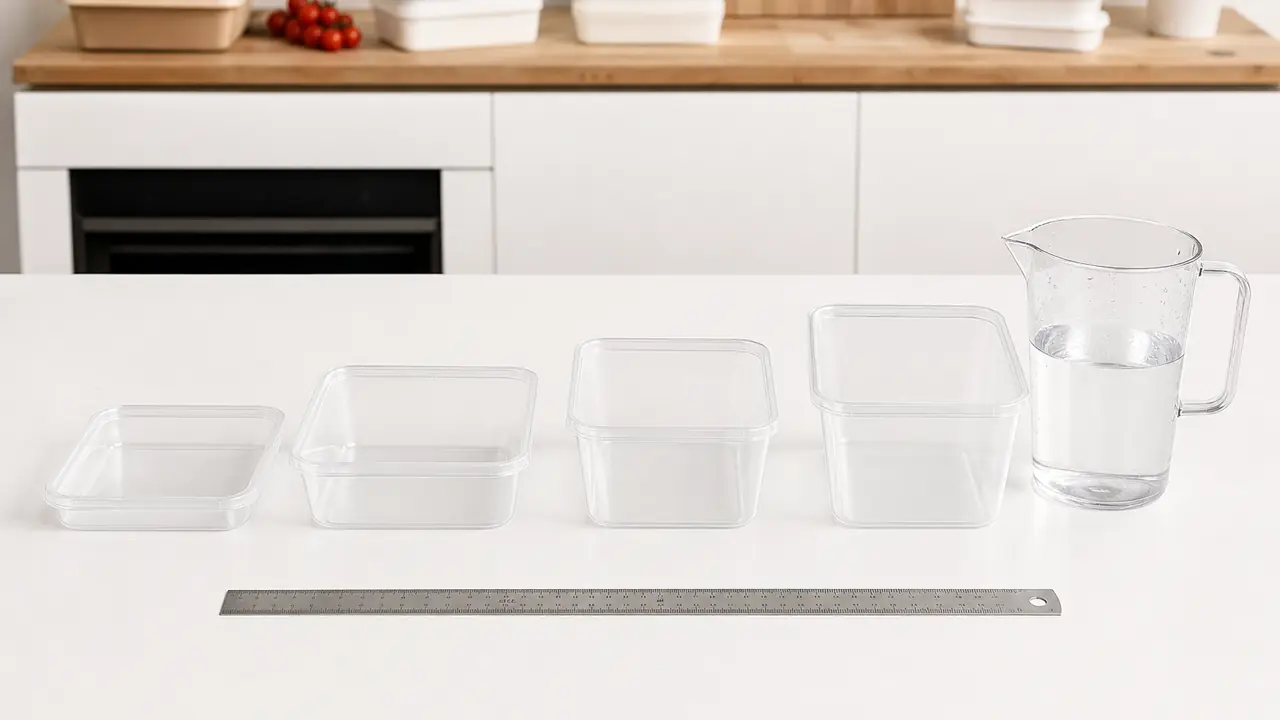
Three numbers that are called capacity
When a supplier lists a 750 ml box, that figure may be one of three things. The model number is a name in the catalogue, often close to the capacity but not always equal to it. The brim-full capacity is the volume of water the base holds when filled to the rim. The fill line capacity is the volume a kitchen can actually serve and still close the lid without pressing food against it or spilling in transit. Fill line is always lower than brim-full, and the gap depends on the shape of the rim and the depth of the lid.
The partner plant data shows why this matters. A starch-based round bowl listed as model 380 is labelled 450 ml by the plant; model 500 is labelled 650 ml; model 1000 is labelled 900 ml. The same plant, three different relationships between model and labelled capacity. The desk therefore records the outer size, the stated capacity and how it was measured for every model, and checks it on the sample with a measuring jug before the size goes into a menu or a product listing.
One footprint, several depths
The most useful sizing decision is the footprint. A partner plant in Huizhou, Guangdong, keeps a 170x115 mm footprint across a series of rectangular PP boxes and changes only the depth. One lid closes all four capacities, a kitchen stocks fewer lids, and mixed sizes stack in a delivery bag.
| Type | Capacity | Outer size | Weight |
|---|---|---|---|
| Rectangular PP box | 500 ml | 170x115x34 mm | 17 g |
| Rectangular PP box | 650 ml | 170x115x43 mm | 18.3 g |
| Rectangular PP box | 750 ml | 170x115x51 mm | 19.6 g |
| Rectangular PP box | 1,000 ml | 170x115x64 mm | 22 g |
| Roast-meat PP box | 1,200 ml | 217x149x60 mm | 35 g |
| Roast-meat PP box | 1,500 ml | 217x149x71 mm | 39 g |
| Round PP tub | 1,250-2,000 ml | 174x125x86 to 174x119x129 mm | 31-37.7 g |
| Round PP bowl | 360-1,000 ml | 118x73x47 to 140x94x84 mm | 7.3-14.7 g |
| PP soup cup | 350-950 ml | 116x99x45 to 117x82x141 mm | Per model |
| Three-compartment PP tray | 1,000 ml | 218x188x42 mm | Per model |
| Five-compartment PP tray | 1,500 ml | 232x232x47 mm | Per model |
| Starch-based lidded bowl | 800 ml model | 175x125x56 mm | Per model |
Round sizes are given as rim diameter class by base diameter by height. All dimensions are hand measurements stated by the partner plants and are checked against the physical sample before an order is confirmed.
Choosing capacities for a menu
- List each dish with its portion and whether it is served hot, cold or reheated.
- Group dishes by shape: flat portions to rectangular boxes, liquids to round tubs or soup cups, separated meals to divided trays.
- Pick one footprint per group so lids are shared.
- Fill the sample to the practical fill line with the real dish and close the lid.
- Only then fix the capacity and write the outer size and weight into the specification.
For liquids, a tall narrow cup is easier to carry but harder to eat from; a wide tub seals evenly around a round rim. Divided trays need each compartment checked separately, because a 1,000 ml total can split into compartments that are too small for a main dish. See divided fruit containers for compartment layouts.
Footprint and the delivery chain
The outer footprint decides how many containers fit side by side in a delivery bag, on a fridge shelf or in a carton. Nested containers ship 200-300 sets per carton for thermoformed PP boxes and soup cups at the partner plants, and the nesting depth decides how many cartons fit in a shipping container, which matters because these goods ship by volume. Weight per piece is the best indicator of wall thickness: two 750 ml boxes on the same footprint at different weights are different products. The note on gram weight and wall thickness explains how to compare them.
Millilitres and ounces
US listings often state capacity in fluid ounces, while the partner plants work in millilitres. Convert from the measured millilitre value, not from the model number, and state which capacity the ounce figure refers to. The note on ml vs oz covers the conversion and the rounding conventions that cause listing disputes.
When a stock size does not fit
Most programs can be built from stock molds. When a brand needs its own footprint, a new mold typically starts from 50,000-100,000 pieces per item, confirmed in writing for each program. Send the dishes, portions and destination through the quote form; the desk returns matched stock models with outer size, stated capacity and weight.