
What this line covers
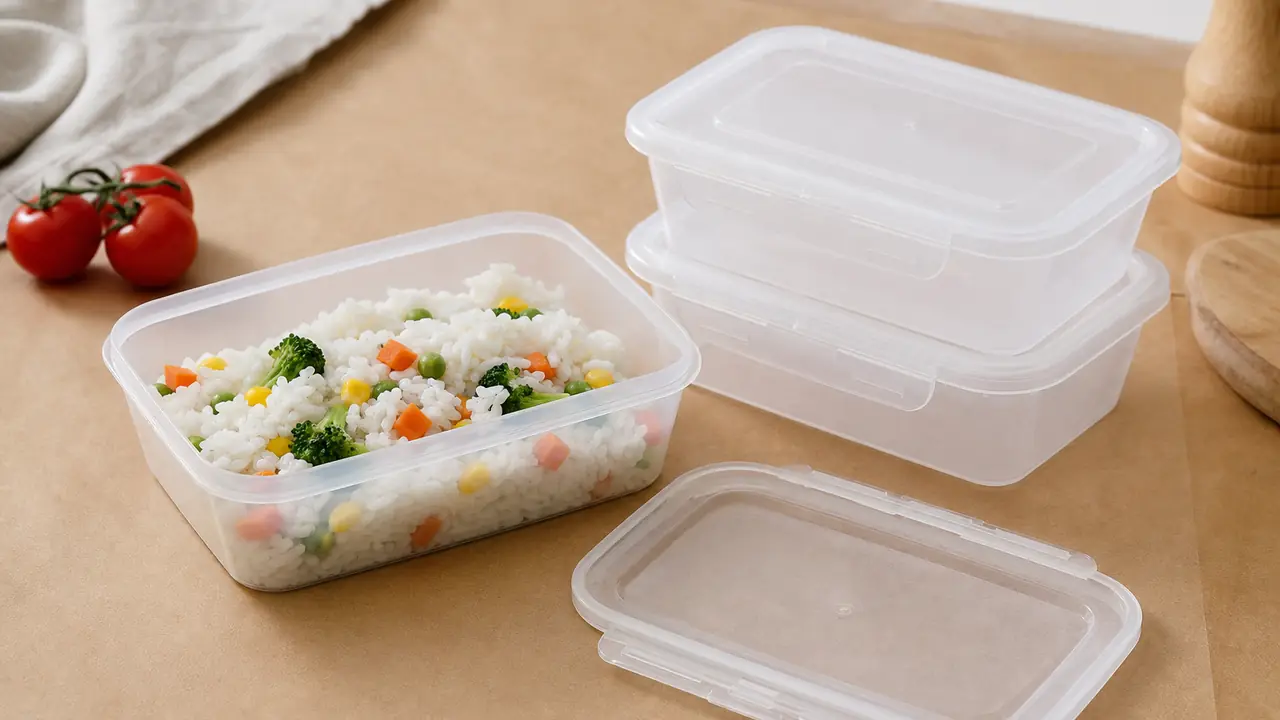
PP food containers are the boxes, tubs and bowls that carry most takeout, delivery and meal prep food. They are made from polypropylene, resin identification code 5, because PP keeps its shape with hot food and tolerates reheating where the marking allows it, while staying light enough to ship hundreds per carton. The line includes rectangular boxes in one to three compartments, round tubs for soups and noodles, shallow bowls, and the snap lids that close them.
The reference model on the cut sheet is a 750 ml rectangular box from a partner plant in Huizhou, Guangdong: 170x115x51 mm outside, 19.6 g per piece. It sits in a series that keeps the same 170x115 mm footprint and changes only the depth, so one lid fits several capacities and a kitchen can stack mixed sizes. Sizes are measured by the plant by hand and checked against the physical sample before an order is confirmed.
The rectangular series on one footprint
Most takeout programs start from a single footprint. The table shows the reference series from the same partner plant; capacities follow the model numbers, and gram weights are the plant's stated values.
| Capacity | Outer size | Weight | Typical use |
|---|---|---|---|
| 500 ml | 170x115x34 mm | 17 g | Sides, salads, desserts |
| 650 ml | 170x115x43 mm | 18.3 g | Rice dishes, single portions |
| 750 ml | 170x115x51 mm | 19.6 g | Main courses, meal prep |
| 1,000 ml | 170x115x64 mm | 22 g | Noodles, larger portions |
Larger formats sit on a wider footprint: 1,200 ml roast-meat boxes at 217x149x60 mm and 35 g, and 1,500 ml at 217x149x71 mm and 39 g. Round tubs run from 1,250 ml at 174x125x86 mm and 31 g to 2,000 ml at 174x119x129 mm and 37.7 g. Bowls start at 360 ml, 118x73x47 mm and 7.3 g. The sizing guide explains how to choose capacities for a menu.
Injection molded or thermoformed
PP containers come from two processes. Injection molded boxes are thicker and heavier for their size, keep sharp corners and are often marketed for reuse. Thermoformed boxes are formed from PP sheet, are lighter, nest tightly and suit single-use takeout. A partner plant in Foshan, Guangdong, for example, thermoforms 650 ml and 750 ml boxes and 1,000 ml boxes in plain, ribbed and two-compartment versions, packed 300 sets per carton. The weight per piece is the clearest sign of which process and wall thickness a quote is based on, so it belongs on every quotation. See injection molding and thermoforming for the differences in tooling and output.
Material, heat and microwave use
The base and lid are both PP in most programs. A clear PET lid is sometimes chosen for cold display, but PET is not used for hot food or reheating, so a mixed set has to be labelled for cold use. PVC is not used for these containers at all. One partner plant's own literature describes its cup PP as tolerating -10 to 120 degrees C; treat such figures as the supplier's statement until they are tested on your sample. Soup cups from the same cluster carry the PP code 5 and a microwave symbol molded in the base, which is the marking end users rely on.
Lids, fit and leak resistance
Most complaints about takeout containers are about the lid: it pops open in a bag, it is too tight to open, or soup escapes at a corner. Lid fit depends on the rim profile, the wall thickness and the tolerance between two parts that are often molded in different cavities. The desk agrees a lid fit check and a tilt and inversion test with liquid for every order, so containers are described as leak-resistant in that test, confirmed per order, and never with an absolute claim. Details are in lids and seals.
Food contact documents
For the United States, buyers ask for a supplier declaration that the PP complies with FDA 21 CFR 177.1520 for olefin polymers, under the conditions of use that match the product. For the European Union, a declaration of compliance to Regulation 1935/2004 and Regulation (EU) 10/2011, backed by an overall and specific migration report from a third-party lab. For China, GB 4806.7-2023 applies to plastic food contact materials. Declarations and reports are issued to partner plants or to your brand per project and verified by the desk; the compliance guide lists what to request.
Private label and ordering
Stock molds are the fastest route: mixed cartons, plain or with a printed sleeve or label. Printing on the lid typically starts at 10,000-50,000 pieces per item, and a new mold with your own footprint or logo emboss from 50,000-100,000 pieces, all confirmed in writing for each program. Send the menu, the capacities you need and the destination market through the quote form; the desk returns matched models with real sizes and weights.