
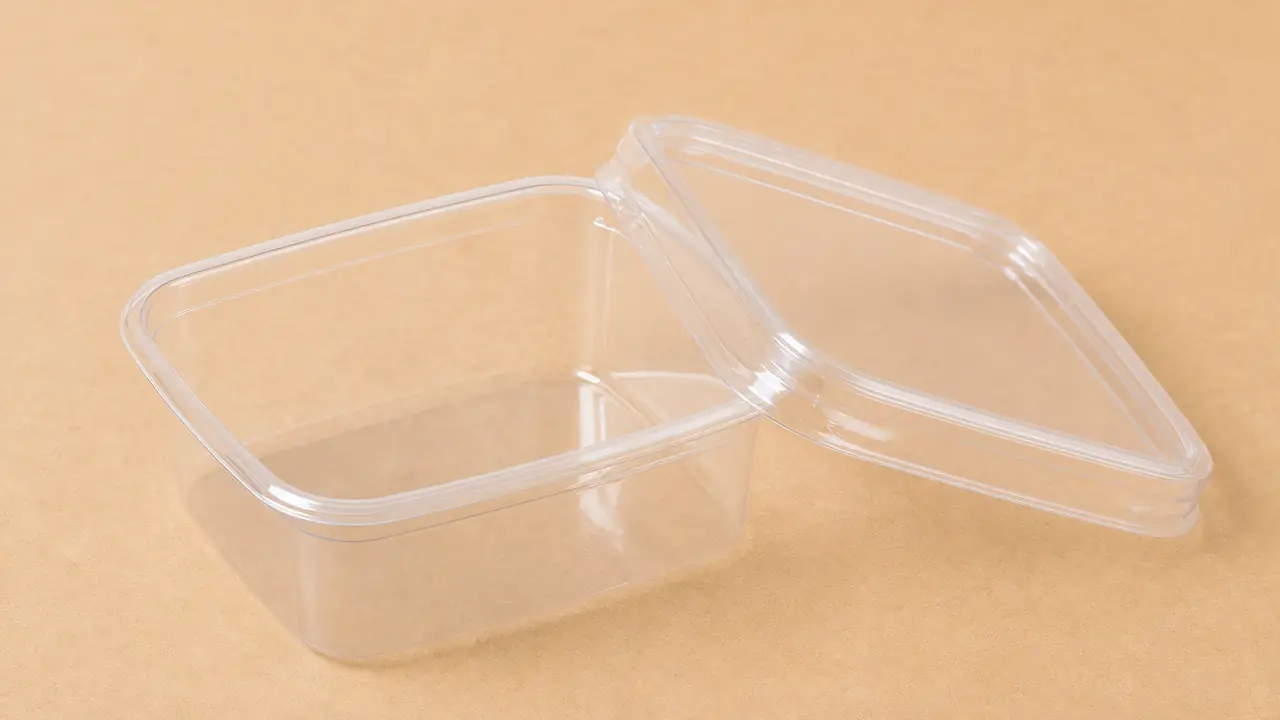
Why weight is the number to ask for
Wall thickness is what actually decides how a container behaves: whether it flexes when picked up full, whether the lid stays on, whether it crushes at the bottom of a stack, whether it warps with hot food. But thickness is hard to state on a quote, because it varies across a part. Walls thin out at the corners of a thermoformed box, and an injection molded box may have a thicker rim than its side walls. Gram weight is the practical proxy. It is easy to measure with a kitchen scale, it summarises how much resin is in the piece and it tracks closely with resin cost. That is why the desk puts weight on every quotation and asks for it on every cut sheet.
Reading weight across a series
A partner plant in Huizhou, Guangdong, makes a rectangular PP series on a 170x115 mm footprint. The weights are the plant's stated values:
| Capacity | Outer size | Weight | Grams per 100 ml (calculated) |
|---|---|---|---|
| 500 ml | 170x115x34 mm | 17 g | 3.4 |
| 650 ml | 170x115x43 mm | 18.3 g | 2.8 |
| 750 ml | 170x115x51 mm | 19.6 g | 2.6 |
| 1,000 ml | 170x115x64 mm | 22 g | 2.2 |
| 1,200 ml | 217x149x60 mm | 35 g | 2.9 |
| 1,500 ml | 217x149x71 mm | 39 g | 2.6 |
Two patterns stand out. Within one footprint, weight rises slowly with depth, because the base and rim stay the same and only the side walls grow; grams per 100 ml fall as the box gets deeper. Moving to a larger footprint, as with the roast-meat boxes, adds a step in weight because the base area and rim grow too. When comparing quotes, compare the same footprint and depth, not just the same capacity.
Round shapes follow their own curve. Reference PP bowls from the same cluster start at 360 ml, 118x73x47 mm and 7.3 g, and reach 1,000 ml at 140x94x84 mm and 14.7 g, far lighter per millilitre than rectangular boxes because a round wall is stiffer for its thickness and the rim is shorter. Round tubs for soups run from 1,250 ml at 31 g to 2,000 ml at 37.7 g. A round tub and a rectangular box of the same capacity should therefore not be expected to weigh the same, and a quote that compares them only on price per piece misses the point. Weight comparisons are only meaningful within one shape, one process and one footprint family.
Weight and process
Process changes the weight for a given size. Thermoformed containers are formed from extruded sheet, so their walls are thin and fairly even, the pieces nest tightly and weight per piece is low. A partner plant in Foshan, for example, thermoforms 650, 750 and 1,000 ml PP boxes packed 300 sets per carton. Injection molded containers are formed by injecting molten resin into a closed steel mold, which allows thicker walls, a reinforced rim and sharper corners; they weigh more for the same capacity and are often sold for reuse. Across the partner plant ranges, single pieces run from about 7 g for a small bowl to around 60 g for the largest items. The thermoforming vs injection note explains the processes in more detail.
Where thin walls show up
Lightweighting saves resin and freight, and every program faces the pressure to take a gram out. It is worth knowing where the risks appear first:
- Lid fit. A thinner rim deforms more, so a lid that fits on the sample may pop open on a warm, full box.
- Handling with hot food. Thin walls soften and flex when hot food is packed, which customers read as poor quality even if nothing leaks.
- Stacking and cartons. Bottom-of-stack crushing in cartons and on delivery racks increases as walls thin.
- Cold. Thin PP becomes more brittle in the freezer; corners and hinges crack first. See container lid cracking.
None of these means heavier is always better. A box that is heavier than its use requires costs more resin, more freight and does not perform noticeably better. The right weight is the lowest one that passes the agreed checks with the real food.
Weight, cost and lower plastic content
Resin is a large part of the cost of a plastic container, so weight is one of the main levers on price alongside cycle time, cavities and print. It is also the most honest sustainability lever: a lighter piece that still performs has lower plastic content, a claim that can be stated factually. Unqualified environmental claims cannot. If a program wants to reduce weight, the desk asks the plant for a lighter version of the same model, runs the same checks on both and records the result, rather than accepting a lighter piece on trust.
Fixing weight in the order
- Ask for weight of base and lid separately on the cut sheet.
- Weigh the approved sample and record it as the reference.
- Agree a tolerance with the plant and write it into the specification.
- Run the agreed functional checks at that weight: lid fit, hot fill where relevant, tilt test, stacking, freezer.
- Weigh a sample of pieces at pre-shipment inspection against the reference.
Wall thickness for storage boxes
For reusable storage boxes, collapsible crates and organizers, weight is less often quoted, but the same logic applies. A collapsible box is judged on its hinges and walls, a shoe box on how its sides hold when stacked, a fridge bin on whether it bows when lifted full. For those lines the desk asks for the piece weight and runs a simple load or stacking check on the sample; see storage box buying guide.
Bringing it together
Gram weight belongs on every quote, next to size and capacity. It lets you compare plants fairly, decide where lightweighting is safe and check the delivered goods with nothing more than a scale. Typical starting quantities are a few mixed cartons from stock molds, 10,000-50,000 pieces per item with printed lids, and 50,000-100,000 pieces for a new mold, confirmed in writing per program; see MOQ and lead time. Send your target sizes through the quote form and the desk returns models with their stated weights, ready to sample.