
What this line covers
Divided fruit containers are clear trays with molded compartments and a snap lid. They carry cut fruit in supermarkets and convenience stores, snack and fruit sets for offices and schools, bento-style lunches and meal sets for delivery. The compartments keep juicy fruit away from dry items, let a retailer show three or four products in one pack, and give a meal service a fixed portion layout.
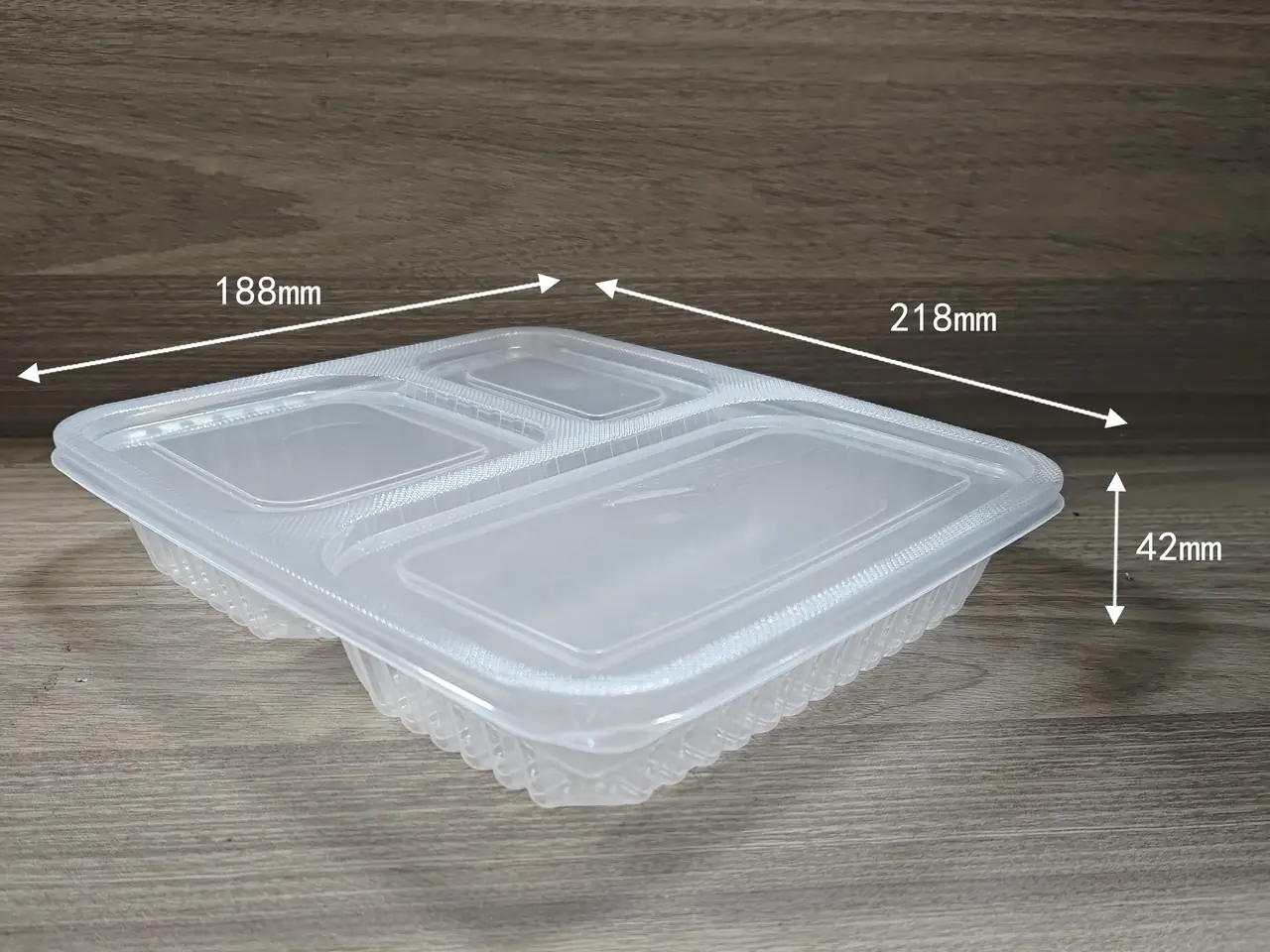
The reference model on the cut sheet comes from a partner plant that thermoforms clear PP: a three-compartment tray measuring 218x188x42 mm outside with a total capacity of 1,000 ml. The photograph on this page shows the plant's own production of the series. Sizes are measured by the plant by hand and are checked against the physical sample before an order is confirmed.
The compartment series
The same plant runs a family of compartment trays on similar footprints, so a range can offer three, four and five compartments with a consistent look on the shelf. Capacities are total capacity across all compartments, as stated by the plant.
| Model | Outer size | Total capacity | Typical use |
|---|---|---|---|
| Three-compartment | 218x188x42 mm | 1,000 ml | Fruit trio, rice with two sides |
| Four-compartment | 219x188x43 mm | 1,000 ml | Fruit and snack sets |
| Large four-compartment | 228x229x45 mm | 1,300 ml | Sharing platters, family meal sets |
| Large five-compartment | 232x232x47 mm | 1,500 ml | Party trays, bento meals |
| Small five-compartment | 240x192x40 mm | 1,100 ml | School and office lunch sets |
All models are packed 200 sets per carton. The lids of this series carry a molded Microwave safe marking, which is the supplier's own statement; it is checked in a heating test on your sample before it is used in any listing or label.
PP or PET for fruit
The choice depends on what happens to the box after it is filled. For supermarket fruit that is only chilled and displayed, clear PET is common because it gives the brightest view of the fruit through the lid. PET is used cold only, so a PET tray is not marketed for reheating. Where the tray holds a meal that is reheated, or where the end user is expected to reuse it, PP is the better choice: it is slightly hazier but tolerates heat where the marking allows it. The partner plant reference series is PP. For a matching PET cold range, the same cluster offers PET cold cups and bowls on a 117 mm rim, from 230 to 700 ml, which pair well with fruit trays in a juice and fruit bar. See clear PET vs PP fruit boxes for the trade-offs.
Thermoforming and what it means for the buyer
These trays are thermoformed: a PP sheet is heated and formed over a mold, then trimmed. The process suits thin, light, clear parts made in high volume, and the trays nest closely, which keeps freight cost down because many sets fit in one carton. Sheet thickness drives both stiffness and weight, so the desk asks the plant to state the gram weight of the exact model being quoted and checks it on the sample. Compartment walls add rigidity to the base; the rim and the lid lock decide how well the pack stays closed. The thermoforming page explains tooling, cavities and output.
Lid fit, condensation and checks
Fruit trays live in chillers, so the common complaints are lids that lift at a corner after chilling and fogging that hides the fruit. The desk agrees a lid fit check before and after chilling, a tilt test with juice for cut fruit, a stacking check on filled trays for display, and an inspection for cracked corners at the trim line. Results are written as tested per order. Where fogging matters, the lid sheet is reviewed on a chilled sample before approval. See lids and seals.
Documents and ordering
For the US, a supplier declaration that the PP complies with FDA 21 CFR 177.1520; for the EU, a declaration of compliance to Regulation 1935/2004 and Regulation (EU) 10/2011 with a migration report from a third-party lab; for China, GB 4806.7-2023. Documents are issued to the partner plant or your brand per project and verified by the desk. Stock molds start from a few mixed cartons; printed lid labels or bands typically from 10,000-50,000 pieces per item; a custom compartment layout needs a new mold from 50,000-100,000 pieces. All quantities are confirmed in writing for each program on the MOQ and lead time terms. Send the layout and target market through the quote form.