
What this line is, and what it is not
Starch-based food containers are bowls, boxes and divided trays with a cream, slightly matte look, sold into takeout and meal programs that want lower plastic content than a plain PP container. The photographs on this page come from a real partner plant in the Guangdong thermoforming cluster. Its literature describes the material simply as corn starch, and lists the range in its PP thermoforming catalogue. The desk therefore treats these containers as corn starch blended with PP, with the ratio confirmed on the spec sheet for each item.
That has one direct consequence: these containers are not described as biodegradable or compostable. A blend that contains PP does not break down like paper or plant fibre. Biodegradable or compostable wording is used only where the exact item carries a certification to EN 13432 or ASTM D6400, with the certificate number, and in line with the FTC Green Guides. What can be said honestly is that the containers have lower plastic content than the same shape in plain PP, and that they behave much like PP in a kitchen.
The reference range
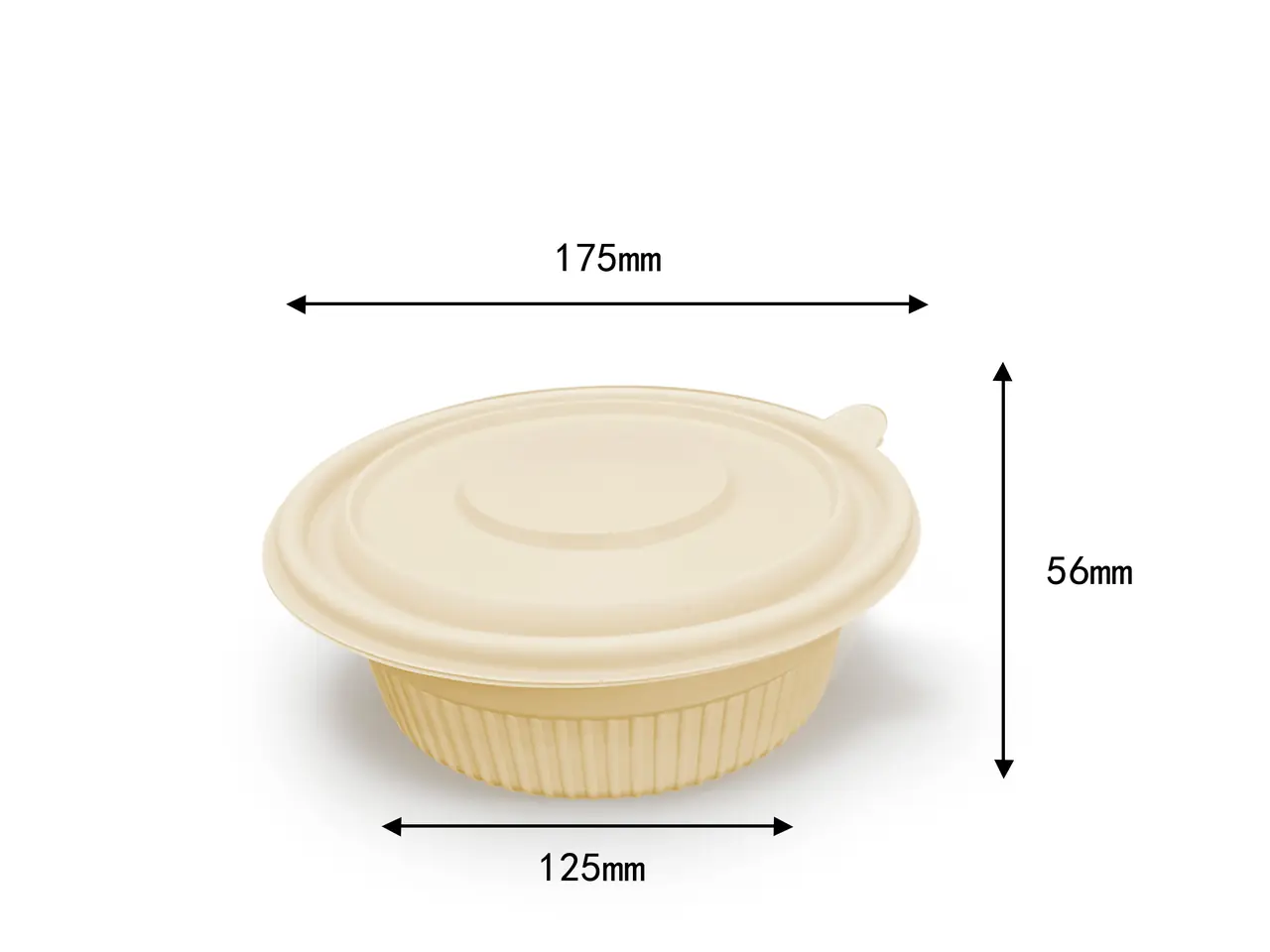
The reference model on the cut sheet is an 800 ml round bowl with lid, 175x125x56 mm outside. Sizes are measured by the partner plant by hand. Note that the capacity marked on an item can differ from its model number: the 380 model, for example, is marked 450 ml, so capacity is confirmed on the physical sample before the order.
| Model | Outer size | Marked capacity | Typical use |
|---|---|---|---|
| Round bowl 380 | 136x83x51 mm | 450 ml | Sides, soups, desserts |
| Round bowl 500 | 136x82x62 mm | 650 ml | Noodles, single portions |
| Round bowl 800 with lid | 175x125x56 mm | Per sample | Rice bowls, salads, poke |
| Round bowl 1000 | 175x125x67 mm | 900 ml | Larger mains |
| Square box 500-1000 | 183x121x42 to 183x123x72 mm | 500-1,000 ml | Rice dishes, meal prep |
| Divided tray, 3 to 5 compartments | 220-251 mm class | 950-1,400 ml | Meal sets, school and office lunches |
All items ship nested, 200-300 sets per carton, in the natural cream tone. The sizing guide explains how to match capacities to portions.
Heat, microwave and everyday use
Because the matrix is PP, the containers are used for hot rice, noodles and stews in the same way as PP boxes. Microwave use is stated per supplier marking on each model, with the lid removed or vented where marked, and is checked in a heating test on your sample. The starch content can change stiffness, odour and surface feel compared with plain PP, so the desk adds an odour check and a lid fit check to the sample review, and a tilt and inversion test with liquid for bowls. Results are described as leak-resistant in that test, confirmed per order. See food contact safety.
Starch blend, molded fiber or PLA
Buyers looking for a lower plastic option usually compare three routes, and each has its own compliance file.
- Starch and PP blend (this line): behaves like PP, tolerates hot food, keeps a plastic food contact file under FDA 21 CFR 177.1520 or EU 10/2011 per supplier declaration. Lower plastic content, no compostable claim.
- Molded fiber and bagasse: plant fibre with no plastic matrix. Grease resistance is often achieved with additives, and intentionally added PFAS are restricted in at least 13 US states; California AB 1200 has applied since 1 January 2023. A PFAS statement and total organic fluorine test belong in the file.
- CPLA and PLA: bio-based plastics that can be certified compostable in industrial facilities, but they still count as plastic under the EU Single-Use Plastics Directive 2019/904, so they do not escape single-use plastic rules in Europe.
The starch blend versus molded fiber note and the sustainable packaging guide go further into the trade-offs.
Claims and labelling
Under FTC Green Guides 16 CFR 260.8, an unqualified degradable claim needs evidence that the item fully breaks down within a reasonably short time after customary disposal; items that go to landfill rarely qualify. Under 260.7, a compostable claim must be qualified where composting facilities are not available to most consumers. The desk keeps labels, sleeves and listings to material facts, such as made with a corn starch and PP blend, and asks your counsel to review any environmental wording before print.
Ordering and private label
Stock molds are the fastest route, with mixed cartons from 1-10 cartons. Printed sleeves or labels typically start at 10,000-50,000 pieces per item, confirmed in writing for each program; the details are on MOQ and lead time. Send the menu, the capacities and the destination market through the quote form, and say which claims you intend to make so the desk can check the documents behind them.