
The short answer
Rectangular boxes suit dry and semi-dry meals, meal prep and anything that needs to pack tightly in a bag, a fridge or a carton. Round tubs and soup cups suit liquids, because a round rim seals evenly with no corners. Most takeout and foodservice ranges need both, and the useful question is which items go in which shape, and how few footprints can cover the menu.
Both shapes are available from stock molds in the Guangdong takeout cluster, in clear, black-base and white PP, so the choice rarely depends on availability. It depends on the food, the way it travels and the way it is stored. The sections below compare the two on sealing, packing, weight, lids, compartments and reheating, and end with a simple menu-by-shape list.
Sealing and liquids
A snap lid seals by pressing a lid rim over a base rim. On a round container that pressure is spread evenly around the circumference. On a rectangular box the straight sides flex more than the corners, so the seal is weakest along the long sides and at the corners where the profile changes. That is why soups, noodles in broth, congee and sauces usually go in round tubs or cups, and why rectangular boxes with liquid dishes need a careful tilt and inversion check on the sample. Results are described as leak-resistant in that test, confirmed per order, never as an absolute claim.
Export soup cups from a thermoforming partner plant run from 350 ml at 116x99x45 mm to 950 ml at 117x82x141 mm, with the PP code 5 and a microwave marking molded in the base by the supplier. Round tubs from the Guangdong cluster run from 1,250 ml at 174x125x86 mm and 31 g to 2,000 ml at 174x119x129 mm and 37.7 g.
Packing in bags, fridges and shelves
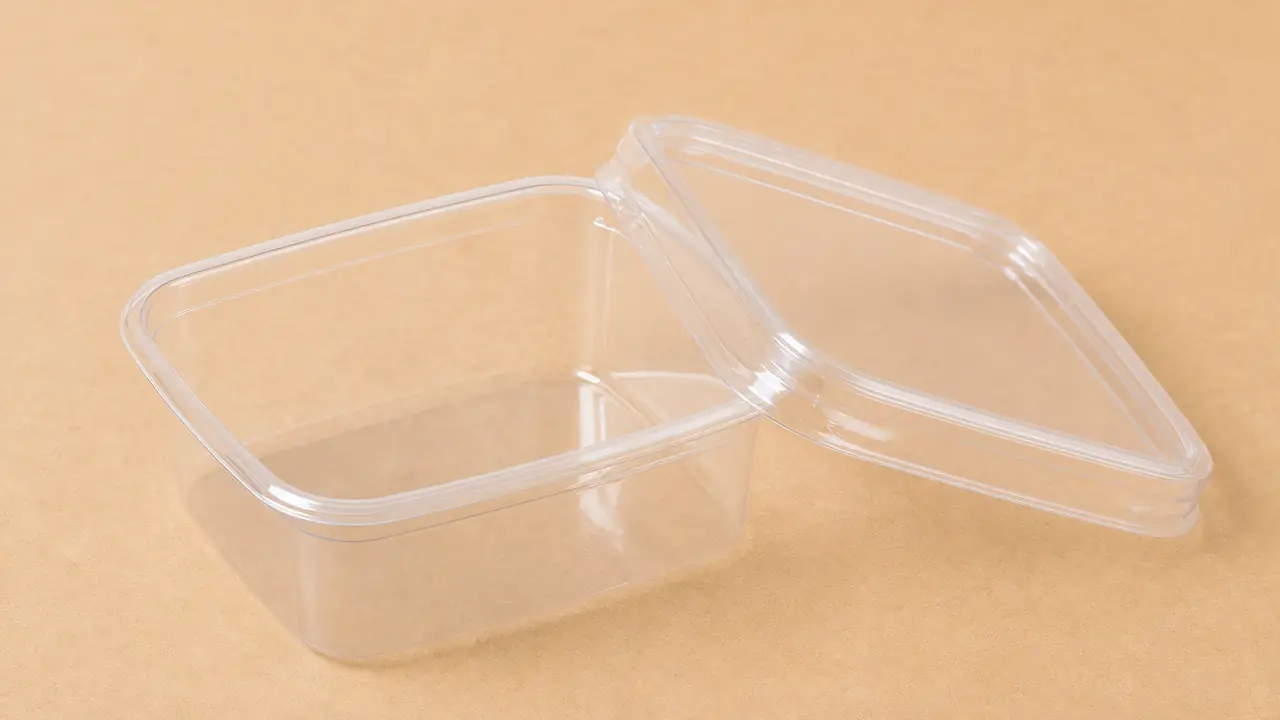
Rectangular boxes waste less space. Side by side in a delivery bag, on a fridge shelf or in a meal prep tray, they leave almost no gaps, while round containers leave corners empty. For a delivery operator that means more meals per bag; for a meal prep brand, more portions per fridge shelf; for a household, a tidier fridge. Rectangular boxes also present the food better when opened, with a flat, wide surface for a main course and sides.
Round containers stack well vertically, and tall cups take up little bag floor area, which suits a soup alongside a rectangular main. The common pattern is rectangular for the main, round for the soup or sauce.
Packing in cartons and containers
Empty containers nest inside each other in sleeves, so carton efficiency depends on the nesting step and the footprint more than on the shape. Partner plants typically pack thermoformed boxes, soup cups and starch-based bowls 200-300 sets per carton. Round items nest very tightly because there is nothing to catch at the corners, while rectangular boxes with sharp corners or ribs can stick together if the nesting step is too shallow. See stackability and nesting for how this affects freight.
Weight per millilitre
| Shape | Reference model | Weight | Typical use |
|---|---|---|---|
| Rectangular box | 750 ml, 170x115x51 mm | 19.6 g | Main courses, meal prep |
| Rectangular box | 1,000 ml, 170x115x64 mm | 22 g | Noodles, larger portions |
| Round bowl | 1,000 ml, 140x94x84 mm | 14.7 g | Salads, rice bowls |
| Round tub | 1,250 ml, 174x125x86 mm | 31 g | Soups, family portions |
| Soup cup | 350-950 ml, about 116 mm diameter class | Per model | Soups, sauces, sides |
Weights are the plants' stated values. Round bowls are light for their capacity, because a curved wall is stiff for its thickness; heavy-duty round tubs for soup carry more resin to keep the rim rigid when full and hot. Compare weights within one shape rather than across shapes, as explained in gram weight and wall thickness.
Lids and footprints
Rectangular ranges are usually built on a shared footprint with different depths. The partner series at 170x115 mm covers 500, 650, 750 and 1,000 ml, so one lid closes all four; a larger 217x149 mm footprint covers 1,200 and 1,500 ml roast-meat boxes. Round ranges do the same with a shared diameter: soup cups from 350 to 950 ml on one diameter class share one lid. Each additional footprint or diameter adds a lid to stock, so the most economical ranges use one rectangular footprint and one round diameter for the core menu.
Compartments
Compartments are easier in rectangular formats. Two- and three-compartment rectangular boxes separate rice from sauce, and clear PP divided trays from a partner plant run from a three-compartment 218x188x42 mm tray at 1,000 ml to a five-compartment 232x232x47 mm tray at 1,500 ml. Round compartment containers exist, mainly in starch-based and paper ranges, but are less common. See divided fruit containers.
Reheating and microwave use
Both shapes are made in PP for hot food, and both can be marked for microwave use by the supplier, usually with the lid removed or vented. Round containers heat more evenly, because there are no corners where food overheats while the centre stays cold, which is one reason soups and stews favour them. Microwave use is stated per supplier marking and checked in a heating test on the sample, not assumed for the whole range. PET versions of either shape are cold use only.
Which shape for which menu item
- Rectangular: rice and noodle dishes, grilled meats, meal prep portions, sandwiches and wraps, anything with sides.
- Round tub or cup: soups, broths, congee, curries with a lot of sauce, desserts, sauces and dips.
- Round bowl: salads, poke and rice bowls, where presentation from above matters.
- Divided rectangular: set meals and bento-style lunches, cut fruit.
Planning the order
List the menu, assign each item a shape, then pick one footprint per shape and set depths from real reference models; the sizing guide walks through the method and the PP food containers page shows the full series. Typical starting quantities are a few mixed cartons from stock molds and 10,000-50,000 pieces per item for printed lids, confirmed in writing per program; see MOQ and lead time. Send your menu through the quote form and the desk returns matched models in both shapes.