
Three processes behind one range
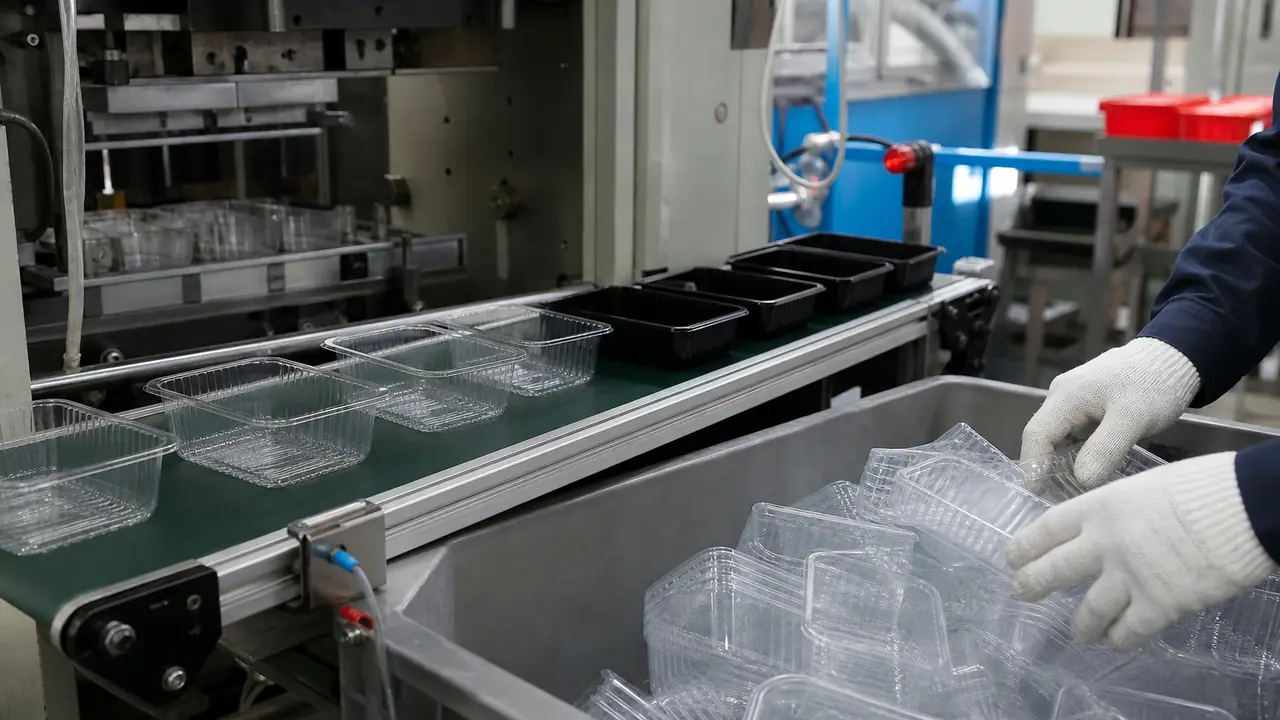
A food container and storage range usually relies on three production routes. Injection molding pushes molten resin into a closed steel mold; it makes storage boxes, fridge bins, vacuum containers, organizers and heavier reusable food containers. Thermoforming heats a plastic sheet and pulls it over a mold; it makes light takeout boxes, soup cups, divided trays and clamshells that nest tightly. Paper box production prints, coats, die-cuts and glues board; it makes bakery boxes, folding gift boxes and click-lock takeout boxes. Each route has its own stages, and the desk follows the stages that matter for the lines in a program. The processes are explained in depth in injection molding and thermoforming.
The stages side by side
| Stage | Injection molded | Thermoformed | Paper box | Checkpoint |
|---|---|---|---|---|
| Material | PP, PS or PET resin, masterbatch | PP or PET sheet, extruded in-house or bought | White card, kraft or foil-lined board | Grade matches the declaration |
| Forming | Molding in a steel mold | Heating and forming over a mold | Printing and coating | First pieces against the golden sample |
| Finishing | Gate removal, flash check | Trimming from the sheet | Die-cutting, creasing | Edges, burrs, size |
| Decoration | Pad print, label, in-mold label | Printed lid or sleeve | Window patching with PET or PVC | Print position and adhesion |
| Assembly | Lid, seal, valve or dividers | Lid matching | Gluing, folding | Lid fit and function |
| Packing | Bagged or boxed retail units | Nested sleeves | Flat-packed bundles | Count, carton marks, stacking |
Stage 1: material
Production starts with the material named on the specification. For food containers that is PP for anything hot or reheated, or PET for clear cold use. For storage boxes it is usually PP, with PS, acrylic or PET for clear organizers. For paper boxes it is the board grade. The desk checks that the resin or board in the plant is the grade the supplier declaration covers, and that colour masterbatch and any regrind are within the agreed policy. PVC enters only as a clear window or soft pouch for non-heated packaging, never as a food container. See container materials.
Stage 2: forming
For a new mold, forming begins with a T1 trial, usually 25-45 days after the tool is ordered, followed by adjustments and approval of a golden sample. For stock molds, the first pieces of each run are compared with the retained golden sample. Wall thickness and gram weight are the key numbers: the 750 ml reference PP box at 170x115x51 mm weighs 19.6 g, and a run that drifts lighter will feel flimsy and fit its lid differently.
Stage 3: finishing and decoration
Injection molded parts are degated and checked for flash; thermoformed parts are trimmed from the sheet, and trim quality decides whether a rim is smooth or sharp. Decoration follows: printed lids, labels or sleeves for plastic lines, and printing, coating and window patching for paper boxes. The printing and labeling page covers inks and adhesion checks.
Stage 4: assembly
Many products are more than one part. A vacuum container needs a lid, a seal and a valve; a fridge bin set may have dividers; a takeout box needs its matched lid. Lids from a different cavity or a different day can fit differently, so lid fit is checked at assembly and again at inspection. Details are in lids and seals.
Stage 5: packing to carton
Packing decides freight cost. Thermoformed PP boxes and starch-based containers are typically packed 200-300 sets per carton, injection molded cups 300-500 per carton, PET cold cups about 1,000 per carton. Food contact parts are sleeved or bagged before cartoning. Retail storage products are boxed or labelled with barcodes as the program requires. Cartons are marked, counted and stacked for the container load. Because most containers are light and bulky, the nesting depth and the carton size decide how many pieces fit in a container, so the carton is fixed on the specification before mass production, not left to the packing line. Collapsible boxes and flat-packed paper boxes are the exception: they fold down, and the folded height is written on the cut sheet so the freight estimate is based on the real packed volume.
How long it takes
Typical reference ranges are 7-15 days for stock items, 15-30 days for printed or customised items and 45-60 days for a first order on a new mold, confirmed in writing for each program. See MOQ and lead time, or send a line list through the quote form.