
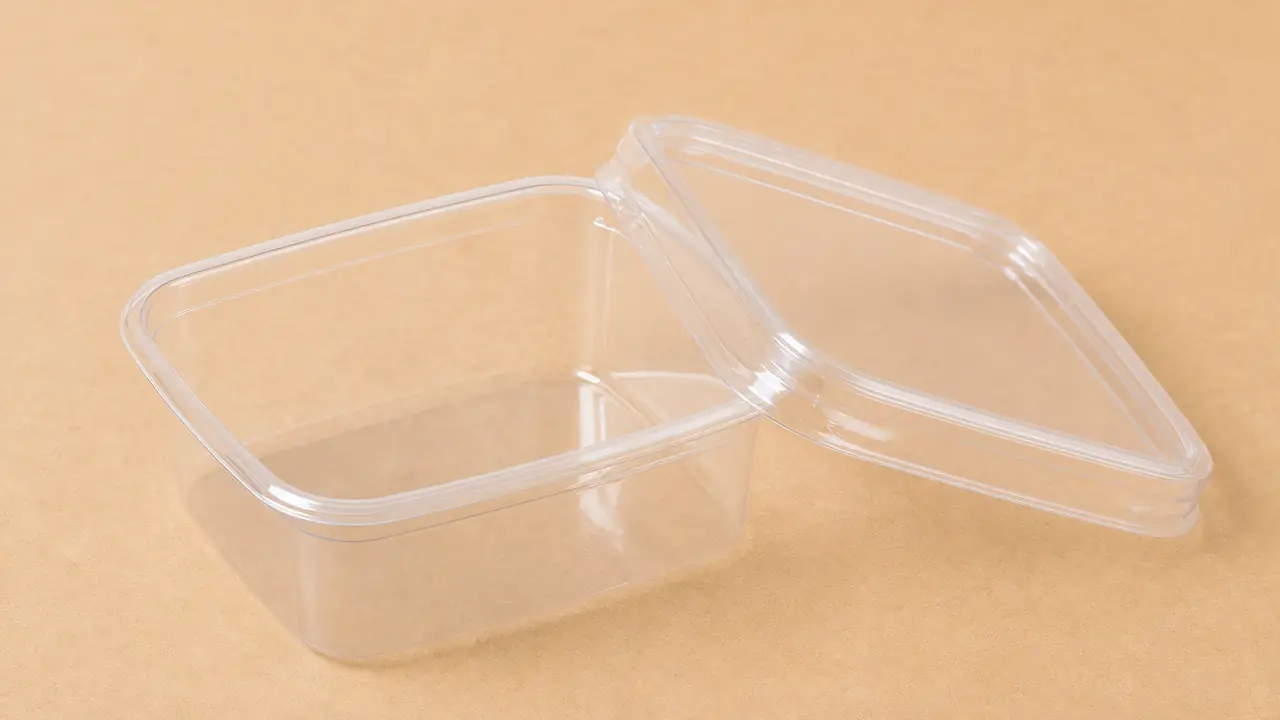
Why the type matters before the size
Most container briefs start with a capacity: we need a 750 ml box. Capacity is the last decision, not the first. The type decides which material can be used, how the lid closes, whether the container can be reheated, how many fit in a carton and which cluster of plants is best placed to make it. A 750 ml rectangular PP box, a 750 ml PET clamshell and a 750 ml paper box with a window hold the same volume and behave like three different products in a kitchen, a delivery bag and a container load.
The sections below cover the seven types that make up most food packaging and storage ranges. For each one we give a real reference model from the partner plants Lidwell works with, or a public listing size where no partner model exists, and the use it fits best.
Rectangular boxes
The rectangular box with a snap lid is the workhorse of takeout and meal prep. It packs efficiently in bags and fridges, fits standard delivery bag widths and lets one lid close several depths. A partner plant in Huizhou, Guangdong, makes a series on a 170x115 mm footprint: 500 ml at 34 mm deep and 17 g, 650 ml at 43 mm and 18.3 g, 750 ml at 51 mm and 19.6 g, and 1,000 ml at 64 mm and 22 g. Larger roast-meat boxes move to a 217x149 mm footprint at 1,200-1,500 ml.
Rectangular boxes are almost always PP when hot food is involved, either thermoformed from sheet or injection molded. Two- and three-compartment versions separate rice from sauce. The PP food containers page carries the full cut sheet.
Round tubs and soup cups
Round tubs suit soups, noodles, congee and anything liquid, because a round rim seals evenly without corners where pressure is lowest. Reference tubs from the same Guangdong cluster run from 1,250 ml at 174 mm diameter class and 86 mm high, 31 g, to 2,000 ml at 129 mm high and 37.7 g. Export soup cups from a thermoforming plant run from 350 ml (116x99x45 mm) to 950 ml (117x82x141 mm), packed 200 sets per carton, with the PP code 5 and a microwave marking molded into the base by the supplier.
Because round tubs hold liquid, the tilt and inversion test is the key check for this type. The desk agrees it per order and describes results as leak-resistant in that test, never with an absolute claim.
Bowls
Bowls are shallower than tubs and wider at the rim, made for salads, rice bowls and poke. PP bowls from the reference range start at 360 ml, 118x73x47 mm and 7.3 g, and reach 1,000 ml at 140x94x84 mm and 14.7 g. Starch-based bowls are a related family: a partner plant offers an 800 ml lidded round bowl at 175x125x56 mm. Their material is starch blended with PP, so they are described as such and not as biodegradable unless a named certification applies. See starch-based containers.
Clamshells
A clamshell has a hinged lid molded in one piece with the base. It is fast to close on a busy line, hard to lose, and common for burgers, sandwiches, bakery items and fruit. Clear clamshells are usually PET, which gives the best clarity for display but is used cold only. Paper clamshells and click-lock boxes made of kraft or white card come from paper packaging plants, including the cluster around Longgang near Wenzhou. Hinges are the weak point: they crack if the sheet is too thin or if the box is opened many times, so hinge flex is worth a simple repeated opening check on the sample.
Divided trays and fruit boxes
Divided containers keep foods apart: meal sets, bento-style lunches, cut fruit and snack boxes. A clear PP three-compartment tray from a partner plant measures 218x188x42 mm with a 1,000 ml total capacity; four- and five-compartment versions run up to 232x232x47 mm and 1,500 ml, packed 200 sets per carton. For supermarket fruit that is only chilled and displayed, PET gives a clearer view; where the box is reheated or reused, PP is the better choice. See divided fruit containers.
Paper boxes and gift boxes
Paper boxes cover bakery, desserts, gifts and pizza. A reference kraft bakery box with a clear lid measures 190x85x35 mm, with medium and small sizes at 160x85x35 and 135x73x35 mm. Click-lock takeout boxes run from 350 to 2,880 ml in kraft, white card or white card with a foil lining. Clear windows and lids can be PET or PVC, which is acceptable here because the window does not touch hot food and is not heated. For the US market, buyers should check state rules on intentionally added PFAS in fibre packaging; California's AB 1200 has applied since 1 January 2023. The folding gift boxes page sets out board grades and print options.
Storage containers for the home
Storage containers are bought to be reused for years, so the comparison is different: lid seal, stacking, clarity and durability matter more than gram weight. Vacuum containers use a pump and a one-way valve; a public listing size for a 1.4 L model is 233x156x90 mm. Fridge bins for a standard shelf are typically about 315x157x89 mm. Pet food bins for a 20 lb bag are around 410x240x425 mm. These lines are covered in food storage.
The types side by side
| Type | Usual material | Reference size | Best suited to |
|---|---|---|---|
| Rectangular box | PP | 170x115x51 mm, 750 ml | Hot takeout, meal prep |
| Round tub or soup cup | PP | 350-2,000 ml | Soups, noodles, liquids |
| Bowl | PP or starch-PP blend | 360-1,000 ml | Salads, rice bowls |
| Clamshell | PET (cold), paper | Per model | Bakery, sandwiches, fruit |
| Divided tray | PP or PET | 218x188x42 mm, 1,000 ml | Meal sets, cut fruit |
| Paper box | Kraft or white card, PET or PVC window | 190x85x35 mm | Bakery, gifts |
| Storage container | PP, copolyester, PET | 0.5-2.0 L per piece | Home storage, reuse |
How to plan a range
- List the foods and whether each is served hot, cold or reheated.
- Pick the type for each food, then the material the type allows.
- Choose one footprint per type so lids are shared.
- Only then set capacities, from real reference models.
- Confirm documents for the destination market and the minimum order per item.
Fewer footprints mean fewer lids, simpler stock and lower tooling cost if a custom mold is ever needed. Typical starting quantities are a few cartons from stock molds and 10,000-50,000 pieces per item for printed lids, confirmed in writing per program; see MOQ and lead time. When the list is ready, send it through the quote form.