
What food contact safety means for a container
A food contact container must not transfer its constituents to food in quantities that could endanger health or change the food unacceptably. Every major market turns that principle into rules on which substances may be used, under what conditions and with what migration limits. For a buyer, food contact safety therefore means three things: the right material for the use, a declaration that the finished container complies with the rules of the destination market, and test evidence where the market or the buyer's customer asks for it. Lidwell does not hold certificates. Declarations and test reports are issued to partner plants or to the buyer's brand per project, and the desk verifies them against the product and the order.
United States
US food contact substances are regulated under 21 CFR parts 174 to 178. Olefin polymers, including PP and PE, are covered by 21 CFR 177.1520, which sets specifications such as the melting point range and limits on extractable fractions, including hexane extractables. Declarations usually refer to the conditions of use listed in 21 CFR 176.170(c), lettered A to H, which describe the temperatures and contact times the container is suitable for. FDA does not approve finished containers, so the correct wording is that a container is compliant with 21 CFR per supplier declaration or test report. Any wording that claims FDA approval is avoided on packaging and listings.
European Union
The framework regulation (EC) 1935/2004 applies to all food contact materials. Plastics are covered by Regulation (EU) 10/2011, which sets an overall migration limit of 10 mg per dm2 of contact surface, or 60 mg per kg of food simulant, and specific migration limits for individual substances. A declaration of compliance is required along the chain. A resin supplier's declaration covers the intermediate material only; the finished container still has to be verified, because colorants, additives and processing can change the result. German buyers often also ask for test reports to LFGB sections 30 and 31 and the BfR recommendations. For paper and board boxes, the documents and tests are agreed with the buyer for each market under the framework regulation.
China
For containers sold in China, or for buyers who ask for Chinese standards, GB 4806.1 sets the general requirements for food contact materials, GB 4806.6 covers resins, GB 4806.7-2023 covers plastic materials and articles, and GB 4806.8 covers paper and board. The 2023 edition of GB 4806.7 replaces the earlier version, so declarations should cite the current text.
Rules by market
| Market | Rules | Typical evidence |
|---|---|---|
| United States | 21 CFR 174-178; 177.1520 for PP and PE | Supplier declaration with conditions of use; test report on request |
| European Union | (EC) 1935/2004, (EU) 10/2011 | Declaration of compliance; overall and specific migration report |
| Germany | As EU, plus LFGB and BfR practice | LFGB 30 and 31 test report |
| China | GB 4806.1, 4806.6, 4806.7-2023, 4806.8 | Test report to the relevant part |
| US states, paper | PFAS rules in at least 13 states | Statement or test on intentionally added PFAS |
Migration testing in practice
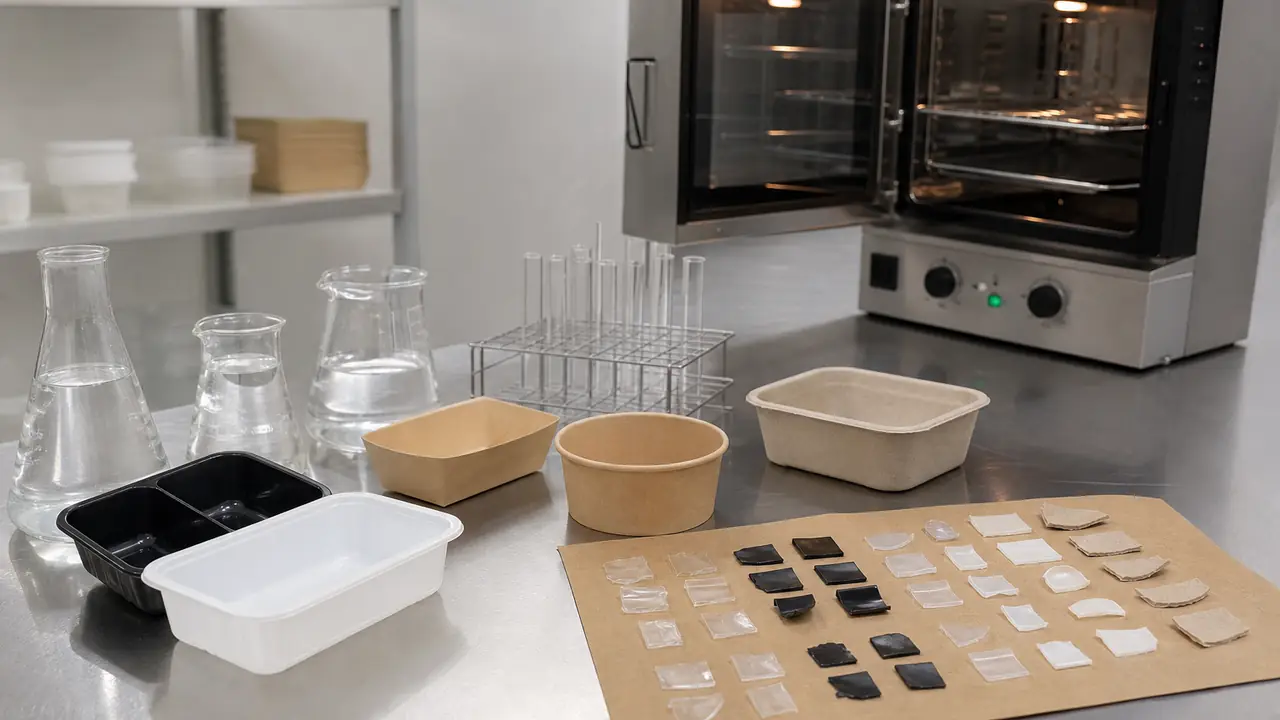
A migration test exposes the container to food simulants under set times and temperatures that represent its use, then measures what has transferred. The lab and the test conditions are chosen for the intended use: cold storage, hot fill, microwave reheating or long storage. A container tested only for cold use cannot be sold for reheating on that report. Tests are run on the finished part in its actual color, from the production mold or the golden sample. The desk agrees the lab, the conditions and the sample with the buyer and records them in the program file. Background is in the note on migration testing.
Wording that stays accurate
Food contact wording on a listing or a carton should repeat what the documents support. The desk uses phrases such as made with food contact grade PP per supplier declaration, tested to EU 10/2011 per report, and microwave use per supplier marking, lid removed where marked. Absolute safety claims, claims of approval by a regulator and claims that a material contains no chemicals are not used. Paper boxes for the US are checked against state PFAS rules: California's AB 1200 has banned intentionally added PFAS in plant fibre food packaging since 1 January 2023, and at least 13 states have restrictions. Legal conclusions belong to your test lab, customs broker or counsel. See compliance and certifications and testing and inspection, and send the destination market with your quote request.