
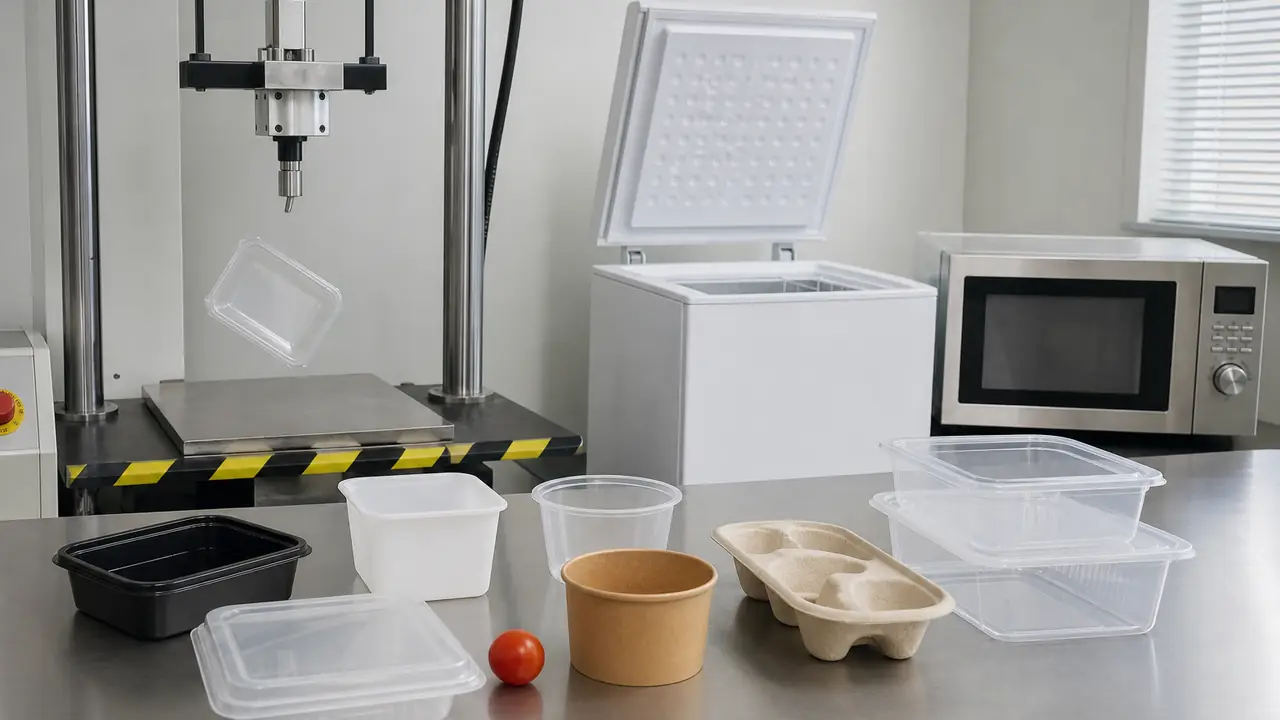
One test list, a plan per line
A takeout soup cup, a fridge bin and a printed bakery box do not need the same tests. The desk keeps one test list for the whole range and picks the tests that fit each line and its use. For every test it states a working default: how many pieces, how the test is done and what counts as a pass. The default is a starting point, not a standard; it is confirmed per order with the buyer and written into the specification, so a partner plant, an inspector and the buyer read the result the same way.
Results are always stated against the test. A container is described as leak-resistant in the standard tilt test, confirmed per order, never with an absolute claim. Microwave use is stated per supplier marking and checked in a heating test on the sample.
The test list
| Test | Applies to | Working default (confirmed per order) |
|---|---|---|
| Size and gram weight | All lines | Measured against the specification and golden sample on every inspection sample |
| Lid fit (opening and closing) | Containers with lids, storage boxes | Lid closes fully on all sides and opens by hand without tearing the rim |
| Tilt and inversion leak | Food containers, soup cups, vacuum containers | Filled with water, closed, tilted and inverted; no drip in the agreed time |
| Drop | Food containers, storage boxes | Filled or empty as agreed, dropped from an agreed height; no crack, lid stays on |
| Freezer | Food storage, meal prep containers | Held at -18 degrees C, then opened and closed; no crack at rim or hinge |
| Microwave heating | PP containers marked for microwave use | Heated with food or water per supplier marking, lid removed or vented where marked; no deformation |
| Hot water | PP cups and bowls | Filled with hot water within the supplier's stated range; no deformation or leak |
| Odor | Food containers, storage boxes | No unusual odor on opening the sleeve or the box |
| Migration | Food contact parts | Third-party lab, overall and specific migration to the market's rules |
| Burst and edge crush | Paper boxes, export cartons | Board strength against the agreed grade |
| Print adhesion and rub | Printed lids, sleeves, boxes | Tape test and rub test with no loss of print beyond agreed limits |
| Carton stacking | Export cartons | Stacked to the expected pallet or container height; no crushing |
Function tests: lid, leak, drop
Lid fit, leak and drop are the tests that predict most complaints from end users. They are run on the inspection sample from finished cartons, not only on the golden sample, because lid fit can drift between cavities and between production days. The tilt and inversion test uses water, which finds weak points faster than thicker foods. Drop height and the number of pieces are fixed in the order. See lids and seals for the design side of these results.
Temperature tests: freezer, microwave, hot water
Temperature tests check the claims printed on a container. The freezer test holds containers at -18 degrees C before opening and closing them, because PP grades differ in how they behave cold. The microwave test follows the supplier's marking: if a soup cup carries a microwave symbol, it is heated as marked, with the lid removed or vented where marked. One partner plant's literature states a range of -10 to 120 degrees C for its cup PP; such statements are tested on the sample before they appear on any packaging. PET is not put through heating tests because it is used cold only. Background is in microwave use and containers.
Laboratory tests
Migration testing is done by a third-party lab, not on the factory floor. For the EU, the lab tests overall migration against the 10 mg/dm2 limit in Regulation (EU) 10/2011 and specific migration for listed substances; for the US, buyers usually rely on a supplier declaration to FDA 21 CFR 177.1520 backed by test data; LFGB test reports are requested for Germany. Reports are issued to the partner plant or to your brand per project and verified by the desk. See the food contact compliance guide.
Paper and packing tests
Paper boxes are checked for board strength, print adhesion, gluing and window bonding. Export cartons are checked for count, marks and stacking strength, because nested containers are light and cartons are often stacked high. Packing details are on packaging and palletizing.
Setting the plan
Send the use conditions with your brief: hot or cold food, freezer, microwave, shipping route and channel. The desk returns a test plan with working defaults for confirmation, alongside quantities and timing from MOQ and lead time. Start through the quote form.