
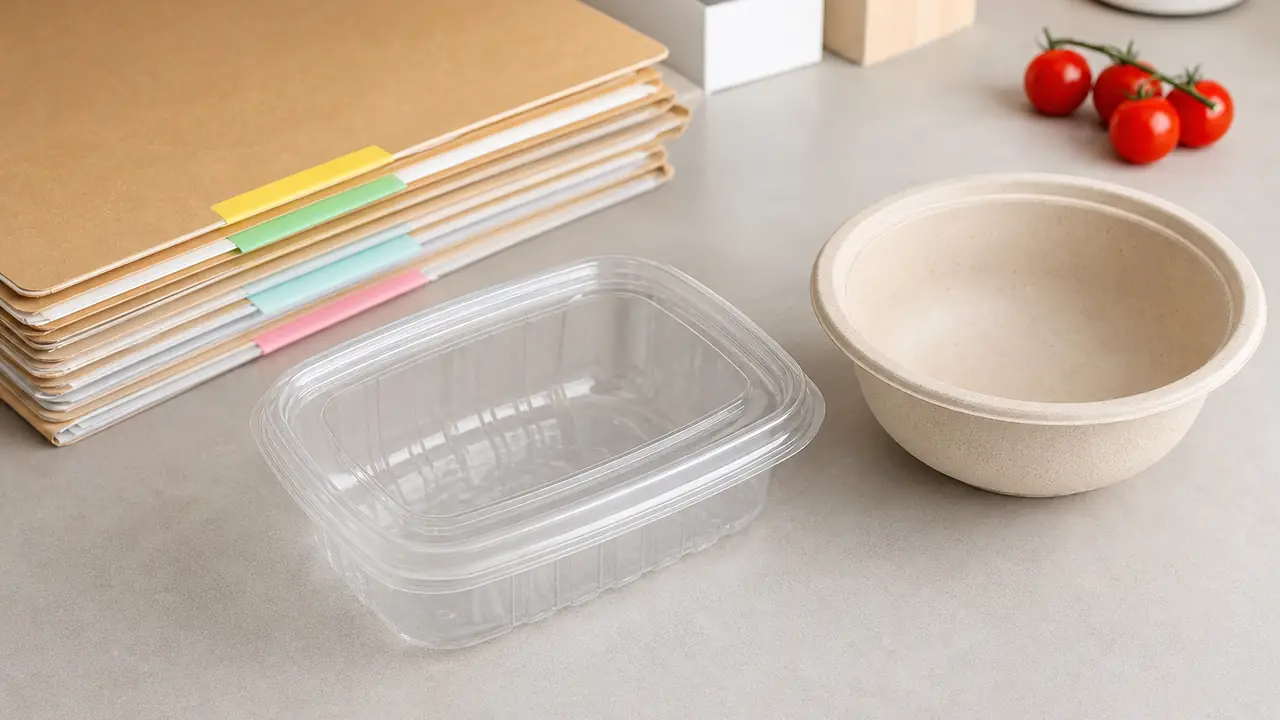
Who holds the documents
Food contact compliance attaches to a material and a finished product made by a specific plant. A declaration of compliance is issued by the partner plant or its resin supplier; a migration test report is issued by a third-party laboratory to whoever ordered the test, usually the plant or the brand; a compostability certificate is issued by a certification body to the product's maker or brand. Lidwell is a sourcing desk and does not hold certificates or reports of its own. What the desk does is collect the documents for each project, check that they cover the product, the material grade and the market, and keep copies in the program file. Where a document is missing, the desk arranges the test with a lab in the brand's or plant's name.
Nothing on this page is a legal opinion. Requirements change and depend on the product and use; confirm the final position with your test lab, customs broker or counsel.
Documents by market
| Market or claim | Rule | Typical document | Issued to |
|---|---|---|---|
| United States | FDA 21 CFR 174-178; 177.1520 for PP and PE | Supplier declaration with conditions of use, test data | Partner plant or resin supplier |
| European Union | (EC) 1935/2004; (EU) 10/2011 for plastics | Declaration of compliance, overall and specific migration report | Partner plant or brand |
| Germany | LFGB sections 30 and 31, BfR recommendations | LFGB test report | Partner plant or brand |
| China | GB 4806.1, GB 4806.6, GB 4806.7-2023, GB 4806.8 | Test report to the relevant GB standard | Partner plant |
| Compostable claims | EN 13432, ASTM D6400; FTC Green Guides 16 CFR 260.7 and 260.8 | Certificate with number, for the specific product | Maker or brand |
| US fibre packaging | State PFAS rules, for example California AB 1200 from 1 January 2023 | Supplier statement and, where needed, total organic fluorine test | Partner plant or brand |
United States: FDA 21 CFR
FDA regulates food contact substances under 21 CFR parts 174 to 178. Polypropylene and polyethylene fall under 21 CFR 177.1520 for olefin polymers. FDA does not issue approvals for finished containers, so the document buyers receive is a supplier declaration that the material complies with 21 CFR 177.1520 under stated conditions of use, with test data behind it. The conditions of use matter: a container used for hot fill or reheating needs a declaration that covers those conditions. See food contact safety.
European Union and Germany
In the EU, Regulation (EC) 1935/2004 sets the general rules and Regulation (EU) 10/2011 sets the rules for plastics, including an overall migration limit of 10 mg/dm2 or 60 mg/kg of food simulant and specific limits for listed substances. A resin supplier's declaration covers an intermediate material; the finished container still needs to be verified, usually with a migration report on the product. German buyers often also ask for an LFGB test report. For single-use items, Directive (EU) 2019/904 has banned single-use plastic cutlery and plates since 3 July 2021, and PLA counts as plastic; EU programs use wooden or other compliant cutlery routes.
China: GB 4806
For products sold in China, GB 4806.1 sets general requirements, GB 4806.6 covers resins, GB 4806.7-2023 covers plastic materials and articles, and GB 4806.8 covers paper and board. Partner plants supplying the domestic market usually hold test reports to these standards, which also help as background for export programs.
Material and green claims
Claims on packaging need documents as much as food contact does. Starch-based containers are usually starch blended with PP, so they are not described as biodegradable or compostable. Compostable wording is used only where the product is certified to EN 13432 or ASTM D6400, with the certificate number, and qualified under FTC Green Guides 16 CFR 260.7 where composting facilities are not widely available. PVC appears in this range only in non-heated packaging and storage, such as gift box windows, and carries no food container claim. Read biodegradable claims and the Green Guides and the sustainable packaging guide.
How the desk verifies a document
- Check the issuer: plant, resin supplier or accredited lab.
- Check the product and material grade named against the specification.
- Check the standard, test conditions and date.
- Check that the conditions of use match the product's use.
- Record the document and its limits in the program file.
Tell the desk your markets and claims with your brief through the quote form; lab testing adds time to a first order, which is reflected in the confirmed lead time.