
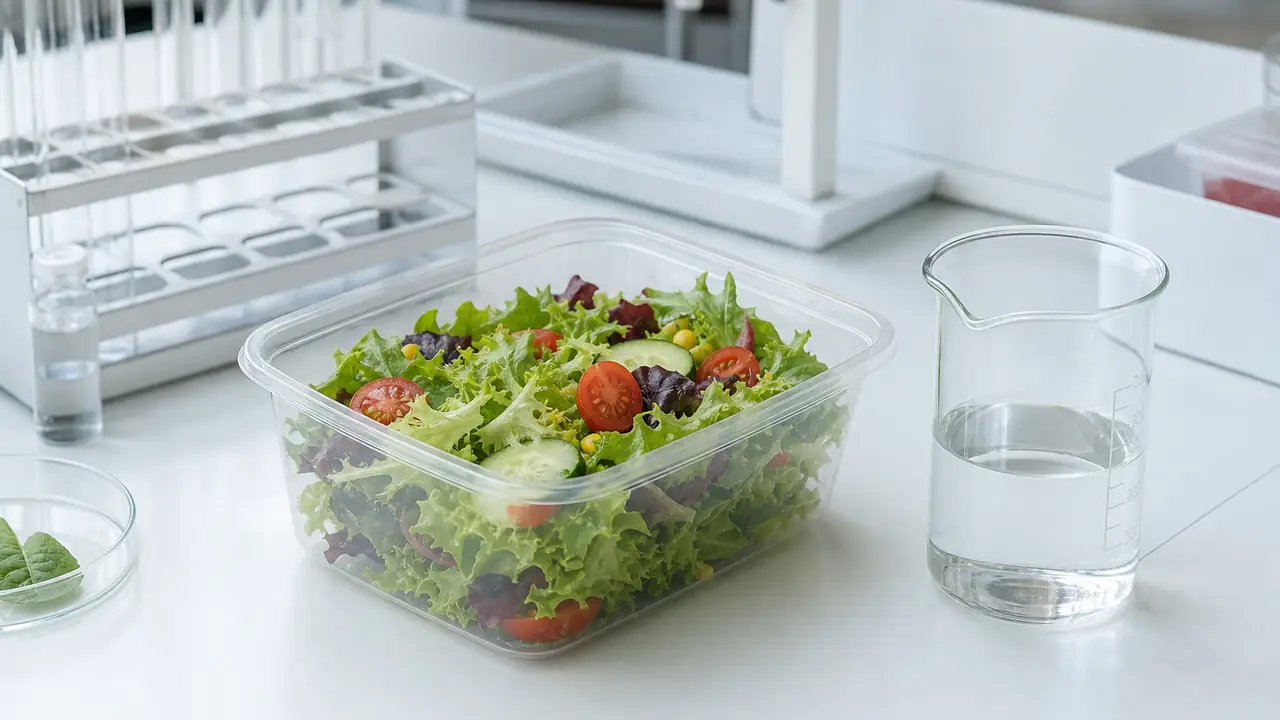
What migration means
Every plastic contains more than the polymer. There are residual monomers from the resin, additives such as antioxidants and slip agents, colorants in the masterbatch and, in recycled content, traces of what the material was before. When food touches the plastic, small amounts of these substances can move into the food. Migration testing measures how much moves, under conditions that represent the real use, and compares the result with legal limits.
The test is run on the finished item, or on a sample of the same material processed the same way, by a third-party lab. A resin producer's declaration is a useful start, but the finished container has been through colouring, molding and sometimes printing at the partner plant, so the finished item is what the market rules care about.
Overall and specific migration
There are two kinds of limit. Overall migration is the total amount of all substances that move into the food simulant. Under Regulation (EU) 10/2011 the overall migration limit is 10 mg per square decimetre of contact surface, or 60 mg per kilogram of food simulant for certain containers and cases. It is a measure of the general inertness of the material.
Specific migration limits apply to individual listed substances, such as a particular monomer or additive, each with its own limit in the regulation. A lab checks the ones that are relevant to the material and its formulation, which is why the lab needs to know the resin and the additives. A report that only shows overall migration is incomplete for most plastics.
| Term | Meaning | What to check in the report |
|---|---|---|
| Overall migration (OML) | Total of all substances moving into the simulant | Result against 10 mg/dm2 or 60 mg/kg |
| Specific migration (SML) | One listed substance at a time | Which substances were tested and why |
| Food simulant | A liquid or solid standing in for a food type | That the simulants match the foods you sell |
| Test conditions | Time and temperature of contact in the test | That they cover your hottest and longest use |
| Surface to volume | Contact area per amount of food | That the real container or a stated ratio was used |
| Repeated use | Successive tests on the same sample | Third exposure result for reusable items |
Food simulants
A lab cannot test with every curry and salad, so the regulation uses simulants: standard liquids or solids that behave like groups of foods. There are simulants for aqueous foods, for acidic foods, for alcoholic foods, for fatty foods, usually a vegetable oil or an equivalent, and a solid simulant for dry foods. The choice depends on what the container will hold. A takeout box for oily dishes needs the fatty food simulant. A fruit box needs the aqueous and acidic simulants. A soup cup usually needs several.
The most common gap in reports buyers receive is a mismatch between the simulants tested and the foods the container will carry. A report on aqueous simulants only, for a box that will hold fried rice, does not cover the actual use.
Time and temperature
Test conditions are chosen to represent the worst foreseeable use. A container for chilled storage is tested at a lower temperature for a longer time than one for hot fill. A container marked for the microwave needs conditions that cover reheating. If a report was run at conditions milder than the real use, it does not cover that use, however good the result looks. Ask the lab, or the partner plant, to state the conditions in plain words next to the intended use; see freezer and hot-fill temperatures for how to define them.
The US and China
US rules are written differently. For PP and PE, 21 CFR 177.1520 sets specifications such as hexane extractables, and declarations name the conditions of use from 21 CFR 176.170(c), graded A to H. FDA does not approve finished containers; the supporting evidence is a supplier declaration and, where useful, a test report. In China, GB 4806.7-2023 sets the requirements for plastic materials and articles in food contact, with GB 4806.1 setting the general rules. For German buyers, LFGB section 30 and 31 test reports are often requested in addition to EU 10/2011. The compliance guide lists the documents per market.
How to read a report in five minutes
- Check the item: does the sample description, colour and material match the container you are buying?
- Check the lab and the date, and who the report is issued to.
- Check the simulants against your foods.
- Check the time and temperature against your hottest and longest use.
- Check that specific migration was tested for the relevant substances, not overall migration alone.
Colour matters more than buyers expect. A report on a natural, uncoloured PP box does not automatically cover the black-base version of the same box, because the masterbatch adds substances. Neither does a report on virgin resin cover a version with recycled content. See additives and colorants.
Who orders the test, and when
For stock items, partner plants often hold existing reports, and the desk checks them against the item and the market. For a new colour, a new material or a custom mold, a fresh test is usually needed, and it is ordered on production-equivalent samples after the sample stage. Reports are issued to the partner plant or to your brand per project; Lidwell does not hold certificates. Lab time is planned into the schedule, so the test plan is set when the order is placed. Confirm the exact test scope with your test lab.
The wording that follows from a good report is narrow and specific: tested to EU 10/2011 per report, for the simulants and conditions it lists. The desk's lab coordination is set out on testing and inspection; to start a program with the test plan included, use the quote form.