
Why so much takeout packaging is thermoformed
Thermoforming makes thin, light parts from a continuous sheet, fast and with relatively simple tools. For single-use packaging that is exactly what is needed: a takeout box has to hold hot food for one journey, nest tightly in a carton and cost as little resin as possible. Partner plants in Guangdong thermoform most of the PP takeout range the desk coordinates. A plant in Foshan, for example, makes 650 ml and 750 ml boxes and 1,000 ml boxes in plain, ribbed and two-compartment versions, packed 300 sets per carton; a thermoforming plant in the same cluster makes export soup cups from 350 ml at 116x99x45 mm to 950 ml at 117x82x141 mm, packed 200 sets per carton.
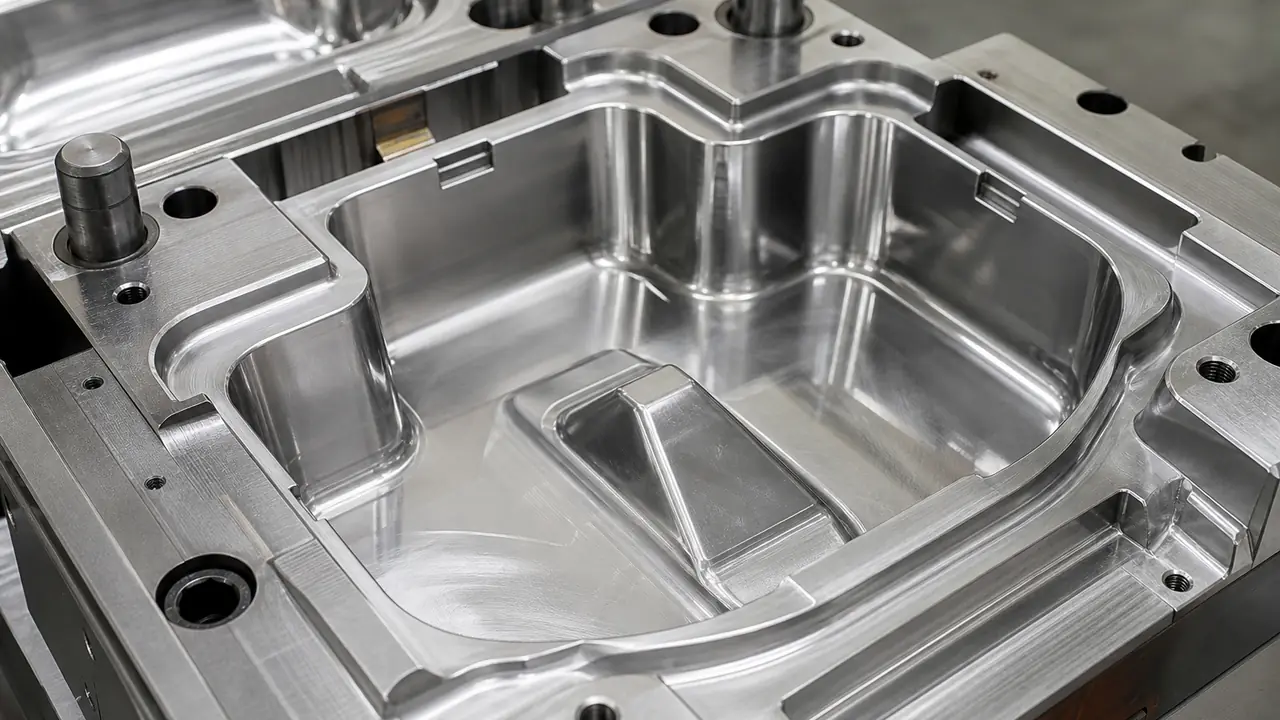
Injection molding is the other route, used for heavier and reusable parts. The two are compared in thermoformed vs injection molded containers; the tooling side of thermoforming is on the thermoforming page.
From pellet to sheet
The process starts before forming. Resin is extruded into sheet, either by the forming plant itself or by a sheet supplier. The sheet decides much of the finished quality: its thickness, called the gauge, its evenness across the width, its clarity and its cleanliness. A plant that extrudes its own sheet controls the gauge and can run the trim scrap back into the sheet; where recycled trim is used, it should be the plant's own clean in-process material, declared on the specification. Buyers who need recycled content from outside sources face a separate set of rules, covered in recycled content in containers.
The choice of sheet follows the use. PP sheet is used for anything hot or reheated; it is slightly cloudy. PET sheet is used for clear cold display, salads and fruit, and is not used for hot food. PVC sheet appears in this range only in non-food items such as clear folding boxes and gift box windows, never as a food tray or clamshell.
The forming line, stage by stage
| Stage | What happens | Parameters the plant sets | Defect if it is wrong |
|---|---|---|---|
| Heating | The sheet passes under heaters until it is soft | Heater zones, sheet temperature, dwell | Thin spots, webbing at corners, haze on PET |
| Forming | Vacuum, air pressure or a plug pushes the sheet onto the tool | Vacuum and pressure, plug depth and timing | Thin corners, poor detail on rims and ribs |
| Cooling | The formed sheet sets against the cooled tool | Tool water temperature, cycle time | Warped rims, poor lid fit, shrinkage after packing |
| Trimming | Parts are cut out of the formed sheet | Cutting tool type, sharpness, alignment | Sharp or ragged edges, angel hair, dust |
| Stacking and counting | Parts are nested and counted into sleeves | Stack count, denest features | Stuck stacks, scuffed clear parts, short counts |
Forming can use vacuum alone, air pressure from above, or a plug that pre-stretches the sheet before vacuum or pressure takes over. Plug assist helps deep parts, such as soup cups, keep material in the base and lower walls, where it would otherwise thin out. The plant chooses the method; the buyer judges the result by checking wall evenness and corner strength on the sample.
Draw depth and where the wall thins
A thermoformed part is made by stretching a flat sheet. The deeper the part relative to its opening, the more the sheet stretches and the thinner it becomes, and it does not thin evenly: the corners and the base edges, which are reached last, are thinnest. That is why a deep cup or a tall box is harder to thermoform well than a shallow tray, and why corners are where cracks and leaks start.
The buyer's tools here are simple. Compare gram weight for the same capacity: a heavier part of the same size started from a thicker sheet. Ask the plant to cut a sample across a corner and confirm the wall is acceptable there, not only at the flat side. And keep corner radii generous in custom designs, because a sharp inside corner is where the sheet runs out.
Trays, boxes and clamshells
Trays and divided containers are shallow and wide. A clear PP three-compartment tray from a partner plant measures 218x188x42 mm with a 1,000 ml total capacity, and a large five-compartment version 232x232x47 mm and 1,500 ml, packed 200 sets per carton. The dividers are formed in the same sheet, so their tops have to be lower than the rim if the lid is to seal on the outer edge; see divided fruit containers.
Takeout boxes and soup cups have separate lids, formed on a matching tool. The lid and base are often formed on different lines or even in different plants, so the rim profile of both has to be checked together. Clamshells have the lid and base in one sheet, joined by a formed hinge. The hinge is the weak point: it cracks if the sheet is too thin there or if the clamshell is opened and closed many times, so a simple repeated opening check belongs on every clamshell sample. Clear PET clamshells are the normal choice for fruit and bakery display, cold use only.
Trimming, edges and cleanliness
Trimming is where many end-user complaints start. A dull or misaligned cutting tool leaves sharp or ragged edges, fine plastic hairs and dust that cling to the part. On food containers that is both a quality and a hygiene issue. The desk includes edge feel, loose particles and visible dust in the appearance standard agreed on the sample, and checks them at inspection. Clear PET parts also show scuffs from stacking, so the stack count and the sleeve material are part of the specification rather than left to the line.
Lids, leaks and testing
For liquid foods the rim seal is everything. The desk agrees a lid fit check, a tilt and inversion test with liquid, and where relevant a freezer check and a heating test per supplier marking, all confirmed per order; containers are described as leak-resistant in that test, never with an absolute claim. Soup cups from the partner cluster carry the PP code 5 and a microwave symbol molded in the base, as the supplier states; microwave use is still checked on the sample. See lids and seals.
Ordering thermoformed items
Stock tools are the quickest start: typical reference ranges are 1-10 mixed cartons from stock and 7-15 days for a stock batch. Printed lids or sleeves typically start at 10,000-50,000 pieces per item, and a new tool with your own footprint from 50,000-100,000 pieces, confirmed in writing per program. The details are on MOQ and lead time; send the foods, capacities and market through the quote form.