
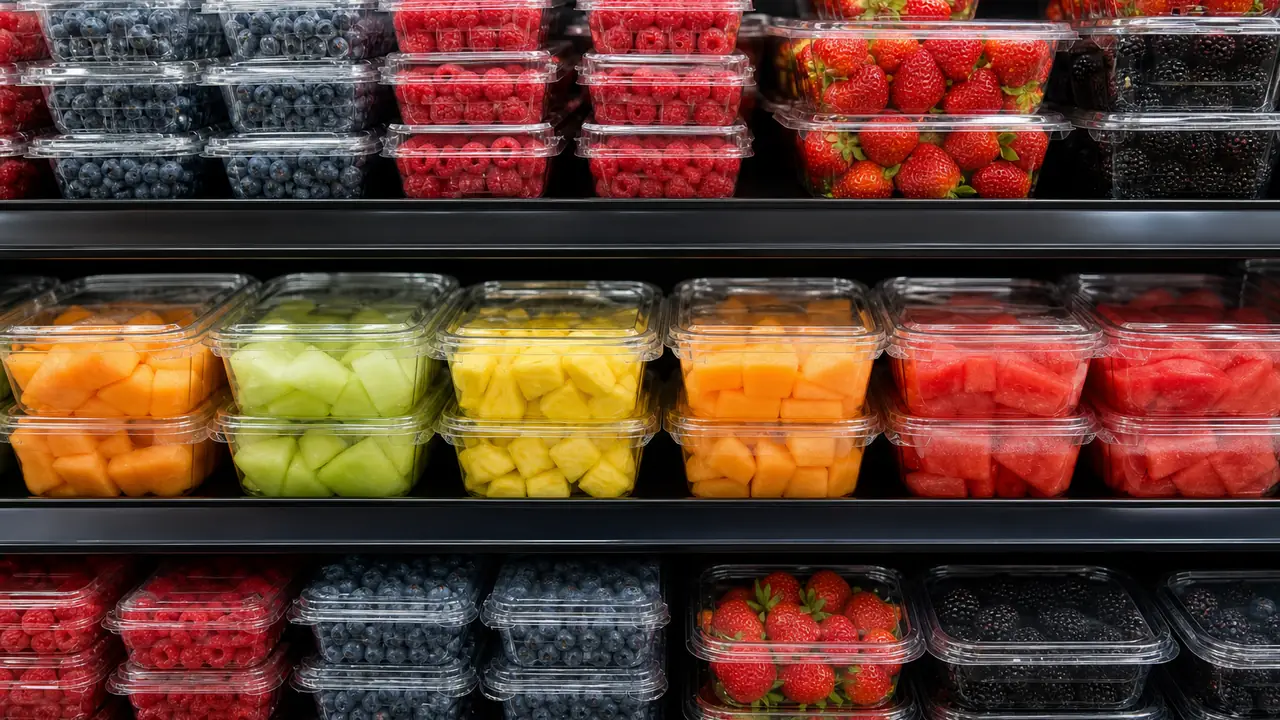
What a produce container has to survive
Supermarket produce packaging works in the cold. Cut fruit, berries and salad are packed in a chilled packhouse or in-store prep room, moved through the cold chain and displayed in an open chiller for one or more days. The container meets three stresses that do not matter much in takeout. First, condensation: every time the box moves between temperatures, water forms on the inside of the lid and hides the fruit. Second, stacking: boxes are stacked in crates and on shelves, and a lid that bows under load crushes soft fruit. Third, handling: shoppers pick up, tilt and put back the box, so lids must stay closed without a seal that tears.
Clarity is the selling point. A lid that scratches in transport or fogs in the chiller makes good fruit look tired, which is why material choice matters more here than in almost any other scenario.
Recommended lines and materials
For chilled display only, clear PET, resin code 1, is the usual choice. It gives the best clarity and stiffness for a given wall, and it suits clamshells, flat lids and cold drink style cups and bowls. PET is used cold only and is not marked for heating. Where a box is also reheated, or where the shopper is expected to reuse it at home, clear PP, resin code 5, is the better fit, with slightly less clarity. PVC is not used for produce containers in this range.
The divided fruit containers line covers clear PP compartment trays from a partner plant, which suit mixed fruit cups, fruit and dip sets and grab-and-go snack boxes. PET cold cups and bowls from the same cluster, on a 117 mm rim, add single-portion formats. For bakery and dry produce such as nuts or dried fruit, paper boxes with a PET window are an option.
Reference sizes
| Item | Material | Outer size | Capacity |
|---|---|---|---|
| Three-compartment tray | Clear PP | 218x188x42 mm | 1,000 ml |
| Four-compartment tray | Clear PP | 219x188x43 mm | 1,000 ml |
| Large four-compartment tray | Clear PP | 228x229x45 mm | 1,300 ml |
| Small five-compartment tray | Clear PP | 240x192x40 mm | 1,100 ml |
| Large five-compartment tray | Clear PP | 232x232x47 mm | 1,500 ml |
| Cold bowl, 117 mm rim | PET | Per spec sheet | 230-700 ml |
Sizes are measured by the partner plants by hand and checked against the physical sample before an order is confirmed. Divided trays ship 200 sets per carton; PET cold cups up to 1,000 per carton, so nesting decides how many fit in a container load.
Checks the desk agrees per order
- Clarity and surface check on the lid, including scratch marks from nesting.
- Lid fit and opening force, so the box stays closed when shoppers handle it.
- Stacking of filled boxes and of the outer carton.
- Tilt test with juice for cut fruit formats.
- Size, gram weight and odour against the approved sample.
- Label adhesion on a chilled, damp surface where labels are applied.
- Third-party migration test with the simulants your market requires.
Counts and pass criteria are a stated working default, confirmed per order. Results are described as leak-resistant in the standard tilt test, never with an absolute claim. Fogging can be reduced by venting and by allowing products to equalise before display; the desk notes it on the spec sheet rather than promising a fog-free lid.
Documents
Retail buyers usually ask for a supplier declaration of compliance for the PET or PP to FDA 21 CFR 174-178 for the US, or to Regulation 1935/2004 and Regulation (EU) 10/2011 for the EU, backed by a migration report on the finished container. For China, GB 4806.7-2023 applies. Resin codes molded in the base help retailers with recycling labels. Documents are issued to partner plants or to your brand per project and verified by the desk; see the compliance guide.
How to brief a produce program
- Name the products: whole berries, cut fruit, salad, mixed snack sets.
- Give the fill weight per pack and the number of compartments.
- Describe the cold chain and display time.
- State the shelf or crate dimensions the box must fit.
- Say how labels or print are applied and give volume per SKU.
Send it through the quote form. Chains buying for many stores can also see retailers for shelf packaging and barcodes.