
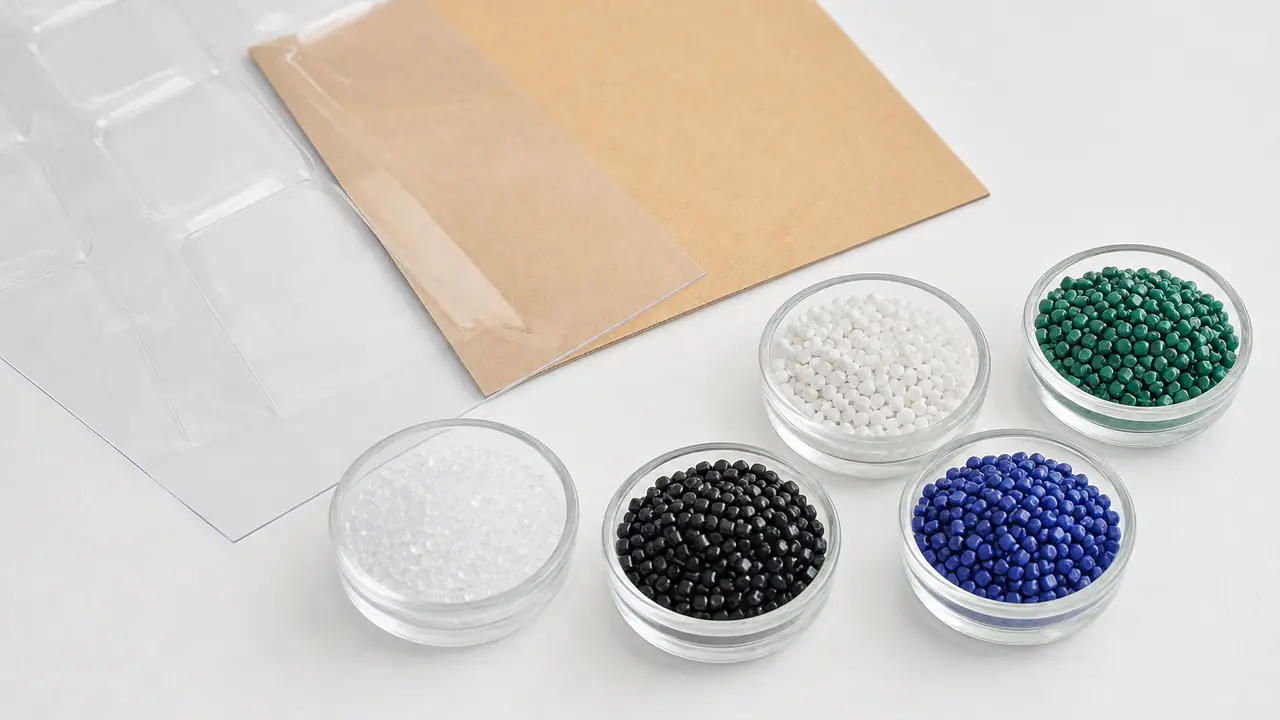
Why this question comes up so often
Buyers searching for food containers often find PVC in the same results as PP and PET. Some listings describe clear PVC boxes in a way that suggests they are suitable for food. The material is cheap, very clear and easy to fold, so it is tempting to use it everywhere. Lidwell takes a simple position: PVC belongs in non-heated packaging and storage, and food containers are PP or PET. This is also how the partner plants work. None of the food container literature from the plants Lidwell coordinates includes a food container made of PVC; the takeout boxes are PP and the export soup cups carry the PP code 5.
What PVC is
PVC, polyvinyl chloride, carries resin identification code 3. In rigid form it is a stiff, clear sheet that takes a sharp crease and can be folded into a box, printed and glued. In flexible form, with plasticisers, it becomes soft film and cases. Both forms have a long track record in retail packaging. In food packaging its main uses have been cling film and some trays, and the general guidance from industry and consumer sources is that PVC shows a higher migration risk when heated, which is why reputable food packaging plants avoid it for microwave containers.
Where PVC belongs
The desk uses PVC where its clarity and folding behaviour help and where it never meets heat or hot food.
- Clear folding boxes. Rigid PVC sheet die-cut and creased into display boxes for gifts, toys, accessories and small goods.
- Gift box windows and lids. A clear window on a paper box, or a clear lid on a kraft bakery box, can be PET or PVC because it is not heated and does not touch hot food.
- Soft cases for small items. Flexible clear PVC pouches and cases for cosmetics, stationery and travel items.
- Retail display packaging. Blister and clamshell display packs for non-food goods.
A reference kraft bakery box with a clear lid from a paper packaging partner measures 190x85x35 mm, with medium and small sizes at 160x85x35 and 135x73x35 mm. The window or lid can be PET or PVC; for bakery items that touch the window directly, the desk recommends PET and asks for the food contact declaration on that part. The folding gift boxes page sets out the options.
Where PVC does not belong
- Any container for hot food, soups or sauces.
- Any container intended for the microwave or reheating.
- Meal prep, takeout and lunch containers.
- Reusable home food storage, including vacuum and fridge containers.
- Any product described to consumers as a food container.
For these uses the desk specifies PP for heat and PET for clarity in cold use. Vacuum food containers are PP or copolyester, fridge bins PET or PP. See PET vs PP food packaging.
The line in one table
| Job | PVC | PET | PP |
|---|---|---|---|
| Hot takeout container | No | No | Yes |
| Microwave reheating | No | No | Per supplier marking |
| Cold fruit or salad box | No | Yes | Yes |
| Window on a bakery box | Possible, not for direct contact | Preferred | Rare |
| Clear folding gift box | Yes | Yes | Possible, less clear |
| Soft cosmetic case | Yes | Rare | Possible |
| Home storage bin | No | Yes | Yes |
PVC in organizers and storage
Home organizer ranges sometimes include PVC. Clear soft cases and zip pouches for small items are a legitimate use. Rigid organizers, though, are usually better in other plastics: cosmetic organizers in PS, acrylic or PET, which are stiffer and scratch differently, and storage boxes in PP. A 318x213x92 mm drawer-style cosmetic organizer from a public listing is the kind of item that should be PS or acrylic rather than PVC. The cosmetic organizers page compares the options.
What to ask when PVC is in the specification
- Name the part: window, lid, folding box or case. PVC should never be the base of a food container.
- State the use: non-heated, no direct contact with hot food.
- Ask whether the market has rules on PVC in packaging; some retailers and regions restrict it. Confirm with your counsel.
- Check the print: inks and glue on PVC behave differently from paper, so ask for a rub and adhesion check on the sample.
- Consider PET as an alternative where clarity is needed and food contact documents are wanted.
How the desk handles a PVC request
When a brief arrives with PVC in it, the desk does not simply quote it or refuse it. It sorts each clear part into one of three cases. If the part is a window, lid or folding box for non-food goods, PVC stays on the table and is quoted next to PET so the buyer can compare clarity, crease behaviour and print. If the part is a window on a food box that does not touch the food, both options are quoted and PET is recommended where the buyer wants food contact paperwork on every part. If the part holds food, PVC is replaced by PP or PET of the same footprint before anything else happens, and the reason is written into the program file. That record matters on repeat orders: a later quote cannot quietly swap a PET window back to PVC without the change being visible.
The same logic applies to samples. Every clear part in a sample set is labelled with its material, so that the buyer approves a material as well as a look.
Claims and labeling
Mark the part with resin code 3 where the format allows, and do not describe PVC parts in a way that suggests they are suited to food or heat. Avoid general safety words on PVC packaging; describe what the part is and how it is used. If you are moving away from PVC for retail reasons, say what replaced it, such as a PET window, rather than making a broad green claim.
Next steps
Most PVC questions are solved in the specification: identify every clear part, decide whether it touches food or heat, and choose the material for that job. The material guide sets out the logic line by line. Typical quantities for printed folding boxes start at 5,000-10,000 per design, confirmed in writing per program; see MOQ and lead time. Send the parts list through the quote form and the desk returns a material for each part.