
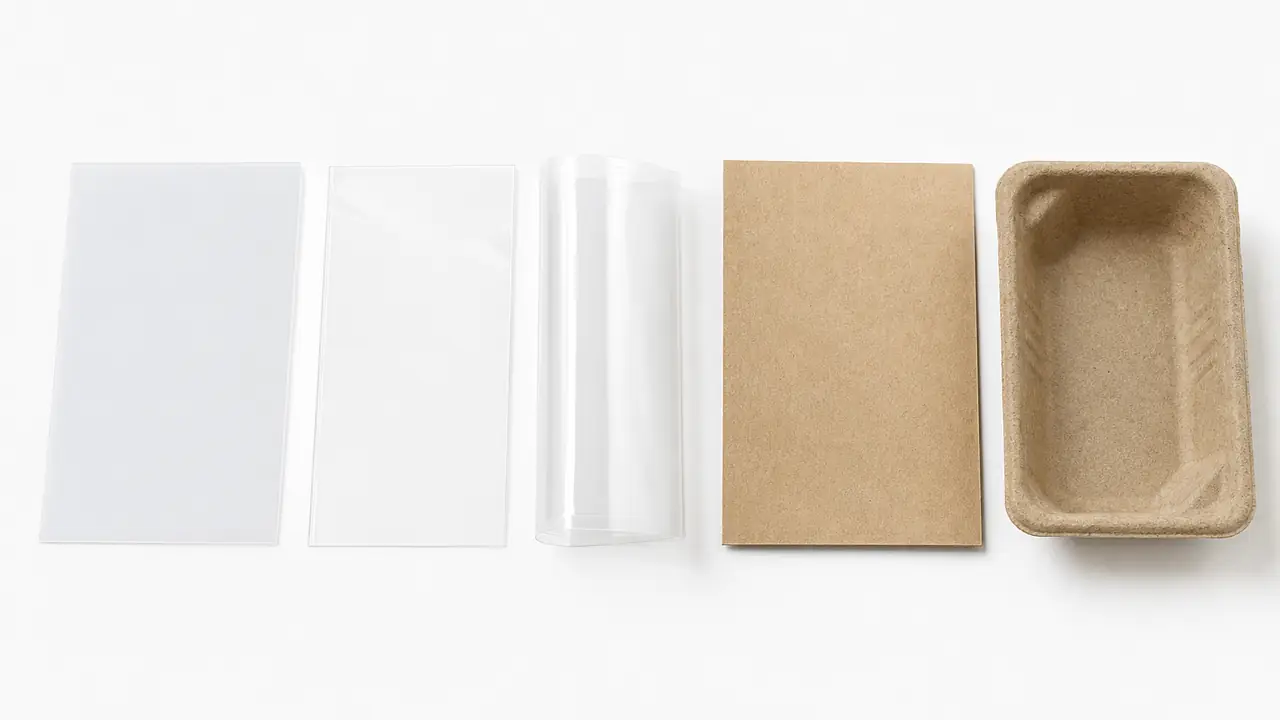
Start from the use, not the material
A material is right or wrong only for a given use. The questions that decide it are simple: will the food be hot, reheated, frozen or only chilled; does the buyer need the product to be seen through the wall; will the item be used once or for years; and does it touch food at all. Answer those four, and the choice usually narrows to one or two materials per part. A takeout box, its lid and a sauce insert may each be a different material, so the specification names the material of every part rather than of the product as a whole.
Resin identification codes
Plastic parts carry a resin identification code inside a triangle: 1 PET, 2 HDPE, 3 PVC, 4 LDPE, 5 PP, 6 PS, 7 other (which includes copolyester, acrylic and many blends). The code identifies the resin for sorting; it is not a safety mark and not a statement about recyclability in a given city. Soup cups from a partner plant in Guangdong, for example, carry the PP code 5 molded into the base next to a microwave symbol, both stated by the supplier and checked on the sample.
Materials at a glance
| Material | Code | Heat | Clarity | Typical use in this range |
|---|---|---|---|---|
| PP | 5 | Hot food; microwave per supplier marking | Translucent to clear | Takeout boxes, soup cups, divided trays, collapsible boxes |
| PET | 1 | Cold and chilled only | High | Fruit clamshells, cold cups, fridge bins, box windows |
| PVC | 3 | Not heated | High | Clear folding boxes, gift box windows, soft organizer pouches |
| PS and HIPS | 6 | Not for hot reheating | PS clear, HIPS opaque | Drawer organizers, desk trays, cosmetic organizers |
| HDPE | 2 | Room temperature storage | Opaque | Pet food bins, large storage |
| Copolyester | 7 | Per supplier rating, not assumed | High | Reusable vacuum and pantry containers |
| Acrylic (PMMA) | 7 | Not heated | Very high | Cosmetic organizers, display trays |
| Paperboard | None | Per coating and design | Opaque, window optional | Bakery boxes, gift boxes, click-lock takeout cartons |
| Starch-PP blend | Usually 5 or 7, per marking | Per supplier marking | Opaque, beige | Bowls, boxes, divided meal trays |
| Molded fiber | None | Per supplier rating | Opaque | Clamshells, plates, bowls |
PP and PET: the two food plastics
PP is the material for hot food. FDA 21 CFR 177.1520 covers olefin polymers including PP, with specifications such as a melting point in the 160-180 degree C range and limits on hexane extractables. One partner plant's literature describes its cup PP as tolerating -10 to 120 degrees C; treat such figures as the supplier's statement until tested on your sample. PET gives glass-like clarity and suits salads, fruit and cold drinks, but it is not used for hot food or the microwave. A common mistake is a PP base with a clear PET lid sold as microwavable: the set then has to be marked for cold use or the lid changed to PP. See PET vs PP.
Where PVC belongs
PVC is clear, stiff and easy to fold and print, which makes it useful for clear folding boxes, gift box windows and soft pouches in cosmetic organizers. It is not used for food containers in this range. When heated, PVC carries a higher migration risk, and reputable food packaging plants avoid it for microwave containers. The rule on every Lidwell spec is simple: PVC only in non-heated packaging and storage, and never in contact with hot food. More in where PVC belongs in packaging.
Storage plastics: PS, HIPS, HDPE, copolyester, acrylic
Organizers and storage boxes use a wider set. PS is clear and rigid, good for drawer trays, but brittle at corners under impact; HIPS adds toughness at the cost of clarity. HDPE is tough and opaque and suits pet food bins. Copolyester gives clarity close to acrylic with better impact behaviour and is common in reusable vacuum containers; its heat rating is taken from the supplier data, not assumed. Acrylic is the clearest but scratches; it suits display and cosmetic organizers rather than kitchen use.
Paperboard, starch blends and molded fiber
Paperboard boxes come in white card, kraft and white card with a foil lining, made around Longgang near Wenzhou. Starch-based containers from a partner plant are listed as corn starch in a PP thermoforming catalogue, so they are most likely starch blended with PP; the blend ratio is confirmed per project, and they are not described as biodegradable or compostable without a named EN 13432 or ASTM D6400 certification. Molded fiber and bagasse avoid plastic but fall under US state PFAS rules, such as California AB 1200 since 1 January 2023. See sustainable packaging.
Documents per material
A resin supplier's declaration of compliance covers an intermediate material; the finished container still needs its own verification, usually a migration test for the destination market. The compliance guide lists what to request; send your parts list through the quote form and the desk names a material for each part.