
What this line covers
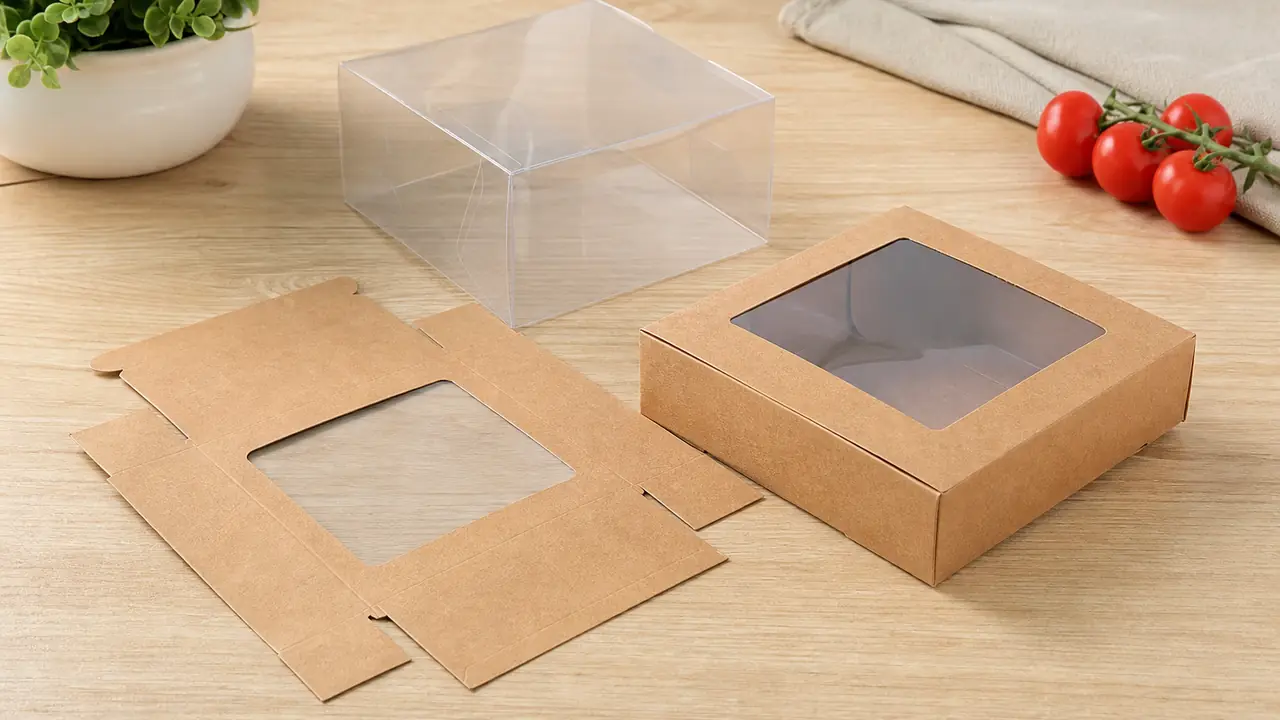
Folding gift boxes and bakery boxes are the paperboard side of takeaway packaging: trays with clear lids for cakes and pastries, click-lock boxes for takeout, pizza boxes and printed gift boxes for seasonal programs. They ship flat and are folded at the point of use, so a carton of flat blanks takes a fraction of the freight volume of the same number of rigid containers. Flat packing also means the folding and locking of the box has to be checked on the sample, because a box that is hard to erect slows down a bakery counter at peak hours. The main material is paperboard, kraft or white card, and the only plastic part is an optional clear window or lid.
The reference model on the cut sheet is a large rectangular bakery box with a clear lid from a partner paper packaging plant: 190x85 mm and 35 mm high. Medium and small sizes in the same family are 160x85x35 mm and 135x73x35 mm. Sizes are stated by the plant and checked against the physical sample before an order.
The reference range
| Format | Reference sizes | Board | Typical use |
|---|---|---|---|
| Rectangular bakery box with clear lid | 190x85x35, 160x85x35, 135x73x35 mm | Kraft or white card | Cake slices, pastries, cookies |
| Square bakery box with clear lid | 137x127, 117x101, 107x92 mm | Kraft or white card | Cupcakes, tarts, desserts |
| Click-lock takeout box | 350-2,880 ml, some two-compartment | Kraft grades, white card, foil-lined white card | Takeout meals, fried food, salads |
| Pizza box | 6-12 inch, 20x20x4.5 to 32x32x4.5 cm | Kraft or white card | Pizza, flatbreads, sharing boxes |
Click-lock boxes come in two kraft grades and in white card, and a white card with an aluminium foil lining for oily or warm food. The paperboard grades note explains how grade and weight affect stiffness and print.
Windows, lids and where PVC belongs
Clear windows and lids are made from PET or PVC film. PVC is acceptable here for one reason: the window is not heated and does not touch hot food. PVC is never used as a food container in this range, and bakery boxes with a PVC window are not for warming or the microwave. Where a buyer prefers to avoid PVC altogether, or where a retailer policy asks for it, PET film is the usual swap with very similar clarity. The material of the window is written on the specification and on the carton label, so it is never a surprise at inspection. See where PVC belongs in packaging.
Printing in the Longgang cluster
Printed boxes come from the paper packaging and printing cluster around Longgang near Wenzhou, named China's printing town in 2002. Local press reporting in 2024 put its printing and packaging output at about 20 billion yuan, more than 60 percent of the city's GDP, with 894 licensed printing companies. The cluster covers die-cutting, offset and flexo print, window patching and gluing, which lets one partner plant take a box from board to folded sample. Print checks include colour against an approved sample, ink adhesion and rub resistance; structural checks include burst strength, edge crush and carton stacking, with the plan agreed per order. More on printing and labeling.
Food contact and PFAS
Paper and board for food contact fall under GB 4806.8 in China and the EU framework Regulation 1935/2004 in Europe; the window film follows the plastics rules. For the United States, the key topic is PFAS. California AB 1200 has banned intentionally added PFAS in plant fibre food packaging since 1 January 2023, with a 100 ppm total organic fluorine screening line, and at least 13 states restrict PFAS in food packaging; Vermont, Connecticut and Minnesota cover all food packaging materials. Grease-resistant coatings are where the question arises, so the desk asks the partner plant for a PFAS statement and, where the market needs it, a total organic fluorine test. Confirm current state rules with your counsel; see PFAS in paper food packaging.
Ordering and private label
Printed paper boxes typically start at 5,000-10,000 per design, and stock boxes from mixed cartons, all confirmed in writing for each program on MOQ and lead time. Send the sizes, board, window material, artwork and destination market through the quote form. The desk returns matched reference sizes, a print and test plan, and the documents each market needs.