
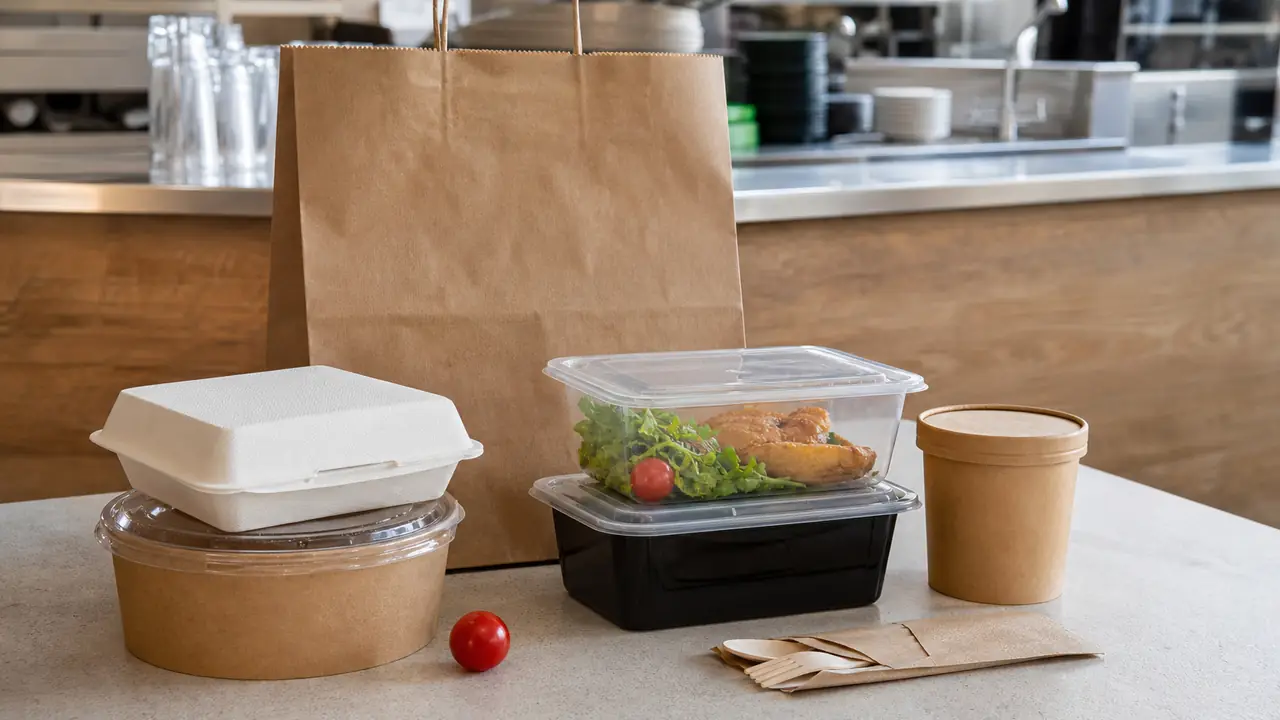
What a takeout container has to survive
Restaurant takeout is the hardest everyday test a disposable container faces. Food goes in hot, often with oil and sauce, and the lid is closed while steam is still rising. The box is then stacked with others in a bag, tilted on a bike or scooter, carried up stairs and sometimes left for twenty minutes before it is opened. At the customer end it may go straight into a microwave. Each stage puts a different stress on the container: heat softens thin walls, steam builds pressure under the lid, tilting pushes liquid against the rim and stacking presses lids into bases.
The complaints that follow are predictable: a lid that pops open in the bag, a corner that lets soup escape, a base that deforms under hot oil, or a lid so tight that the customer spills food opening it. All of them can be reduced at the specification stage by choosing the right material, the right rim and the right test plan.
Recommended lines and materials
For hot dishes the base and lid are PP food containers, resin code 5. PP keeps its shape with hot food and tolerates reheating where the supplier marking allows it. Thermoformed PP boxes are light and nest tightly for single-use takeout; injection molded boxes are heavier and often chosen when the restaurant wants a container customers reuse. PET lids appear on cold items only, and PVC is not used for takeout food containers at all.
Restaurants that want a plant-based look often ask for starch-based containers. The partner plant material is described as corn starch and listed under PP thermoforming, so the desk treats it as a starch and PP blend and does not describe it as biodegradable or compostable unless a certificate to EN 13432 or ASTM D6400 is in place. Paper click-lock boxes in kraft or white card from the Longgang cluster suit fried and dry food. Cutlery sets are covered on disposable cutlery sets; for the EU, single-use plastic cutlery has been banned under Directive 2019/904 since 3 July 2021, and PLA counts as plastic, so wooden sets are the usual route.
Reference sizes for a menu
| Item | Capacity | Outer size | Typical dish |
|---|---|---|---|
| Rectangular PP box | 500 ml | 170x115x34 mm, 17 g | Sides, salads |
| Rectangular PP box | 750 ml | 170x115x51 mm, 19.6 g | Main courses |
| Rectangular PP box | 1,000 ml | 170x115x64 mm, 22 g | Noodles, rice sets |
| Roast-meat PP box | 1,200 ml | 217x149x60 mm, 35 g | Roast meats, family portions |
| PP soup cup | 350-950 ml | 116x99x45 to 117x82x141 mm | Soups, congee |
| Starch-PP round bowl | 800 ml | 175x125x56 mm | Rice bowls, salads |
| Kraft bakery box | Per model | 190x85x35 mm | Pastries, desserts |
The 170x115 mm series shares one lid across four depths, which keeps lid stock low in a busy kitchen. Sizes are measured by the plants and checked against the physical sample before an order is confirmed. The sizing guide explains how to map capacities to portions.
Checks the desk agrees per order
- Size and gram weight against the sample, since weight shows wall thickness.
- Lid fit and opening force, so the lid holds in the bag and opens by hand.
- Tilt and inversion test with liquid for soup cups and sauce boxes.
- Microwave heating per supplier marking, lid removed or vented where marked.
- Hot water fill per the supplier rating, and an odour check.
- Drop test and outer carton stacking for transport.
- Migration test at a third-party lab where the market requires it.
Sample counts and pass criteria are a stated working default, confirmed per order. Results are written as leak-resistant in the standard tilt test, never as an absolute claim.
Documents
US buyers usually need a supplier declaration that the PP complies with FDA 21 CFR 177.1520 under the conditions of use that match hot fill. EU buyers need a declaration of compliance to Regulation 1935/2004 and Regulation (EU) 10/2011 with an overall and specific migration report. For paper boxes sold into the US, check state rules on intentionally added PFAS in plant fibre packaging, such as California AB 1200 in force since 1 January 2023. Documents are issued to partner plants or to your brand per project and verified by the desk; confirm the final position with your test lab or counsel.
How to brief a takeout program
- List the menu items and mark each as hot, cold, liquid or fried.
- State how orders travel: counter pickup, own riders or delivery platforms.
- Say whether customers reheat in the container.
- Give weekly or annual volume per item and the destination market.
- Say whether you need printed lids, sleeves or stickers.
Send it through the quote form. Restaurant groups and central kitchens can also see foodservice projects for supply continuity across sites.