
What foodservice buyers usually struggle with
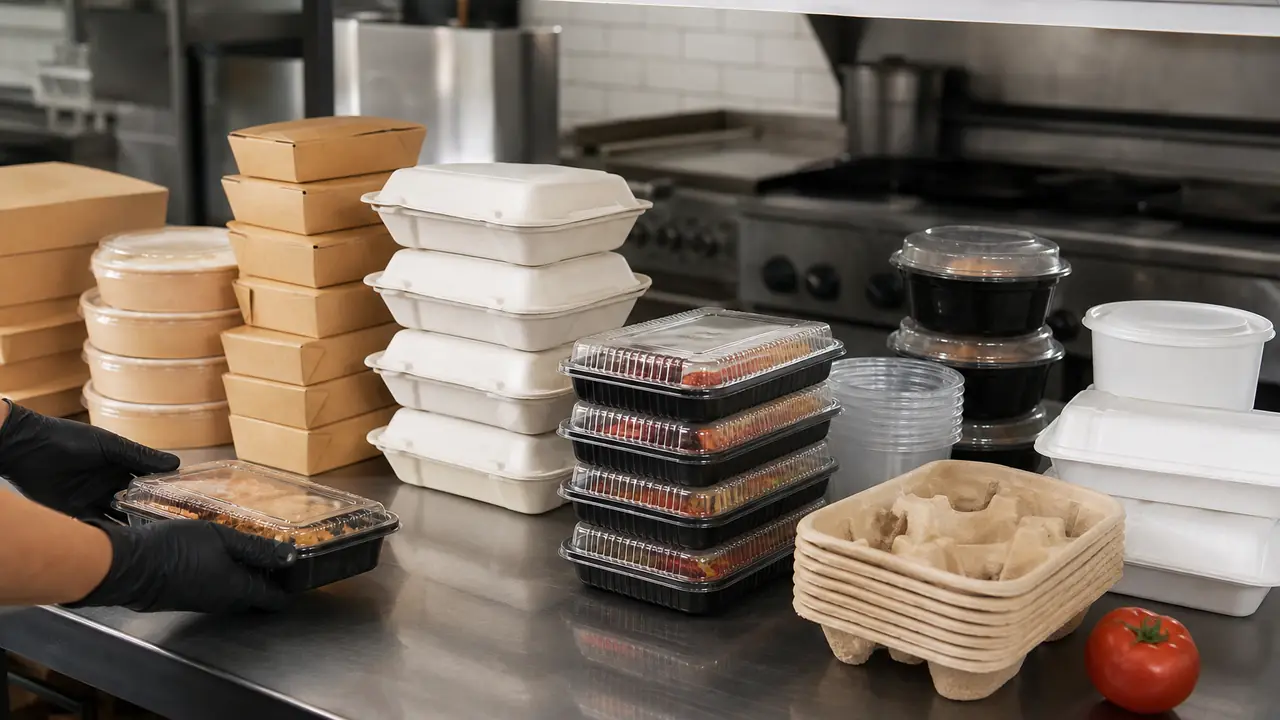
Foodservice is where containers meet real heat, real liquid and real volume. A restaurant chain or a central kitchen fills hot food straight from the line, reheats it or sends it out on a scooter, and expects the same container in every outlet. A delivery operator needs boxes that stack in an insulated bag without the top one crushing the bottom. An event caterer needs a large quantity on one date, with no second chance. The common failures are predictable: a lid that pops open in a bag, soup escaping at a corner, a base that softens with hot oil, and a stock-out because the next lot was late. Continuity of supply matters as much as the container itself, because switching a container mid-menu means new portion settings, new lids and new staff habits.
Recommended lines and reference sizes
| Line | Reference model | Material | Menu use |
|---|---|---|---|
| PP rectangular boxes | 500-1,000 ml on 170x115 mm; 750 ml at 51 mm deep, 19.6 g | PP | Mains, rice dishes, meal prep |
| PP round tubs and soup cups | Tubs 1,250-2,000 ml; cups 350-950 ml | PP | Soups, noodles, congee |
| Divided trays | Three compartments, 218x188x42 mm, 1,000 ml | Clear PP | Meal sets, bento-style lunches |
| Starch-based containers | 800 ml lidded bowl, 175x125x56 mm; divided 950-1,400 ml | Starch blended with PP | Bowls and sets where a lower plastic content is wanted |
| Cutlery sets | PP spoon 136x32 mm, 1.6 g; wooden kits for the EU | PP or wood | Delivery and events |
Starch-based containers are described as starch blended with PP; biodegradable or compostable wording applies only where a product is certified to EN 13432 or ASTM D6400, and the FTC Green Guides at 16 CFR 260.7 and 260.8 govern such claims in the United States. See PP food containers, divided containers and starch-based containers.
Heat, reheating and stacking
Hot food and reheating call for PP. Clear PET lids suit cold lines only, and PVC is not used for these containers. One partner plant's literature describes its cup PP as tolerating -10 to 120 degrees C; that is the supplier's statement until tested on your sample. Microwave use is stated per supplier marking, with the lid removed or vented where marked. Stacking depends on footprint discipline: keeping mains on the 170x115 mm footprint lets mixed depths share a lid and stack in a delivery bag.
Quantities and supply continuity
Chains usually enter on stock molds, from 1-10 mixed cartons per item, then move to printed lids or sleeves at 10,000-50,000 pieces per item. Stock production runs 7-15 days and printed orders 15-30 days, with sea freight about 15-25 days to the US West Coast and 30-45 days to Europe. The desk keeps a reorder plan with the partner plant and a second qualified source where the volume justifies it. All figures are typical reference ranges, confirmed in writing for each program.
Documents and market rules
For the United States, a supplier declaration to FDA 21 CFR 177.1520 for PP; for the European Union, a declaration to Regulation 1935/2004 and Regulation (EU) 10/2011 with a migration report. Single-use plastic cutlery and plates, PLA included, have been banned from the EU market since 3 July 2021 under Directive 2019/904, so EU operators use wooden cutlery kits. For molded fibre and paper ware in the United States, check state PFAS rules. The compliance guide lists what to request.
Checkpoints for foodservice
- Tilt and inversion test with liquid, so containers are leak-resistant in our standard tilt test, confirmed per order.
- Lid fit and opening force across mixed depths on one footprint.
- Hot fill and microwave heating per supplier marking; freezer at -18 degrees C for meal prep.
- Grease resistance and odor check; see leaking takeout containers.
An illustrative example
This example is illustrative and anonymous. A regional restaurant chain with a central kitchen wants one container system for dine-out and delivery. The desk maps the menu to the 170x115 mm PP series, soup cups and a three-compartment tray from Guangdong partner plants, agrees a tilt test and a reheating check per supplier marking, and starts on stock molds. Printed sleeves follow at a quantity inside the 10,000-50,000 range once the menu settles.
How to start
Send the menu, portion sizes, hot or cold service, outlets, monthly volume and market through the quote form.