
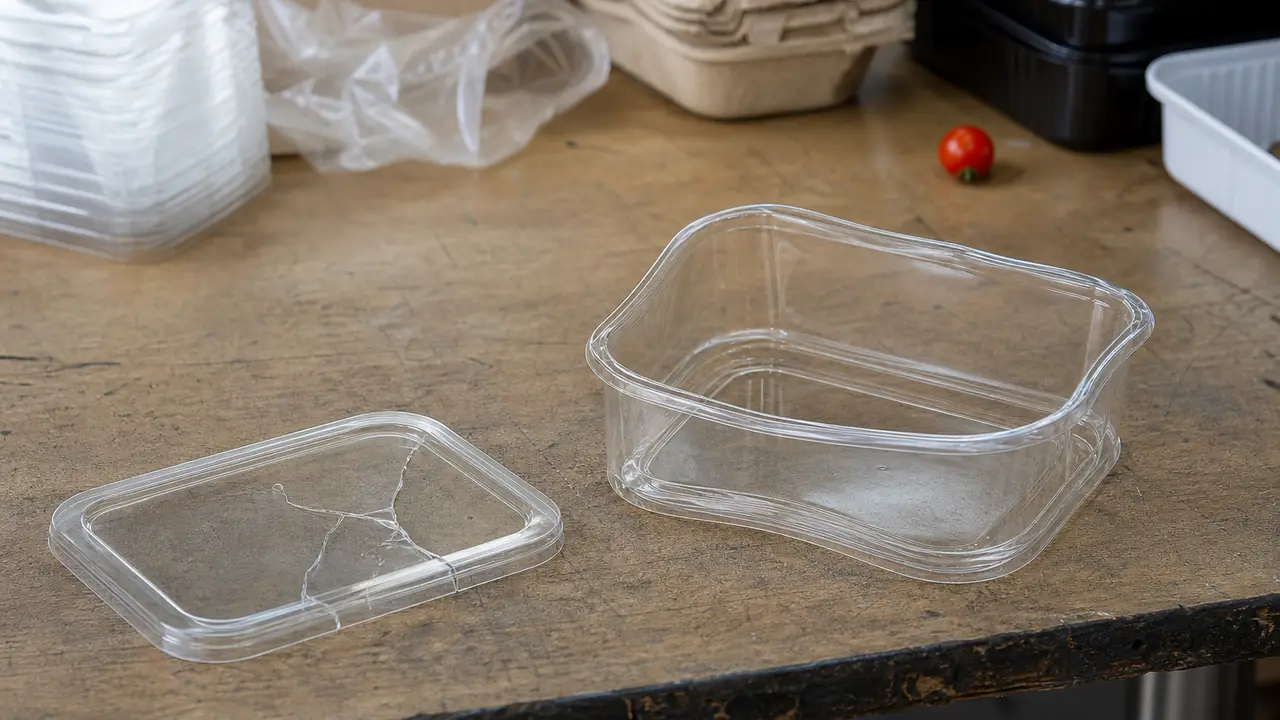
Why containers leak
A takeout container does not leak through its wall. Liquid escapes where the lid meets the base, and it does so when three things come together: a gap at the rim, liquid that reaches that gap, and pressure that pushes it through. The gap comes from fit and tolerance. The liquid reaches the rim when the container is overfilled, tilted in a bag or carried on a scooter. The pressure comes from steam inside a hot container, from the lid flexing when the box is picked up by its sides, or from a stack of boxes pressing down in a delivery bag.
Remove any one of the three and the problem shrinks. That is why the fix is rarely just a different supplier; it is usually a combination of the right shape, the right lid, a sensible fill line and a test that proves the pair works together.
Rim fit and tolerance
A snap lid seals by gripping a bead or channel around the top of the base. If the lid is slightly too large, it sits on the bead without gripping. If it is too small, it is hard to close and staff press it on at one corner, leaving the opposite side open. Both happen when lids and bases come from different molds or different production runs, and when gauge varies from one batch to the next.
Shared lids make this more sensitive. A partner plant in Huizhou runs one 170x115 mm footprint at 500, 650, 750 and 1,000 ml, so one lid can close four depths. That simplifies stock, but every base must share the same rim dimension. The desk checks the lid on every depth, records the opening force on the golden sample and asks for the same check at pre-shipment inspection. The lids and seals page explains closure types in more detail.
Shape: round against rectangular
Round tubs seal more evenly than rectangular boxes, because pressure along a circular rim is uniform and there are no corners where the lid can lift. That is why soups, broths and noodle soups go into round tubs and soup cups. Reference export soup cups from a thermoforming partner plant run from 350 ml at 116x99x45 mm to 950 ml at 117x82x141 mm, packed 200 sets per carton. Round tubs from the Huizhou plant run from 1,250 ml at 86 mm high to 2,000 ml at 129 mm high.
Rectangular boxes are better for rice, noodles and dishes with some sauce, where packing efficiency in a delivery bag matters more. Corners are the weak point: a rectangular lid that flexes when the box is lifted can open a small gap at a corner. A deeper rim channel and a stiffer lid help; so does carrying the box flat.
Lid type and steam
Press-fit and snap lids differ in how firmly they grip. Hinged clamshells are fast to close but usually seal less tightly than a separate lid, which makes them a poor choice for liquids. Steam adds a separate problem. Hot soup sealed immediately builds pressure, and as it cools it can pull the lid down or, while still hot, push liquid past a weak point. Some plants offer lids with a small vent; others recommend letting very hot liquids stand briefly before closing. Either way, the instruction to kitchen staff matters as much as the lid.
Fill level and handling
Capacity on a cut sheet is often brim-full volume. A 750 ml box filled to 750 ml has no headspace, and any tilt brings liquid straight to the rim. A practical fill line is lower, and it is worth stating it for each size in the range. The food container sizing guide covers brim-full volume against working fill.
Handling finishes the story. Delivery bags tilt, riders brake and boxes get stacked. Asking the kitchen to keep soups upright and at the bottom of the bag, with flat boxes on top, often does more than any change of container.
The tilt test
The desk uses a simple, repeatable check on samples and at inspection. Containers are filled with water to the agreed fill line, at room temperature and, where hot use is part of the brief, with hot water. The lid is closed as kitchen staff would close it. The container is then tilted to an agreed angle, held, inverted for an agreed time and checked for drips. Counts, angles, times and pass criteria are a stated working default and are confirmed per order. Containers that pass are described as leak-resistant in a standard tilt test, confirmed per order, never with an absolute claim. More on test planning is on testing and inspection.
Diagnosis table
| Symptom | Likely cause | Check | Fix |
|---|---|---|---|
| Leaks along one side of the rim | Lid pressed on at one corner | Watch staff close the lid | Closing instruction, easier opening force |
| Lid sits loose on new batch | Base or lid from a different mold or run | Opening force against golden sample | Single rim spec, batch matching |
| Corner leaks on rectangular boxes | Lid flexes when box is lifted | Tilt test with lid flexed | Stiffer lid, deeper rim channel |
| Soup leaks in delivery | Wrong shape or clamshell for liquids | Inversion test with hot water | Round tub or soup cup with separate lid |
| Leaks only with hot food | Steam pressure at the rim | Hot water tilt test | Vented lid or stand time before closing |
| Leaks on full boxes only | Filled to brim-full capacity | Tilt at stated fill line | Publish a working fill line per size |
Putting it into the order
- Name the foods, the serving temperature and whether liquids are included.
- Match shape to food: round tubs and soup cups for liquids, rectangular boxes for drier dishes.
- Fix one rim specification for every base that shares a lid.
- Agree the tilt test, fill line and pass criteria on the golden sample.
- Repeat the tilt test and lid fit check at pre-shipment inspection.
Stock molds can usually start from a few cartons per model, while printed lids typically need 10,000-50,000 pieces per item, confirmed in writing per program; see MOQ and lead time. The restaurant takeout page shows how a full range is usually assembled. To compare options for a current leak problem, send photos, the model and the menu items through the quote form.