
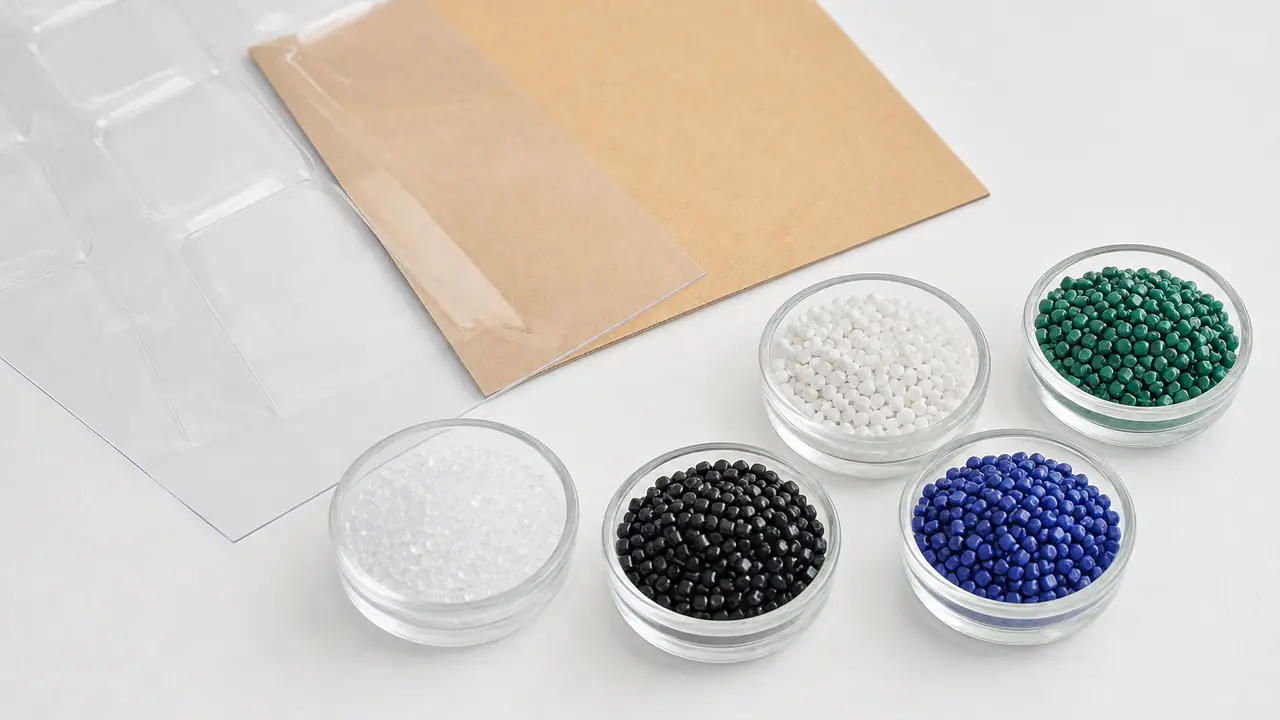
Why PP became the default
Walk through any takeout kitchen and most of the boxes, tubs and bowls on the shelf are polypropylene. That is not habit. PP is the common container plastic that combines three things a food program needs at the same time: it keeps its shape with hot food, it is light enough to ship hundreds of pieces per carton, and it can be either injection molded or thermoformed from sheet. PET is clearer, paper looks warmer and PS is stiffer, but none of them covers hot rice, curry, soup and reheating in one material.
PP is identified by resin code 5. Export soup cups from a partner plant in Guangdong carry the code 5 and a microwave marking molded into the base, which is what end users read when they decide whether a container can go into the microwave. The marking is the supplier's statement; the desk checks it on the sample before it goes into a specification.
Heat: what PP does and does not promise
The FDA rule for olefin polymers, 21 CFR 177.1520, describes polypropylene with a melting point in the range of 160-180 degrees C, together with limits on extractables. That melting range is a property of the resin, not a rating for a finished container. A thin thermoformed lid will soften and deform long before the resin melts, and a container that holds boiling soup for a short time is in a different situation from one that is reheated for several minutes.
Partner plant literature shows how suppliers state heat. One plant describes the PP of its injection molded cups as tolerating -10 to 120 degrees C and suitable for boiling water. That figure is the supplier's own statement. It is useful as a starting point and it has to be tested on your sample, at your fill temperature and your reheating time, before anyone repeats it on a listing or a carton.
Cold is the other side. PP becomes more brittle at freezer temperatures, which shows up as cracked lid corners and snapped hinges. Where a program includes frozen meals, the desk adds a freezer check at -18 degrees C followed by opening and closing the lid, as listed in the standard test items, and agrees the pass rule per order.
Clarity: the trade-off buyers notice
PP is translucent rather than glass clear. Clear PP boxes show the food, but with a slight haze that becomes more visible as the wall gets thicker. For hot food that rarely matters. For supermarket fruit, salads and desserts that sell on appearance, buyers often prefer PET, which is clearer but is used for cold food only. A common compromise is a black PP base with a clear lid, which reads well in a display and hides sauce stains on the base. See PET vs PP food packaging for the full comparison.
Gram weight and wall thickness
The weight of a container is the clearest single number on a quote, because it tells you how much resin is in each piece and therefore how stiff the walls will be. A partner plant in Huizhou, Guangdong, makes a rectangular series on one 170x115 mm footprint. The weights below are the plant's stated values for each model.
| Capacity | Outer size | Weight per piece | Typical use |
|---|---|---|---|
| 500 ml | 170x115x34 mm | 17 g | Sides, desserts |
| 650 ml | 170x115x43 mm | 18.3 g | Single portions |
| 750 ml | 170x115x51 mm | 19.6 g | Main courses, meal prep |
| 1,000 ml | 170x115x64 mm | 22 g | Noodles, larger portions |
| 1,200 ml | 217x149x60 mm | 35 g | Roast meat, family portions |
| 1,500 ml | 217x149x71 mm | 39 g | Sharing portions |
Across the category the partner plant literature covers roughly 350-3,500 ml and 7-60 g per piece. Two quotes for the same 750 ml box can differ by several grams, and that difference is the reason one box flexes in the hand and the other does not. Always compare quotes at the same stated weight, and write the weight with a tolerance into the specification so that it cannot drift down between orders.
Injection molded or thermoformed PP
PP containers come from two processes. Thermoformed boxes are formed from PP sheet: they are light, nest tightly and suit single-use takeout. A partner plant in Foshan thermoforms 650 ml, 750 ml and 1,000 ml boxes in plain, ribbed and two-compartment versions, packed 300 sets per carton. Injection molded containers are heavier for their size, hold sharp corners and thicker rims, and are the usual route for reusable meal prep and home storage. The process decides tooling cost and minimum order as much as the material does. The thermoforming and injection molding pages explain the difference.
What drives the cost of a PP container
Lidwell does not publish prices, because they move with resin and with each specification. The drivers are stable, though, and a buyer can control most of them.
- Gram weight. Resin is the largest share of a plain container, so every gram matters at volume.
- Process. Thermoformed sheet is usually cheaper per piece; injection molding costs more but gives thicker, reusable parts.
- Color. Clear, black base and white are standard; a custom color needs masterbatch matching and a minimum run.
- Print and decoration. A printed lid or sleeve adds a step and raises the minimum order.
- Mold. A stock mold costs nothing extra; a new mold adds tooling cost and a higher first order.
- Packing. Nesting decides how many pieces fit in a carton and a container load, which decides freight per piece.
Typical starting points are 1-10 mixed cartons from stock molds, 10,000-50,000 pieces per item for a printed lid or sleeve and from 50,000-100,000 pieces for a new mold, confirmed in writing for each program. See MOQ and lead time.
Documents to request for PP
For the United States, ask for a supplier declaration that the PP complies with FDA 21 CFR 177.1520 under the conditions of use that match the product, as listed in 21 CFR 176.170(c) table 1. FDA does not approve finished containers, so the wording is a declaration or a test report, never an approval. For the European Union, a declaration of compliance to Regulation 1935/2004 and Regulation (EU) 10/2011, backed by a migration report on the finished container; a resin supplier's declaration covers an intermediate material, not the box. For China, GB 4806.7-2023 applies. Documents are issued to the partner plant or your brand per project and verified by the desk; confirm the requirements with your test lab. The compliance guide lists them by market.
When the specification is ready, send the foods, temperatures, capacities and market through the quote form and the desk returns matched PP reference models with stated weights.