
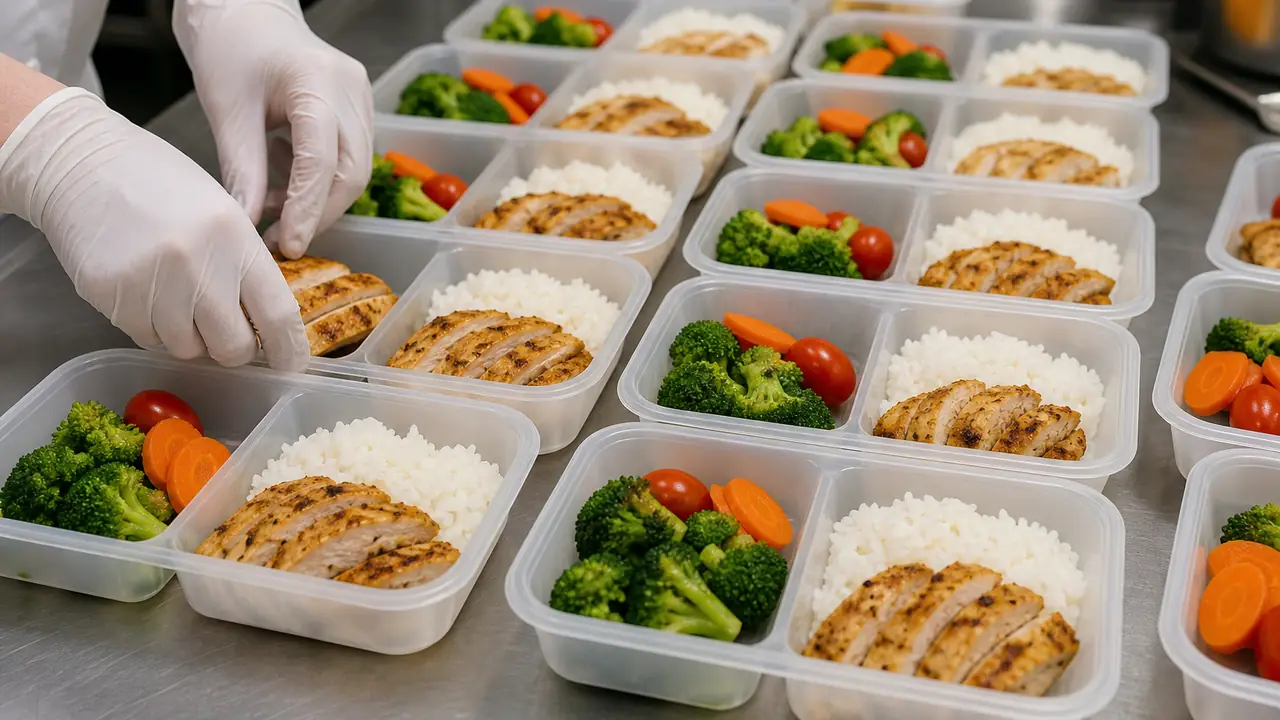
What a meal prep container has to survive
A meal prep program asks more of a container than a single takeout order. Food is portioned in a central kitchen, sealed while warm, cooled and then held chilled or frozen for days. Containers are stacked in crates and in shipping cartons, sometimes several layers deep, and travel through cold chain delivery where condensation forms every time the temperature changes. The customer then keeps them in a fridge or freezer and finally reheats the meal, often in the same container.
Each step brings its own failure. Thin PP lids can become brittle at freezer temperatures and crack at the corners when opened. Condensation fogs the lid so the customer cannot see the meal. Stacked containers press lids into bases and distort the rim. And a container marked for microwave use only with the lid vented will warp or spill if the customer heats it closed. A good specification addresses all of these before the first order.
Recommended lines and materials
Meal prep is a PP application, resin code 5, for both base and lid. PP is the material that handles hot fill, chilled storage and reheating where the supplier marks it, and it stays light enough to ship hundreds per carton. Rectangular PP food containers on a shared footprint are the core: one lid fits several depths and mixed portions stack evenly. Divided trays in clear PP separate protein, grain and vegetables so sauces do not run into each other.
Injection molded containers are worth considering for subscription programs that collect and reuse containers, because thicker walls keep shape through many cycles. Thermoformed boxes suit single-use delivery. PET is not used where the meal is reheated, and PVC has no place in a meal prep container.
Reference sizes
| Item | Capacity | Outer size | Typical portion |
|---|---|---|---|
| Rectangular PP box | 650 ml | 170x115x43 mm, 18.3 g | Light meal, breakfast |
| Rectangular PP box | 750 ml | 170x115x51 mm, 19.6 g | Standard main meal |
| Rectangular PP box | 1,000 ml | 170x115x64 mm, 22 g | Large portion |
| Thermoformed two-compartment box | 1,000 ml | Per spec sheet | Main plus side |
| Three-compartment PP tray | 1,000 ml | 218x188x42 mm | Protein, grain, vegetables |
| Five-compartment PP tray | 1,500 ml | 232x232x47 mm | Bento-style set |
The compartment trays carry a molded microwave marking on the lid as stated by the supplier; that marking is confirmed in a heating test on the sample before it appears on your label. See the sizing guide for portion planning.
Checks the desk agrees per order
- Opening after freezing at -18 degrees C, to catch brittle lids and cracked corners.
- Microwave heating per supplier marking, with the lid removed or vented as marked.
- Lid fit and opening force before and after chilling.
- Tilt and inversion with liquid for sauced dishes.
- Stacking of filled containers and of the outer carton for cold chain transport.
- Size, gram weight and odour against the approved sample.
- Third-party migration test with the simulants your market requires.
Counts and pass criteria are a stated working default, confirmed per order. Results are written as leak-resistant in the standard tilt test, confirmed per order, never as an absolute claim. Condensation can be reduced by venting design and lid profile, but a fogged lid is normal in cold chain and is worth explaining on the customer label.
Documents
For the US, a supplier declaration that the PP complies with FDA 21 CFR 177.1520, with the conditions of use stated for hot fill and reheating. For the EU, a declaration of compliance to Regulation 1935/2004 and Regulation (EU) 10/2011, backed by overall and specific migration tests at the time and temperature the meal actually sees. For China, GB 4806.7-2023. A resin declaration alone does not cover the finished container, so the report should be on the finished part. Documents are issued to partner plants or to your brand per project and verified by the desk; the compliance guide lists what to request.
How to brief a meal prep program
- Describe the menu and the portion sizes in grams or millilitres.
- State the cycle: hot fill or cold fill, chilled or frozen, how many days.
- Say how customers reheat and whether containers are returned.
- Give weekly volume, number of SKUs and the destination market.
- Note print needs: lid print, sleeves or labels for nutrition data.
Send it through the quote form. Delivery brands selling direct can also see DTC brands for sets and unboxing.