
What the Green Guides are
The Green Guides, published by the US Federal Trade Commission at 16 CFR part 260, explain how the FTC applies the law against deceptive advertising to environmental claims. They are guidance rather than a product standard, but they describe how the FTC reads claims on labels, packaging, listings and websites, and they are the reference point for brands, retailers and marketplaces in the US. They cover general environmental benefit claims, degradable claims, compostable claims, recyclable claims and others.
For container buyers two sections matter most: 260.8 on degradable claims, which includes biodegradable, and 260.7 on compostable claims. This note summarises how those sections work for food containers and storage boxes. It is not legal advice; confirm the wording for a specific product with your counsel.
Degradable and biodegradable: 16 CFR 260.8
Under 260.8, a marketer making an unqualified degradable claim, and biodegradable is a degradable claim, should have competent and reliable scientific evidence that the entire item will completely break down and return to nature within a reasonably short period of time after customary disposal. The guides then add the point that decides most packaging cases: it is deceptive to make an unqualified degradable claim for items that are customarily disposed of in landfills, incinerators or recycling facilities, because those environments do not allow complete decomposition within a reasonably short time. The guides treat one year after customary disposal as the outer limit for an unqualified claim for items entering the solid waste stream.
Takeout containers, cutlery and storage boxes are, in practice, disposed of in the solid waste stream. A plain biodegradable claim on them is therefore very hard to support, whatever the material. Qualified claims are possible, but the qualification has to be clear, close to the claim and backed by evidence for the conditions it names, and time-bound statements such as a stated number of days need evidence for that exact time and setting.
Compostable: 16 CFR 260.7
A compostable claim says the item will break down into usable compost in a safe and timely manner in an appropriate composting setting. Under 260.7, marketers should qualify the claim where municipal or institutional composting facilities are not available to a substantial majority of the consumers or communities where the item is sold, and should not imply that an item can be composted at home if it cannot. In practice that means words such as commercially compostable where such facilities exist, and the evidence should be a certification to a recognised standard. The desk's rule is simple: compostable wording only where the exact item is certified to EN 13432 or ASTM D6400, with the certificate number on file; see compostable certification.
Claims and what they need
| Claim on pack or listing | Position under the Green Guides | What the desk uses instead or requires |
|---|---|---|
| Biodegradable, unqualified | Deceptive for items customarily landfilled or incinerated (260.8) | Not used |
| Degradable within a stated time | Needs evidence for that time and setting | Not used without test evidence for the exact item |
| Compostable | Needs evidence; qualify where facilities are limited (260.7) | Only with EN 13432 or ASTM D6400 certificate number |
| Green or similar general benefit wording | Broad claims are hard to substantiate | Specific, provable statements only |
| Lower plastic content | Specific and comparative, needs a basis | Used with the material named, such as starch and PP blend |
The starch-based container case
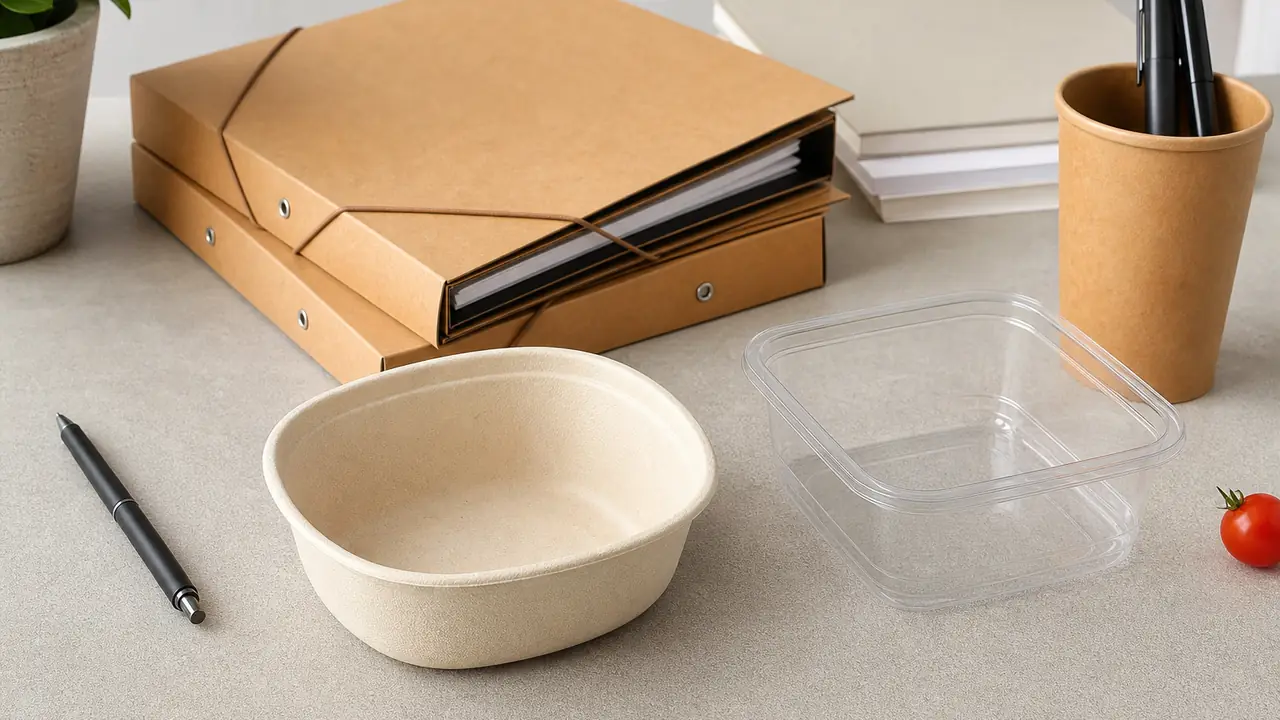
Starch-based containers are where this matters most. The partner plant literature for the starch-based range describes it only as corn starch and files it under PP thermoforming. The desk therefore treats it as a starch and PP blend, with the ratio to be confirmed per spec, and describes it as such: a starch and PP blend container with lower plastic content and a cream, matte look. It is not described as biodegradable or compostable, because a blend containing PP is not shown by the available evidence to break down completely after customary disposal, and no compostable certificate applies to it. If a buyer wants compostable wording, the route is a different item that holds a certificate for the exact model.
The same caution applies to molded fibre and bagasse. They are plant fibre products and often compostable where certified, but in the US they also face state PFAS rules, so the claim and the PFAS statement belong in the same file; see PFAS in paper food packaging.
Wording the desk uses
- Made with food contact grade PP per supplier declaration.
- Starch and PP blend container with lower plastic content.
- Commercially compostable where facilities exist, certified to EN 13432, certificate number on file, only for certified items.
- Recyclable only with the qualification the recyclable section of the guides requires for the market.
- Resin identification code shown as a material code, not as a recycling promise.
How the desk reviews a claim
- Collect every claim from the lid, sleeve, carton, listing and images in one list.
- Name the material of each part the claim refers to.
- Match each claim to a document: declaration, test report or certificate with its number.
- Strike or qualify any claim the evidence does not support.
- Send the marked list to the brand and its counsel before artwork is approved.
Doing this before the print proof is cheap. Doing it after the cartons are printed means scrapping packaging or relabelling stock.
Other markets
The Green Guides are a US instrument. In the EU, claims are assessed under consumer protection law and material rules, and in China GB/T 41010 covers marking for degradable plastics. A claim that works in one market is not automatically safe in another, so the desk reviews wording per market and records the evidence in the program file. Documents and certificates are issued to partner plants or to your brand per project; Lidwell does not hold them.
Next steps
The sustainable packaging guide sets out the material routes, and starch-based containers shows the reference models. Printed sleeves and lids carrying claims have their own minimums, typically 10,000-50,000 pieces per item, confirmed in writing per program; see MOQ and lead time. Send your draft wording with the item list through the quote form and the desk will mark what the evidence supports.