
What a lid has to do
A food container lid has several jobs at once: keep the food in during handling and transport, keep contamination out, stay on when the box is tilted or squeezed, open without effort or mess, and in many cases stack, vent, show the food or carry a brand. Different lid types balance these jobs differently, and the right choice depends on the food, the line speed, the journey and whether the container is single-use or reused.
The lid is also where the cost of a container program hides. A kitchen that uses four box depths with four different lids carries four lid stocks; one that uses a shared footprint carries one. Lids are often molded or formed separately from bases, sometimes in a different plant, so the lid is also where fit problems start. Choosing the lid type early, before capacities are fixed, saves trouble later.
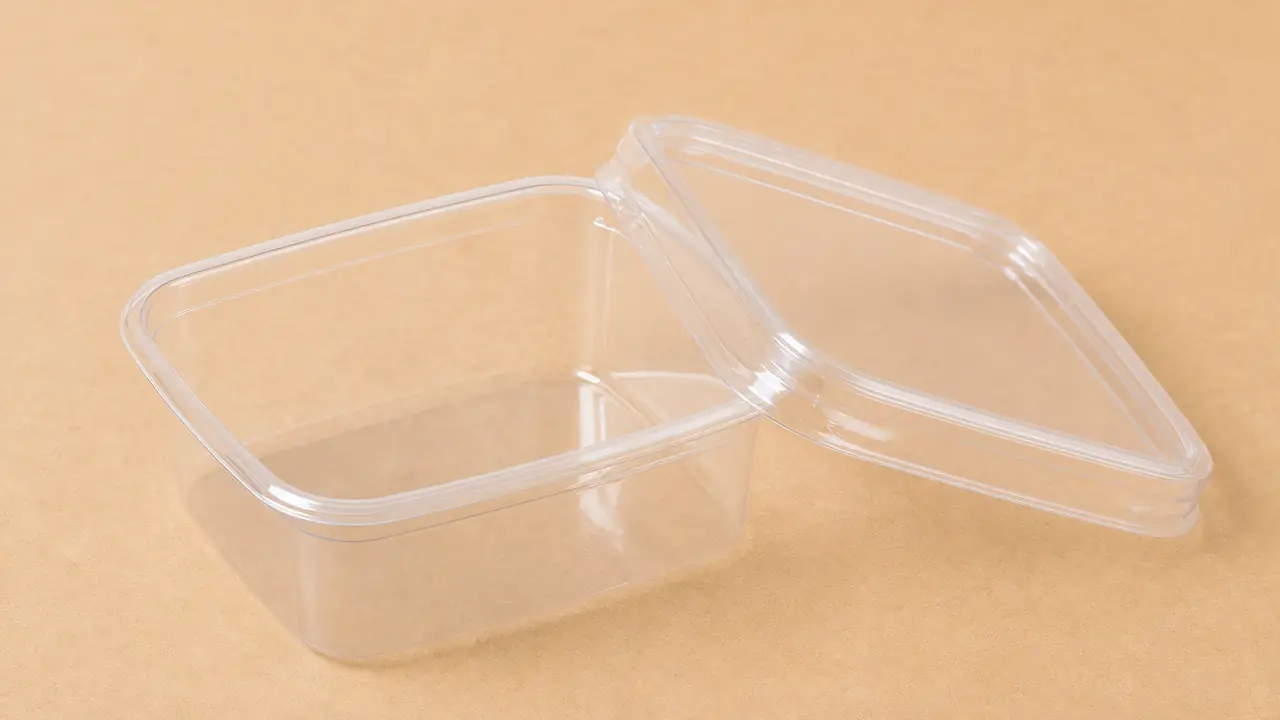
Snap lids
The snap lid is a separate lid whose rim clicks over the rim of the base. It is the standard for takeout boxes, soup cups and tubs. A separate lid seals more evenly than a hinged one and allows one lid to close several bases on the same footprint, as with the partner series at 170x115 mm from 500 to 1,000 ml. Snap lids can be flat for stacking, domed for salads and noodles, and fitted with a vent tab for steam. Their weak point is the tolerance between two parts that may come from different cavities or tools: too tight and they crack or are hard to open, too loose and they pop off.
Hinged lids and clamshells
A hinged lid is formed in one piece with the base and closes with a click lock at the front. It is fast to close on a busy line, cannot get lost and suits burgers, sandwiches, bakery, salads and fruit. Clear clamshells are typically PET, cold use only. Paper clamshells and click-lock boxes in kraft or white card come from paper packaging plants; reference click-lock boxes run from 350 to 2,880 ml. The hinge is the weak point: thin sheet cracks after repeated opening, and cold makes it worse. A repeated open-and-close check on the sample is a simple way to judge hinge life.
Press-fit and plug lids
A press-fit or plug lid pushes into the opening of the base rather than snapping over it. It is common on deli tubs, sauce cups and some soup containers. A good plug lid seals well against liquids because pressure from inside pushes it against the wall, but it can be hard to open with wet or gloved hands. Pull tabs help. For sauce and condiment cups, which partner plants pack 2,000-5,000 per carton, plug or snap lids are matched to the cup diameter.
Locking lids for storage
Reusable food storage containers often use lids with two or four hinged clips that press the lid down onto a silicone seal. These are injection molded, heavier and designed for many cycles. Vacuum containers go further: a lid with a one-way valve, a seal and a manual or electric pump draws air out. A public listing size for a 1.4 L square vacuum container is 233x156x90 mm, sold in sets of 0.5-2.0 L pieces. The seal and clips are the parts that wear, so they are worth checking in a repeated cycle test. See vacuum food containers.
The types side by side
| Lid type | Usual material | Best suited to | Main check |
|---|---|---|---|
| Snap lid | PP, or PET for cold | Takeout boxes, soup cups, tubs | Fit, opening force, tilt test |
| Hinged clamshell | PET, PP or paperboard | Bakery, sandwiches, fruit | Hinge flex, click lock |
| Press-fit or plug | PP | Deli tubs, sauce cups | Seal with liquid, opening |
| Clip-locking | PP or copolyester with silicone seal | Reusable food storage | Clip cycles, seal |
| Vacuum valve | PP or copolyester, silicone seal | Vacuum storage sets | Vacuum hold, valve |
Lid materials and heat
The lid often sets the temperature limit of the whole container. A PP base with a PP lid can be used with hot food and, where the supplier marks it, reheated, usually with the lid removed or vented. A PP base with a clear PET lid is popular for display, but PET is used cold only, so the set must be labelled for cold use. PVC is not used for food container lids in this range; clear PET or PVC appear only as windows and lids on paper and gift boxes that do not touch hot food. For more on materials see the container material guide.
Fit, opening force and leak resistance
Lid fit depends on the rim profile, wall thickness, resin and the tolerance between parts, and it changes with temperature: a lid that fits at room temperature can loosen on a hot box or become brittle in the freezer. The desk agrees a short set of checks per order: lid fit on a sample of bases from production, opening force by hand, a tilt and inversion test with liquid, and where relevant a freezer check at -18 degrees C followed by opening. Containers are described as leak-resistant in that test, confirmed per order, never with an absolute claim. See lids and seals and container lid cracking.
Branding on lids
The lid is the most visible surface of a takeout container, so it is where most brands go first. Options include printed lids, embossed logos in a custom mold, labels and paper sleeves or bands. Printed lids typically start at 10,000-50,000 pieces per item and a new mold with an embossed logo from 50,000-100,000 pieces, confirmed in writing per program; a sleeve or label on a stock lid is the lowest-quantity route. See printing and labeling.
Choosing a lid
- Decide whether the food is hot, cold or reheated, and pick a lid material that allows it.
- Choose separate or hinged by line speed and whether the lid must fit several bases.
- Choose flat or domed by stacking and food height.
- Agree fit, opening, tilt and freezer checks on the sample.
- Decide the branding route and its starting quantity.
Send the bases you are considering and how the food travels through the quote form; the desk matches lids from partner plants and lists the checks with each. Starting quantities and lead times are on MOQ and lead time.