
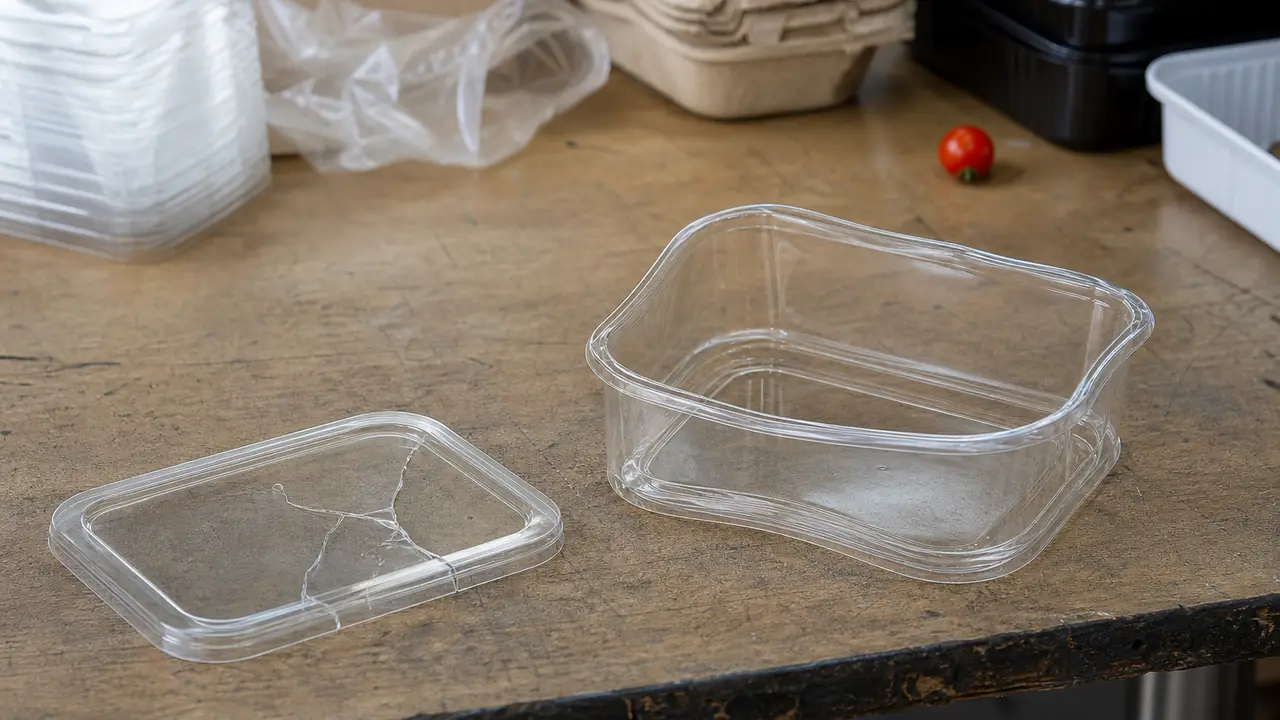
Where lids crack and what that tells you
A lid fails in a small number of places, and the location is the first clue. Cracks at the corners of a rectangular lid usually mean the sheet was stretched too thin in the deepest part of the forming draw. Cracks along the snap rim point to a lid that is too tight for its base, so every closing bends the plastic beyond what it can recover from. Splits across a hinge on a clamshell come from repeated opening on thin or brittle material. Star-shaped cracks in the middle of a flat lid usually mean impact while cold: a dropped stack in a freezer room or a carton thrown onto a truck in winter.
Before anyone changes the material, the desk asks for photos of ten failed lids, the date code or batch number and a short note on how the containers were used. That small set is usually enough to separate a material problem from a fit problem or a handling problem.
Material: PP, PET and why the grade matters
Most takeout lids in the partner plant ranges are PP, thermoformed from sheet or injection molded. PP tolerates heat well, which is why it is used for hot food and for lids that are removed before microwave use where the supplier marks it. Its weakness is cold impact. Standard PP becomes stiffer and more brittle as it gets colder, so a lid that flexes easily at room temperature can snap when it comes out of a freezer. Plants that sell into frozen food or meal prep often use a PP grade with better cold impact behaviour; the grade is named on the supplier declaration and confirmed per order.
Clear PET lids crack for a different reason. PET gives excellent clarity for cold display and fruit, but it is stiffer than PP and has little give at a tight rim. PET is for chilled and room temperature use only, never for heating. If a PET lid is matched to a PP base, the two materials move differently with temperature and the fit can change between the cold room and the shop shelf. The container materials page sets out where each resin fits.
Gauge and gram weight
Gram weight is the fastest proxy for wall thickness. Reference models from a partner plant in Huizhou show how weight rises with depth on the same 170x115 mm footprint: 17 g for the 500 ml box, 18.3 g for 650 ml, 19.6 g for 750 ml and 22 g for 1,000 ml. When a buyer pushes for a lower unit cost, the easiest lever for a plant is to run thinner sheet, and the lid is usually where the saving shows up first. A lid that is a gram or two lighter than the approved sample is worth investigating before the cartons are sealed.
Thinning also happens inside a single lid. In thermoforming the sheet stretches most where the draw is deepest, which is usually the corners and the rim channel. A lid can meet its total gram weight and still be too thin at one corner. Cutting a sample lid across the corner and comparing it with the golden sample is a simple check; see thermoforming for how draw depth and sheet gauge interact.
Cold handling and the freezer
Freezer use is the single biggest multiplier of lid complaints. A container that passes every room temperature check can fail when a customer pulls a frozen lid off with a thumb at one corner. The desk runs a freezer check on samples where the brief includes frozen storage: the filled container is held at -18 C, then the lid is opened and closed and the container is dropped from an agreed height. Counts and pass criteria are a stated working default and are confirmed per order.
Shipping in winter has the same effect without anyone using a freezer. Cartons in an unheated container or warehouse can reach low temperatures for days. If cartons are dropped or stacked carelessly when cold, lids at the bottom of the stack can crack before they reach the buyer. Packing and handling are part of the fix; see packaging and palletizing.
Fit between lid and base
A lid that is too tight cracks slowly; a lid that is too loose leaks. Plants tune the rim fit when the mold is first run, and the approved sample sets the opening force. Problems start when lids and bases come from different molds, different plants or different production dates. A base from a new mold cavity can be a fraction larger, and the matching lid then has to stretch more on every closing. Over several openings the rim develops white stress marks and then a crack.
Mixed sourcing is common in takeout ranges, where one lid closes several depths. That is efficient, but only if every base in the series uses the same rim. The desk checks lid fit across every depth in the series on the sample, not only on one size. The lids and seals page explains snap, press-fit and hinged closures in more detail.
Diagnosis table
| Symptom | Likely cause | Check | Fix |
|---|---|---|---|
| Cracks at lid corners | Sheet thinned at deep draw | Cut corner, compare with golden sample | Thicker sheet or revised draw depth |
| White marks, then cracks on the rim | Lid too tight for base | Opening force across all depths | Retune rim fit, single rim per series |
| Hinge splits on clamshells | Thin or stiff hinge material | Repeated opening on samples | Hinge redesign or different sheet |
| Star cracks after freezer use | Cold impact on standard PP | -18 C hold, open, close and drop | Grade with better cold impact, per declaration |
| Cracks found on arrival | Cold transit and stack damage | Inspect bottom cartons, carton strength | Stronger cartons, corner protection, handling marks |
| Lighter lids than approved | Gauge reduced in production | Weigh lids at inspection | Weight tolerance written into the order |
Preventing it in the order
- State the use: hot fill, reheating, chilled display or frozen storage. The material and grade follow from it.
- Approve a golden sample and record the lid gram weight and opening force.
- Write a weight tolerance for lids and bases into the purchase order.
- Test lid fit on every depth that shares the lid.
- Include freezer and drop checks in the sample stage if frozen storage is part of the brief.
- Have the lid weight, fit and a sample freezer check repeated at pre-shipment inspection.
None of these steps adds much cost. Most lid complaints the desk sees trace back to a missing line in the order, not to a bad plant. The quality control page shows where each check sits in the program.
When the answer is a different container
Sometimes the lid is fine and the container is wrong for the job. A PET clamshell used for hot food, a thin stock lid used in a freezer program or a lid shared across bases from two plants will keep failing however carefully it is inspected. In those cases the desk proposes a different stock model or, for larger programs, a custom lid. Typical starting quantities run from a few cartons on stock molds to 10,000-50,000 pieces per item for printed lids, confirmed in writing per program; see MOQ and lead time. Send photos and the use case through the quote form and the desk will come back with a shortlist.