
What this line covers
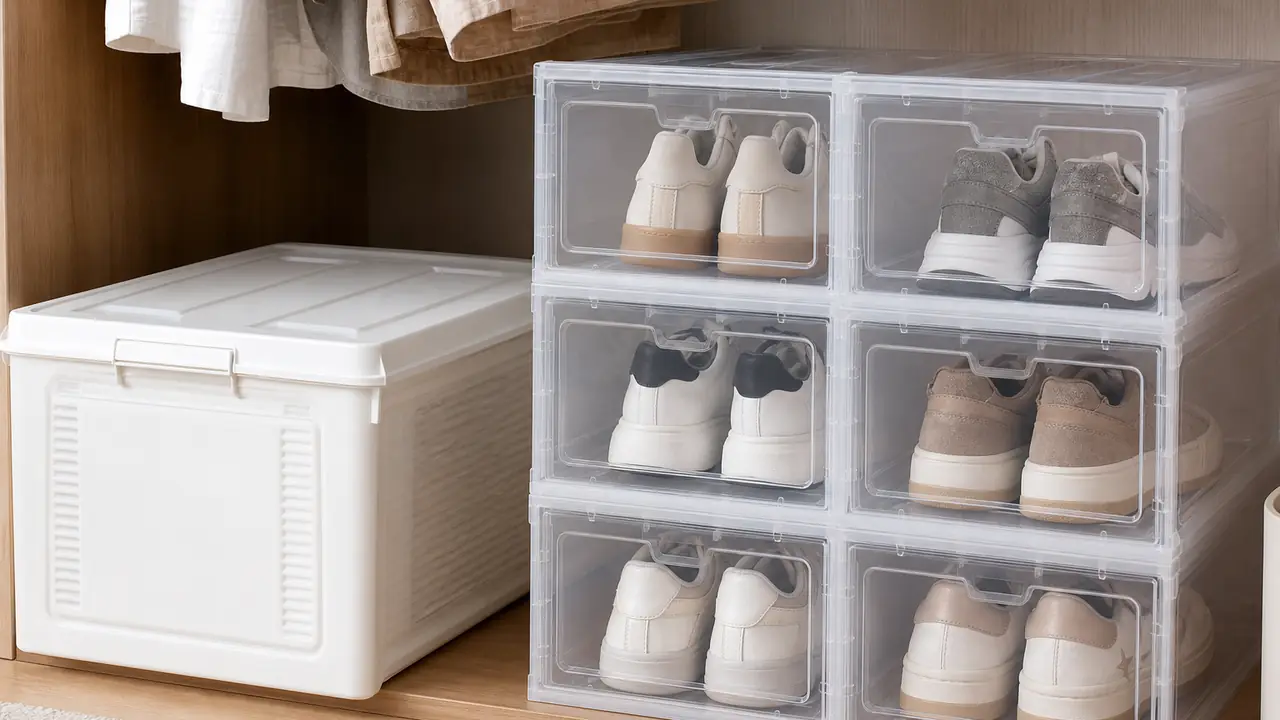
Shoe and clothes storage boxes keep footwear, folded clothes and accessories dust-free while letting the owner see what is inside. They are sold in multi-packs on marketplaces and in home stores, and they live stacked in a wardrobe, under a bed or by the front door, so stacking strength and door design matter more than anything else. The line includes folding clear shoe boxes with a lift lid or drop-front, rigid boxes with a magnetic flip door, wider boxes for boots and clothes, and matching sets that build a wall of storage.
The reference on the cut sheet is a public listing reference size, not a partner plant model: a folding clear shoe box at 330x230x140 mm, about 10.6 L, which fits shoes about 31 cm long and 13 cm high. Rigid boxes with a magnetic front door run from about 34x25x19 cm to 38x30x24 cm, roughly 15-27 L. No partner reference model exists yet for this line, so the desk measures the partner plant's sample before an order is confirmed.
Formats and reference sizes
| Format | Outer size | Volume | Fits |
|---|---|---|---|
| Folding clear shoe box | 330x230x140 mm | About 10.6 L | Shoes up to about 31 cm long, 13 cm high |
| Rigid magnetic door box, small | About 340x250x190 mm | About 15 L | Trainers, high-tops |
| Rigid magnetic door box, large | About 380x300x240 mm | About 27 L | Larger shoes, ankle boots, folded clothes |
Shoe fit is the number customers check. A listing should give the outer size, the inner size and the longest shoe that fits with the door closed, because the door or lid takes up depth. For clothes, the useful figure is how many folded items a box takes at a given height. The clothes storage box sizing note shows how to state it.
Doors, ventilation and stacking
A box with a lift lid has to be taken off the stack to open; a drop-front or flip door opens in place, which is why front-door designs dominate stacked shoe walls. Magnetic doors need magnets set firmly in their pockets and a hinge that does not loosen. Shoes also need air: vent holes or slots in the side walls reduce trapped moisture and odor, but too many weaken the wall. The note on shoe box ventilation and doors sets out the options.
Stacking load decides whether a column of boxes stays square. Folding boxes rely on how well the walls lock; rigid boxes rely on wall thickness and stacking lugs that key one box into the next. See stackable storage load for how to specify it.
Material by part
Listings describe these boxes in PP, PET or ABS with PP, and the cut sheet names the material of each part. PP (resin code 5) suits folding walls and hinges because it flexes without cracking. Clear PET (code 1) gives a see-through door or wall with more toughness than PS. ABS is used for stiff frames, often combined with PP or a clear panel. PVC is not used for these boxes. Where a supplier claims a material, the desk asks for a material declaration and checks it against the sample.
Packing and channel
Shoe boxes are usually sold in multi-packs, so the retail pack is part of the product. Folding boxes ship flat in a color box and are assembled by the customer; rigid boxes ship assembled or flat-packed for snap assembly. Either way the carton has to survive a fulfilment centre without crushing corners. The desk agrees the set size, the color box and the master carton with the partner plant; see packaging and palletizing and the marketplace sellers page.
Private label and ordering
Brands typically change the frame color, the tint of the door, the logo on the door or label slot and the retail pack. A new box size or door mechanism needs a new mold, made in the Taizhou cluster in many programs. Typical starting quantities for storage lines are about 1,000-3,000 pieces per item, depending on size and mold, confirmed in writing for each program; reference ranges are on MOQ and lead time. Send the shoe sizes or clothes you want to store and the set size through the quote form.