
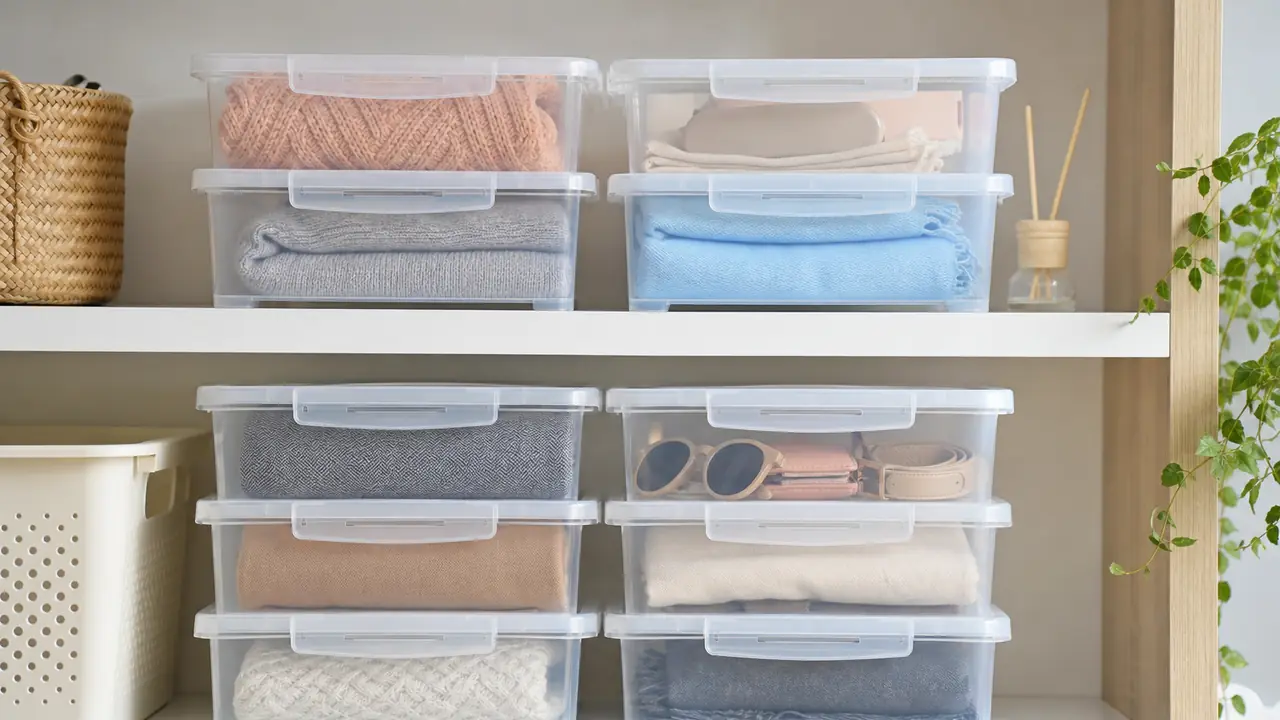
Litres sell, millimetres fit
Storage box listings lead with a volume: 30 L, 45 L, 60 L. Customers, however, have a shelf, a wardrobe floor or a gap under the bed with fixed dimensions, and a box that is two centimetres too tall for the gap is useless whatever its volume. For a seller, the most effective way to reduce returns in this category is to state three sizes clearly: outer size, inner size and, for folding boxes, folded height. Volume follows from those, not the other way round.
Lidwell has no partner plant reference model for this line yet. The figures below are public listing reference sizes, used to describe the category and confirmed against a physical sample before an order.
Reference sizes across the category
| Format | Listed outer size | Volume | Typical position |
|---|---|---|---|
| Folding clear shoe box | 330 x 230 x 140 mm | About 10.6 L | Closet shelf, wardrobe floor |
| Rigid flip-door box | About 34 x 25 x 19 to 38 x 30 x 24 cm | About 15-27 L | Closet shelf, stacked column |
| Folding storage crate | About 440 x 330 x 230 mm, folds to about 47 mm | 30 L | Shelf, wardrobe, seasonal storage |
| Folding storage crate, large | About 525 x 355 x 300 mm | 45 L | Wardrobe floor, top of wardrobe |
Across folding boxes, inner dimensions are typically about 2-4 cm smaller than outer dimensions, and folded heights typically run 4-9 cm. Those two figures belong on every listing.
Closet shelves
Closet shelves limit depth and height. Depth is usually the tighter limit, because shelves in built-in wardrobes are often shallower than a freestanding unit, and a box that overhangs the front edge looks untidy and can tip. Height between shelves sets how tall a box can be with room to lift it out. A practical rule for a listing is to give the box size and ask the customer to allow a few centimetres of clearance above the box for the hand and the lid. Boxes with front doors, like the flip-door shoe boxes, need clearance in front for the door to open.
Wardrobe floors and the top of the wardrobe
Wardrobe floors take the larger formats, such as 45 L crates, because there is depth and the box is reached from above or slid out. The top of a freestanding wardrobe is another common place for seasonal clothes and bedding, and there the limit is the gap to the ceiling and the reach of the user. Lids matter in both positions: dust settles on open boxes, and a box that stacks with its lid on uses the height better.
Under beds: measure the clearance
Under-bed storage is where sizing errors are most common, because bed clearances vary widely between frames and the box has to slide in and out along the floor. There is no single standard height to design for. The honest approach is to ask the customer to measure two figures, the clear height from the floor to the lowest part of the frame or slats, and the depth from the edge of the bed to any central leg or rail, and to give the box outer height including the lid and any wheels next to those figures on the listing.
- Measure the clear height from floor to the lowest point of the frame.
- Measure the usable depth to the first leg, rail or support.
- Subtract a little for sliding and for lifting the lid, if the lid lifts.
- Compare with the box outer height including lid and wheels.
- Choose a box with a sliding or side-opening lid if the clearance is tight.
Flat boxes for under beds are usually wide and shallow. Wheels help on hard floors; on carpet, a smooth base slides better. A rigid base is essential, since a long, low box filled with clothes flexes in the middle when lifted.
For a range, two under-bed heights are usually enough: one low box for tight frames and one taller box for beds with more clearance. Keep the same footprint for both, so the lid is shared and the boxes can sit side by side under one bed. Give each height a clear name on the listing that includes the outer height in centimetres and inches, so customers compare the figure that matters rather than the litre count alone.
Volume and what fits
Volume is useful for comparing boxes, but clothes do not fill a box like liquid. Folded clothes stack in layers, and a box whose inner size matches a folded garment holds more in practice than a slightly larger box that leaves awkward gaps. For buyers designing their own range, it helps to plan inner dimensions around a folded garment and a pile height, then check the result on the sample with real clothes. Vacuum bags inside a box change the picture again, compressing bulky items such as duvets.
Materials and lids
Clothes and shoe boxes in public listings are described as PP, PET or ABS with PP. PP is the common choice for larger boxes and folding crates because it is tough and suits hinges. Clear PET shows the contents well in smaller boxes. Rigid boxes with doors often use an ABS frame. Lids are either loose, hinged or sliding; a lid that locates the box above in a stack keeps columns straight. For how much a stack can carry, see stackable storage load, and for folding crates see collapsible box hinge design.
Packing and quantities
Large boxes are mostly air in a carton, so freight decides much of the landed cost. Folding crates ship flat; rigid boxes ship nested, with lids packed separately. HS classification for general storage boxes is usually under 3924.90, to be confirmed with your customs broker. Storage lines typically start from 1,000-3,000 pieces per item, depending on size and mold, with custom work typically 15-30 days, confirmed in writing for each program on MOQ and lead time. Plants for this line sit mainly in the household plastics clusters of Taizhou and Ningbo. See the storage box buying guide, then send the target positions and sizes through the quote form.