
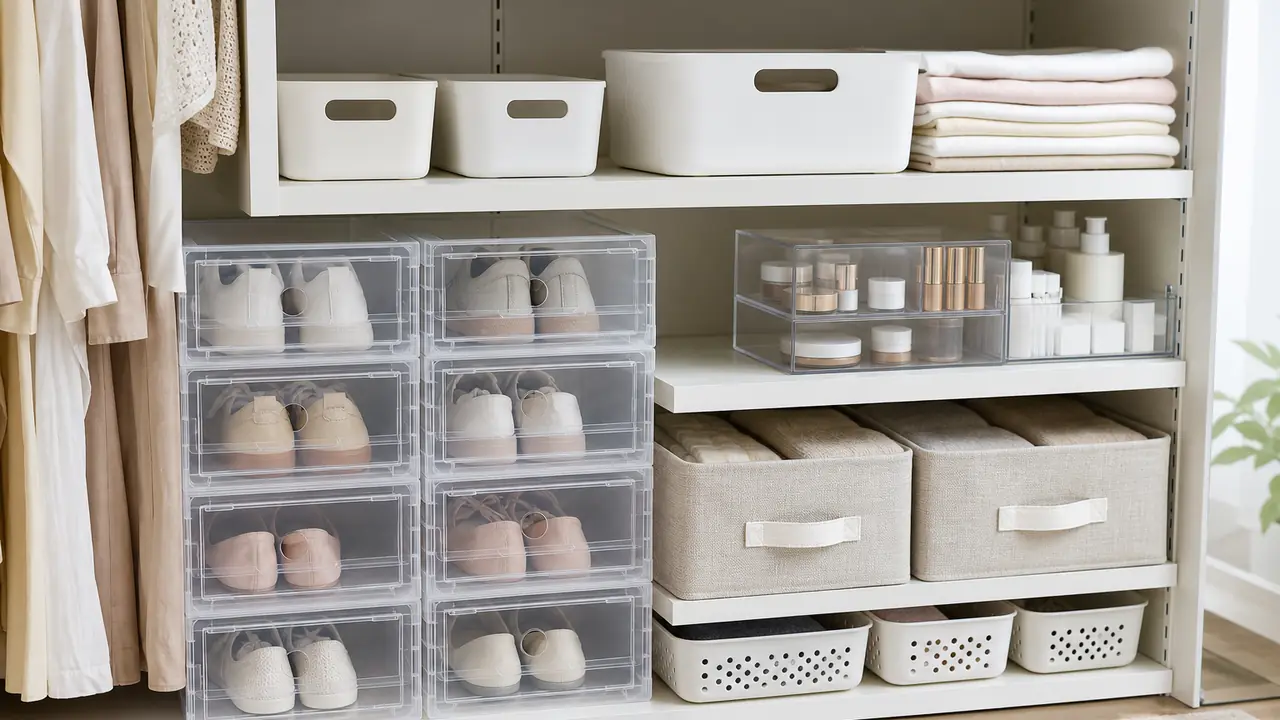
What a storage box has to survive
Home organization boxes do not touch food, but they face their own hard tests. A shoe box in a closet may sit eight high with the bottom box carrying the weight of all the others. A clothes box is pulled out of an overhead shelf by one handle. A collapsible box is folded and unfolded many times, so its hinges take the wear. A vanity organizer sits next to a sink and is wiped with cleaning products. A desk tray goes into a drawer whose inside height leaves only a few millimetres to spare.
Most returns in this channel come from three problems: the box does not fit the space the buyer measured, the box bows or cracks under stacking load, or a clear box arrives scratched or cracked because the shipping carton was too weak. The listing dimensions are therefore part of the product. Outer size, inner size and folded height have to be stated precisely and checked on every lot.
Recommended lines and materials
Collapsible storage boxes are PP with molded hinges, which flex repeatedly without cracking when the wall is right. Shoe and clothes boxes come in PP, PET or ABS with PP, in folding clear versions and rigid boxes with magnetic drop-front doors. Cosmetic organizers are usually clear PS, acrylic (PMMA) or PET; soft clear PVC pouches appear only as small-item packaging, which is a non-heated, non-food use. Desk organizer boxes are PS, PP or acrylic trays and drawers.
Most of these lines come from injection molders in the Taizhou and Ningbo cluster in Zhejiang, close to the Huangyan mold makers, which matters if a retailer wants its own stacking footprint or a molded logo.
Reference sizes
| Item | Material | Outer size | Note |
|---|---|---|---|
| Collapsible box, 30 L | PP | about 440x330x230 mm | Folds to about 47 mm |
| Collapsible box, 45 L | PP | about 525x355x300 mm | Larger closet size |
| Folding clear shoe box | PP or PET | 330x230x140 mm | About 10.6 L, shoes to about 31 cm |
| Rigid drop-front shoe box | ABS with PP | 34x25x19 to 38x30x24 cm | About 15-27 L |
| Drawer-style cosmetic organizer | PS or acrylic | about 318x213x92 mm | Countertop |
| 7-compartment desk tray | PS or PP | about 359x232x52 mm | Drawer insert |
No partner plant reference models exist yet for these lines, so the sizes come from public listings as category references. Inside dimensions of collapsible boxes are typically 2-4 cm smaller than the outside, which matters for buyers measuring what goes in. The desk confirms every dimension on the physical sample before it goes onto a listing. See the storage box buying guide for sizing from a shelf.
Checks the desk agrees per order
- Outer, inner and folded dimensions against the approved sample.
- Stacking load on filled boxes, and on the outer carton for transport.
- Repeated fold and unfold of hinges on collapsible boxes.
- Door and magnet function on drop-front boxes; drawer slide on organizers.
- Drop test of the packed retail unit.
- Clarity, surface scratches and odour.
- Print adhesion and rub on labels or printed sleeves.
Counts and pass criteria are a stated working default, confirmed per order. Strength is described from the measured test result on the spec sheet, never with absolute wording that no test can support, and the result is repeated on each lot before shipment.
Documents and packing
Storage boxes are not food contact items, so the core documents are a material declaration per part and the product checks agreed with the buyer for the destination market. If a box is also sold for food, it moves to the food contact route with a declaration and migration report. Packing drives landed cost here: collapsible boxes ship folded and nested shoe boxes ship flat, while rigid boxes ship as air. The desk compares cartons per container for each option; see packaging and palletizing.
How to brief a storage program
- Name the space: closet shelf, entryway, vanity, drawer or under-bed.
- Give the inside dimensions of that space and what goes in the box.
- State how high boxes will stack and whether they fold.
- Say whether you need retail packaging, barcodes or a molded logo.
- Give volume per SKU and the channels you sell through.
Send it through the quote form. Marketplace sellers can also see marketplace sellers for listing sizes and shipping cartons.