
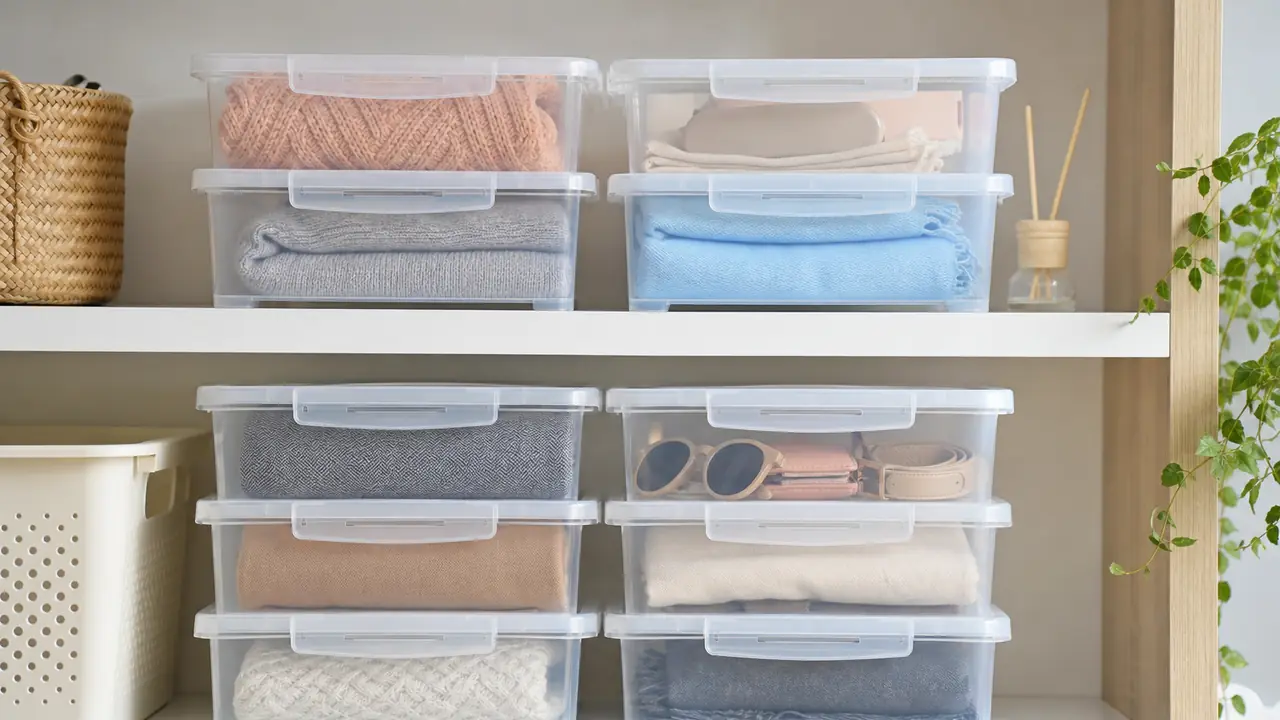
Why stackable needs a number
A storage box that is sold as stackable is making a promise about what happens to the bottom box in a column. If the lid of the bottom box dishes, the column leans; if the walls bow, the lid pops off; if the box cracks, the customer loses trust in the whole range. Yet many specifications say only stackable. Without a stated load, the plant designs to its own idea of normal use, and the buyer learns the real limit from reviews. The fix is to set a load from the intended use, design the box to carry it and test it on the sample.
No public standard fixes a stacking load for household storage boxes. The method below is how the desk sets a stated working default for a program, confirmed in writing per order.
Step one: work out the real load
The load on the bottom box is the weight of everything above it: the boxes, their lids and their contents. Three questions set it. How many boxes high will the customer stack, given the shelf or room height? What will be inside, clothes, shoes, books, tools or food? And is the column static on a shelf, or moved, as in a garage or a warehouse? The answers multiply: a column of light boxes of clothes on a shelf is a very different case from a column of boxes of books on a garage floor.
| Factor | Question to answer | Effect on the load |
|---|---|---|
| Stack height | How many boxes high in normal use? | Each layer above adds a filled box |
| Contents | Clothes, shoes, books, tools, food? | Dense contents raise the load sharply |
| Time | Days or months in the stack? | Plastics creep under a constant load |
| Temperature | Heated room, cold garage, sunny window? | Warmth softens, cold makes brittle |
| Handling | Static, or moved and knocked? | Shocks add to the static load |
Write the result as a test load for the bottom box, with the stack height and contents it represents. Add a margin above the calculated load, agreed with the plant, so normal variation between boxes does not cause failures.
Time and temperature: creep
Plastics under a constant load slowly deform over time. This is called creep, and it is why a box that holds a stack for an hour can bow after a season. Warmth speeds creep, so a column next to a radiator or in a hot loft behaves worse than the same column in a cool room. Cold reduces creep but makes plastics more brittle, so a garage stack is more likely to crack if it is knocked. A short load test on a sample tells you about strength; a longer test, held for days, tells you about creep. For a program that sells on heavy-duty stacking, both are worth doing.
Design features that carry the load
Load travels down through the walls, so what matters is how the walls and lid are shaped, not just how thick they are.
- Corners: the corners carry most of the load. Rounded, thickened or ribbed corners are the strongest part of a box.
- Ribs: vertical ribs on the walls stiffen them against bowing without adding much weight.
- Lid: a flat lid dishes under load; a lid with ribs or a raised rim that rests on the walls passes the load to the corners.
- Stacking locators: recesses or rims that seat the box above keep the load centred and the column straight.
- Material and gram weight: PP is tough and forgiving, PS and PET are stiffer but more brittle. Gram weight is the simplest check that the box matches the approved sample; see gram weight and wall thickness.
Folding boxes add a weak point: the locks that hold the walls upright. Their release force and their hold under load both belong in the test; see collapsible box hinge design.
How to test on the sample
- Take boxes from the T1 trial or the production lot, not selected pieces.
- Close the lid as the customer would, and place the agreed test load evenly on the lid.
- Hold it for the agreed time, short for strength and longer for creep.
- Record lid deflection, wall bowing and whether the lid stays seated.
- Remove the load and check for cracks, whitening and permanent deformation.
- Repeat on boxes conditioned warm and cold if the use calls for it.
The count, the load, the hold time and the pass criteria are a stated working default for the program and are confirmed in writing per order. The desk records the results in the program file; see testing and inspection.
Shipping stacks are different
The load in use is not the only stack a box sees. In a container and in a warehouse, cartons are stacked far higher than any customer would stack boxes, and the carton carries most of that load if the boxes inside are nested. Carton strength and pallet patterns are planned separately; the packaging and palletizing page and the note on carton crush in transit cover them. A box that passes its use test can still arrive cracked if the carton is too weak.
How to describe it on a listing
Once a load is tested, describe exactly what was tested: the stack height and type of contents, for example stacks up to the stated number of boxes filled with clothes, tested on the sample. Avoid absolute words about strength. A plain, specific statement is more convincing than a superlative and is easier to defend if a customer complains.
Quantities and sourcing
Stackable storage boxes come from injection molding plants in the household plastics clusters of Taizhou and Ningbo. Changing ribs, corners or lid design means changing the mold, so the load should be set before the mold is cut. Storage lines typically start from 1,000-3,000 pieces per item, depending on size and mold, confirmed in writing for each program; see MOQ and lead time. Send the intended stack height and contents through the quote form.