
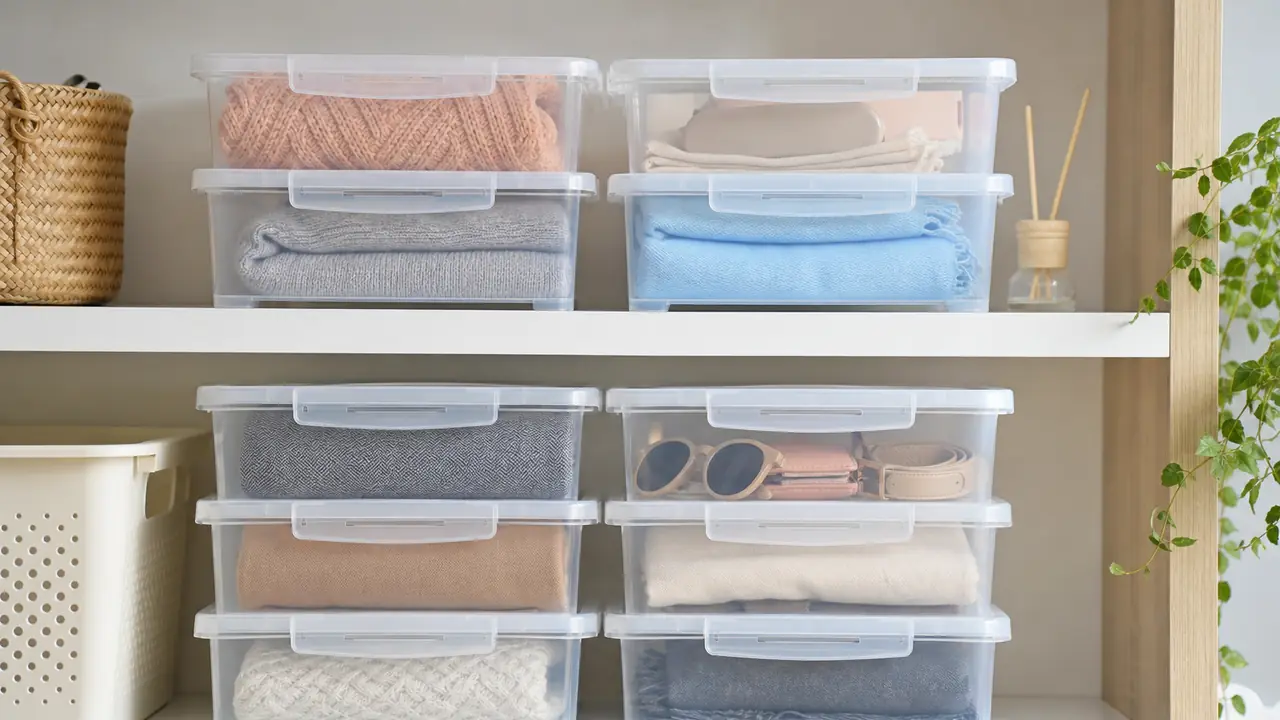
Why shoe boxes are a design product
A shoe box looks like the simplest item in a storage range, but customers judge it on details. Can I see which pair is inside? Can I take the shoes out without lifting the boxes above? Does the column stay straight when it is eight boxes high? Do the shoes smell after a month in a closed box? Those questions map to clarity, door design, stacking features and ventilation. A brief that covers all four produces a box that survives reviews; a brief that only gives a size produces a box that competes on price alone.
Lidwell has no partner plant reference model for this line yet. The sizes below are public listing reference sizes, used to describe the category and confirmed against a physical sample before an order.
Size: the shoe sets the box
A common folding clear shoe box is listed at 330x230x140 mm, about 10.6 L, and fits a shoe of about 31 cm length and 13 cm height. Rigid boxes with a magnetic flip door run from about 34x25x19 cm to 38x30x24 cm, about 15-27 L, and take larger shoes, high tops and boots in the bigger sizes. Inner dimensions are what matter for the customer, so the cut sheet should state both outer and inner sizes, and the listing should say which shoe length and height fit.
| Format | Listed size | Volume | Typical use |
|---|---|---|---|
| Folding clear shoe box | 330 x 230 x 140 mm | About 10.6 L | Shoes up to about 31 cm long and 13 cm high |
| Rigid box, magnetic flip door, smaller | About 34 x 25 x 19 cm | About 15 L | Trainers, larger shoes |
| Rigid box, magnetic flip door, larger | About 38 x 30 x 24 cm | About 27 L | High tops, short boots |
Doors: top lid, drop front or flip door
The door decides how the box is used in a column. A top lid is the simplest option, with the fewest parts and the lowest tooling cost, and suits boxes stored on a shelf one layer deep; in a stack, the customer has to lift the boxes above to reach the pair below. A drop-front door hinges at the bottom of the front wall and opens downward, so shoes can be taken out of a stacked box. A magnetic flip door hinges at the top and is held closed by small magnets; it looks neater and closes with a soft click, but the magnets and their housing add parts and cost. Hinges on drop-front and flip doors are either molded pins or living hinges, and both need a repeated open and close check on the sample.
Ventilation holes
Closed boxes trap moisture from worn shoes, and that is where odor complaints come from. Most designs add a row of small holes or slots in the side walls or the back. The holes have to be large enough for air to move but small and well placed enough that the box still looks clean and does not weaken the corners. Holes near the base let warm, damp air out less well than holes higher up. Slots are usually molded, which means they are part of the mold design and cannot be added later without changing the tool. Ventilation does not replace drying shoes before storage, and the listing should say so plainly. Agree the hole pattern on the drawing before the mold is cut, and check it on the T1 trial pieces against the look the brand wants on the shelf.
Stacking features
A column of shoe boxes stays straight when each lid or top has a raised rim or recessed corners that locate the box above. Without them, the column drifts when a door is opened. The stacking feature has to match between all sizes that are sold to stack together, so a range with two sizes needs a shared footprint or a defined stacking pattern. The load in a column is the weight of the boxes and shoes above; the note on stackable storage load explains how to set a test load for the bottom box.
Materials
Shoe boxes in public listings are described as PP, PET or ABS with PP. Clear PP is tough and flexible, suits folding boxes and hinges, but is less clear. PET is clearer and stiffer, good for showing the shoe, but less suited to living hinges. ABS frames give rigid magnetic door boxes a stiff structure, often with a clear panel in the door. Each part is named in the specification: frame, door, door panel, magnets and hinge. Clear surfaces scratch, so the packing should protect the front panel; see scratches and scuffs on clear boxes.
What to test on the sample
- Inner size against the cut sheet, and a real shoe of the target length inside.
- Door open and close cycles, with the count agreed per order as a stated working default.
- Magnet hold on flip doors: the door stays shut when the column is moved.
- Column stability: the agreed number of boxes stacked with shoes, one door opened.
- Drop test of a packed carton, and a check of the clear panel for scratches.
The desk sets the plan with the plant and records the results in the program file; see testing and inspection.
Packing, quantities and channels
Folding shoe boxes ship flat, which keeps freight low and suits marketplace sellers who pay for warehouse volume. Rigid boxes ship assembled or as nested parts, so the carton plan has to be agreed early. Storage lines typically start from 1,000-3,000 pieces per item, depending on size and mold, and custom work typically runs 15-30 days. These are typical reference ranges confirmed in writing per program on MOQ and lead time. Plants for this line sit mainly in the household plastics clusters of Taizhou and Ningbo. For seller-specific advice see marketplace sellers, then send sizes, door type and quantities through the quote form.