
What this line covers
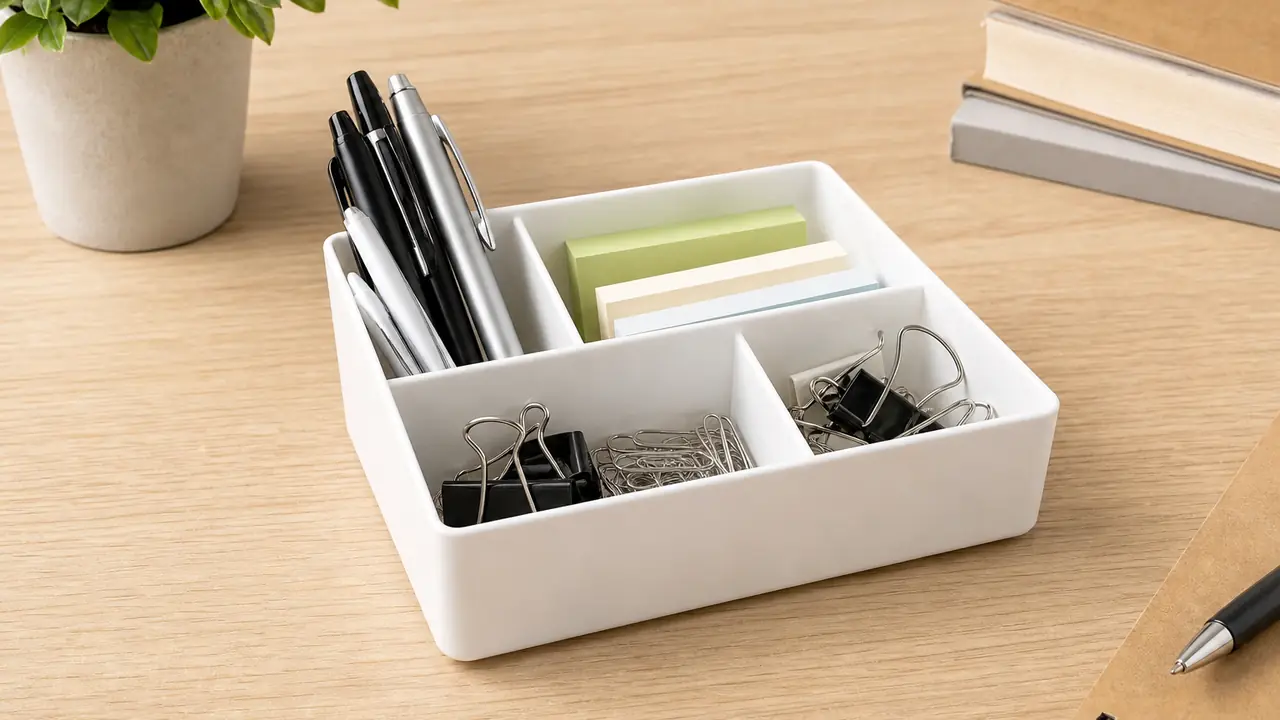
Desk organizer boxes sort the small things that collect on and in a desk: pens, clips, sticky notes, cables, chargers, tape and tools. The line includes shallow drawer trays with fixed compartments, deeper trays for larger items, lidded compartment boxes that stack on a shelf and open countertop caddies. They sell to home offices, students and offices, and they are often bought in sets that fill one drawer, so modular sizes matter.
The reference on the cut sheet is a public listing reference size, not a partner plant model: a 7-compartment drawer tray at 14.13x9.13x2.04 inches, about 359x232x52 mm. A deeper tray is listed at 15-1/8x11-1/2x2-1/4 inches, about 384x292x57 mm. Metal mesh organizers exist in the same category but are quoted separately. No partner reference model exists yet for this line, so the desk measures the partner plant's sample before an order is confirmed.
Formats and reference sizes
| Format | Outer size | Usual material | Typical use |
|---|---|---|---|
| 7-compartment drawer tray | 359x232x52 mm | PS or PP | Pens, clips, notes in a standard drawer |
| Deep drawer tray | About 384x292x57 mm | PS or PP | Cables, chargers, larger stationery |
| Lidded compartment box | Per model | PP | Small parts, craft supplies, shelf storage |
| Countertop caddy | Per model | Acrylic or PS | Display on a desk or reception counter |
Drawer depth is the number buyers most often miss. A tray of 52 mm suits a standard desk drawer; a deep tray needs a drawer with clearance above it. Listings should give outer size, inner compartment sizes and the minimum drawer depth. Width and length matter too: measure the inside of the drawer, not the front panel, and allow a few millimetres of clearance so the tray lifts out without catching. For marketplace listings, a simple drawing with the compartment sizes reduces questions and returns far more than a lifestyle photo does.
Compartment layout
The layout is what the customer is really buying. Long narrow slots take pens and rulers; square cells take notes and clips; a wider bay takes tape or a phone. Fixed compartments are molded into the tray and keep the part stiff; removable dividers let one body suit several users but add parts and tolerance. A brand planning a set should keep a common module, so two small trays sit beside one large tray in the same drawer. The note on desk organizer compartments covers layout choices in more detail.
Material by part
Three plastics cover the line, and the cut sheet names the material of each part. Clear PS (resin code 6) is stiff, molds crisp walls and gives a glass-like look, but it is brittle and cracks on a hard corner drop. PP (code 5) is tougher and flexes, so it suits lidded boxes with snap closures and hinges, though it is less clear. Acrylic, PMMA, gives the most premium clarity for countertop pieces, and scratches if packed without film. The comparison of acrylic and PS organizers sets out the trade-offs. PVC is not used for these trays.
Process and packing
Desk trays are injection molded, so the tooling decides the detail and the cost of a custom layout. Shallow open trays with enough draft on the walls nest inside one another, which keeps cartons small and freight low; lidded boxes do not nest and ship in inner boxes. The desk agrees the nesting count, the retail sleeve and the master carton with the partner plant. See injection molding and packaging and palletizing.
Documents, private label and ordering
Desk organizers are not food contact products, so the usual file is a supplier material declaration and a lot inspection report covering size, flatness, appearance and drop. Brands change the color, add a printed logo, set a compartment layout and design a retail sleeve; a new layout needs a new mold, often cut in the Huangyan mold cluster. Typical starting quantities for storage lines are about 1,000-3,000 pieces per item, depending on size and mold, confirmed in writing for each program; see MOQ and lead time. Send the drawer sizes and the items to be stored through the quote form.