
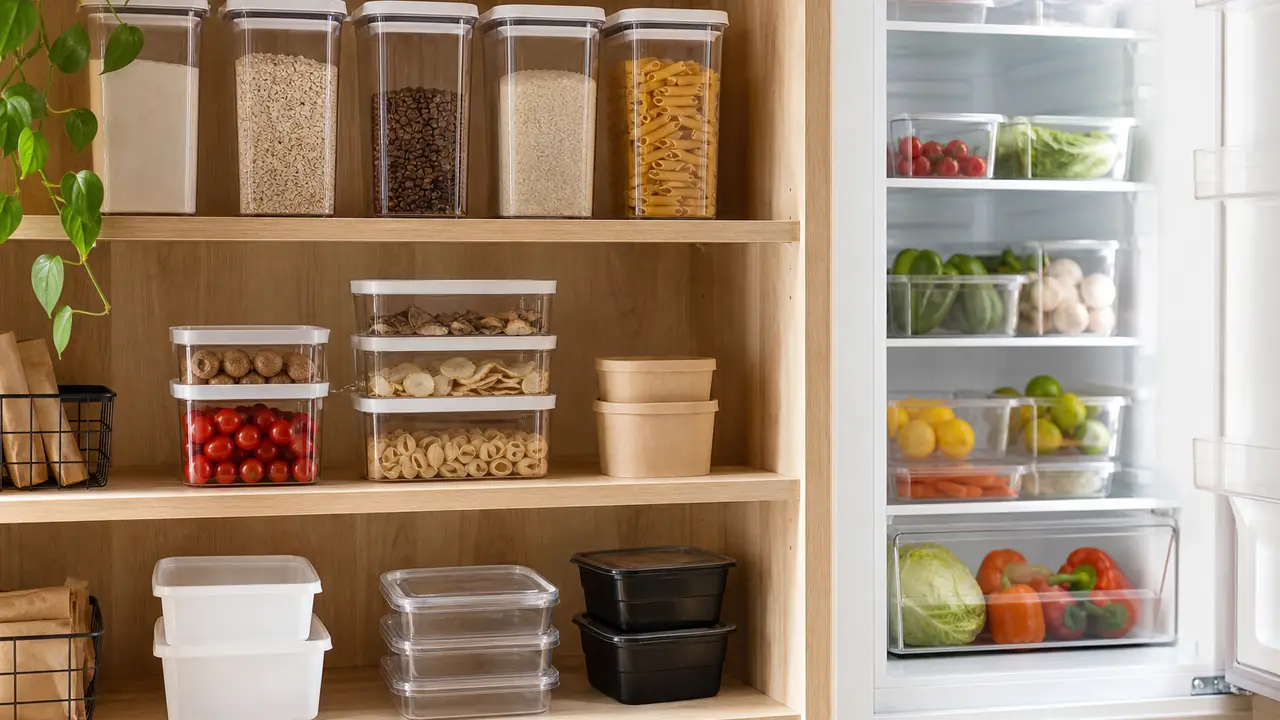
What a kitchen storage container has to survive
Home kitchen containers live a very different life from takeout ware. They are filled and emptied hundreds of times, washed by hand or in a dishwasher, moved between freezer, fridge and counter, and stacked in cupboards and on fridge shelves. They are judged by the person who uses them every day and who writes the review. The stresses are repetition and seal: a lid clip that whitens after a few months, a gasket that slips out of its groove, a vacuum valve that stops holding, a clear body that scratches or clouds, or a bin that is two centimetres too tall for the shelf it was bought for.
Freezer use adds brittleness at the corners and condensation when containers come out. Oily and coloured foods test the material for staining and odour. For a brand selling a set, one weak lid means a one-star review for the whole set.
Recommended lines and materials
Vacuum food containers use a body of PP or copolyester, a lid with a one-way valve, a silicone sealing ring and a manual or electric pump. Copolyester gives glass-like clarity; PP is lighter and tolerates heat better where marked. Fridge organizer bins are clear PET or PP, open or lidded, with front handles and stacking ribs; they are used chilled and not heated. Reusable PP food containers on a shared footprint cover leftovers and lunch boxes. For pantry and dry goods, the same bins and vacuum bodies apply. PVC is not used for any kitchen food container in this range.
These lines come mainly from the household plastics cluster in Taizhou and Ningbo, Zhejiang, where Huangyan is known for its mold makers. That matters when a brand wants its own shape: mold design, T1 trials and golden sample approval happen close to the molding plants.
Reference sizes
| Item | Material | Outer size | Note |
|---|---|---|---|
| Square vacuum container, 1.4 L | Copolyester | 233x156x90 mm | Public listing size |
| Vacuum container, 1.4 L | PP | about 232x152x73 mm | Public listing size |
| Vacuum set pieces | PP or copolyester | 0.5-2.0 L each | Common set combinations |
| Fridge organizer bin | PET or PP | about 315x157x89 mm | Most common listing size |
| Reusable PP box, 750 ml | PP | 170x115x51 mm | Partner plant reference |
Standard fridge shelves take bins about 10-12.5 inches long and 3-4 inches high, so fridge bins are best briefed from the shelf, not from a catalog. Vacuum and fridge sizes come from public listings because no partner plant reference model exists yet; the desk confirms the final size on the physical sample.
Checks the desk agrees per order
- Lid fit and opening force, repeated over many open and close cycles on the sample.
- Vacuum hold check on the valve and gasket for vacuum lines.
- Opening after freezing at -18 degrees C for freezer formats.
- Microwave heating per supplier marking for PP bodies, lid removed where marked.
- Tilt and inversion with liquid for lidded containers.
- Drop test, odour check and clarity against the golden sample.
- Third-party migration test for each food contact material in the set.
Counts and pass criteria are a stated working default, confirmed per order. Dishwasher use is stated only per supplier marking. Seals are described as leak-resistant in the standard tilt test, never with an absolute claim.
Documents
A kitchen set often combines three materials: a PP or copolyester body, a PP lid and a silicone gasket. Each part that touches food needs its own declaration: FDA 21 CFR 177.1520 for PP in the US, the relevant 21 CFR sections for other materials, and Regulation 1935/2004 with Regulation (EU) 10/2011 for plastics in the EU, plus a migration report on the finished item. The compliance guide explains the per-part approach. Documents are issued to partner plants or to your brand per project and verified by the desk.
How to brief a kitchen storage program
- Name the set: pieces, capacities and whether lids are shared.
- Give the shelf, drawer or fridge dimensions the containers must fit.
- State freezer, microwave and dishwasher expectations.
- Say whether you need your own mold, colors or logo emboss.
- Describe the retail pack and the channels you sell through.
Send it through the quote form. Brands planning their own shape can read OEM and private label first.