
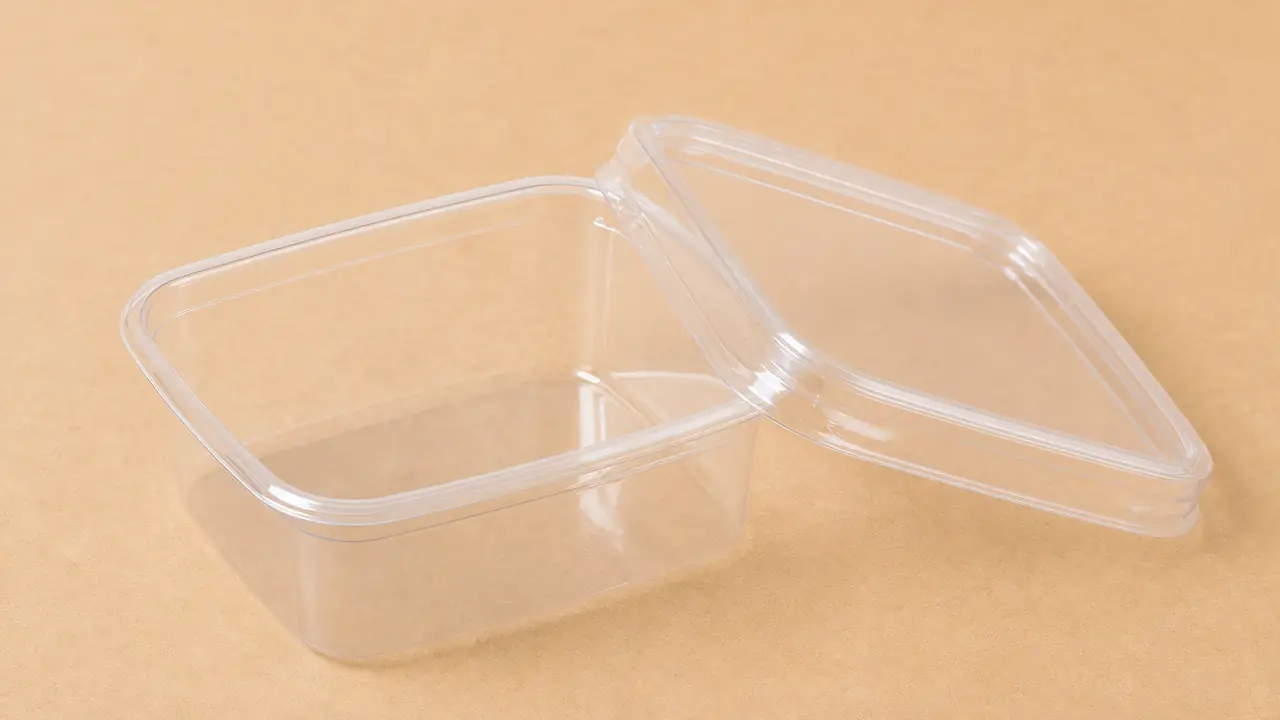
Two processes, two kinds of plant
Thermoforming starts from a sheet of plastic. The sheet is heated until soft, pulled or pressed over a mold by vacuum or air pressure, cooled, then trimmed out of the web. Injection molding starts from resin pellets. The pellets are melted and injected under pressure into a closed steel mold, held until the part solidifies, then ejected. The two processes usually run in different plants with different equipment, and in China they cluster in different places: thermoformed takeout boxes, cups and clamshells are concentrated in Guangdong, while injection molded storage boxes, food storage containers and organizers are concentrated in Taizhou and Ningbo in Zhejiang, close to the mold makers of Huangyan.
Thermoforming in practice
Thermoforming suits thin-walled, single-use or light-use parts made in high volumes: takeout boxes, soup cups, bowls, clamshells, fruit punnets, divided trays and lids. Sheet in PP, PET or PS is formed many parts at a time, and walls are thin and fairly even, though they thin out at deep corners. A partner plant in Foshan, Guangdong, thermoforms PP takeout boxes in 650, 750 and 1,000 ml, packed 300 sets per carton. Export soup cups from 350 to 950 ml and clear PP divided trays up to 1,500 ml come from the same process, packed 200 sets per carton.
The strengths are low weight per piece, tight nesting, fast output and lower tooling cost than injection molding. The limits are that wall thickness cannot be controlled precisely across the part, rims and threads are less rigid, and very thick or complex features are not possible. The thermoforming page covers tooling and output.
Injection molding in practice
Injection molding suits rigid, durable or complex parts: reusable food storage containers, vacuum container lids with valves, fridge bins, collapsible crate panels and hinges, cosmetic organizers, desk trays, cutlery and injection molded cups. Wall thickness is set by the steel mold, so ribs, thick rims, clips, hinges and logos can be molded precisely, and sharp corners and good surface finish are possible. A partner plant's injection molded PP cups are packed 300-500 per carton, for example 500 in a 41x32x48 cm carton.
The strengths are rigidity, dimensional precision, durability and freedom of design. The limits are higher piece weight, higher mold cost, longer tooling time and, usually, a higher volume needed to justify a new mold. The injection molding page explains cycle, gates and walls.
Side by side
| Factor | Thermoformed | Injection molded |
|---|---|---|
| Starting material | Extruded sheet, PP, PET or PS | Resin pellets, PP, PS, PET, ABS and others |
| Wall | Thin, thinner at deep corners | Set by the mold, can vary by design |
| Weight per piece | Low | Higher for the same size |
| Typical products | Takeout boxes, cups, clamshells, punnets, trays | Reusable storage, organizers, bins, cutlery, cups |
| Rims, clips, hinges | Formed, less rigid | Molded precisely, rigid |
| Tooling | Lower cost, shorter build | Higher cost, longer build |
| Main cluster | Guangdong | Taizhou and Ningbo, Zhejiang |
How to tell which one you are looking at
- Edges. Thermoformed parts have a trimmed edge, often rolled or flanged at the rim. Injection molded parts have a molded edge and usually a small gate mark, often on the base.
- Walls. Press the side: a thermoformed wall flexes easily; an injection molded wall is stiffer.
- Weight. For the same capacity, an injection molded part is heavier. Weight per piece is the clearest sign of which process a quote is based on; see gram weight and wall thickness.
- Corners and detail. Sharp corners, thick ribs, clips and fine logos point to injection molding.
Lids: often a mix
A single product can combine both. Many takeout programs use thermoformed bases with thermoformed lids for speed and cost; reusable food storage usually pairs an injection molded base with an injection molded lid and a silicone seal; some soup containers use a thermoformed cup with an injection molded lid for a firmer seal. Because the two parts may come from different processes, and sometimes different plants, lid fit is checked on the sample from the actual production tools. See lids and seals.
Process and food contact documents
The process does not change the food contact rules, but it changes what the documents need to cover. A thermoformed part involves a sheet supplier as well as a forming plant, so the declaration should trace the PP or PET from resin to sheet to finished part. For an injection molded part, the resin and any masterbatch go straight into the mold. In both cases the finished article is what has to comply, whether to FDA 21 CFR 177.1520 for PP in the US or EU 10/2011 in Europe, so the desk asks for a declaration on the finished part, verified per project.
Tooling, samples and lead times
For both processes, the fastest route is a stock mold: an existing model, plain or printed. Stock samples typically take 3-7 working days and printed samples 7-15 working days. A new mold adds the tool build and a T1 trial, the first shots from the new mold, typically 25-45 days for the mold cycle, and a first order with a new mold typically 45-60 days including tooling. Injection molds sit at the longer end because the steel is more complex. Huangyan in Taizhou is one of China's main mold-making centres; Zhejiang press reported in 2025 that it accounts for around 30% of the country's injection mold output.
Volumes and MOQ
Stock molds from either process typically start from 1-10 mixed cartons. Printed lids or sleeves typically start at 10,000-50,000 pieces per item. A new mold typically starts from 50,000-100,000 pieces per item for takeout lines, with lower starting quantities for storage boxes, around 1,000-3,000 pieces per item depending on size and mold. All figures are reference ranges, confirmed in writing for each program; see MOQ and lead time.
Which one to choose
Choose thermoformed for single-use takeout and fresh produce packaging where weight, nesting and cost per piece matter most. Choose injection molded for reusable food storage, organizers and any part that needs a rigid rim, a hinge, a valve or a precise fit. Where a range spans both, the desk coordinates partner plants in each cluster under one project and one specification. Send your list through the quote form.