
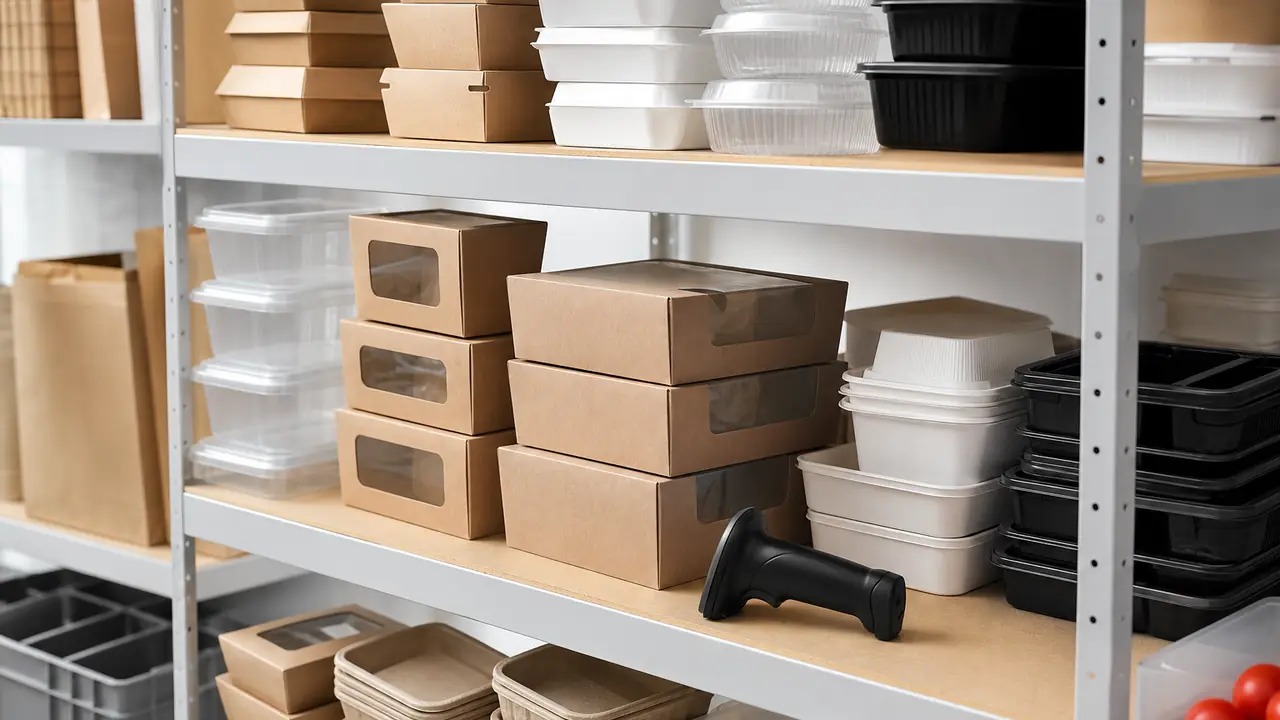
Start from footprints, not capacities
Most range briefs list capacities: 500, 650, 750 and 1,000 ml. The more useful question is how many footprints sit behind those numbers. A footprint is the length and width of the rim. When several depths share one footprint, one lid closes all of them, the containers stack in the same column in a fridge or delivery bag, and the plant runs the same lid tool for every depth. Each extra footprint adds a lid, a carton size and a line on every stock sheet.
The reference series from a partner plant in Huizhou, Guangdong, shows the logic. Four rectangular boxes share a 170x115 mm footprint and differ only in depth. Two larger roast-meat boxes share a 217x149 mm footprint. Six capacities, two lids.
| Capacity | Outer size | Gram weight | Footprint group |
|---|---|---|---|
| 500 ml | 170x115x34 mm | 17 g | A, 170x115 mm |
| 650 ml | 170x115x43 mm | 18.3 g | A |
| 750 ml | 170x115x51 mm | 19.6 g | A |
| 1,000 ml | 170x115x64 mm | 22 g | A |
| 1,200 ml | 217x149x60 mm | 35 g | B, 217x149 mm |
| 1,500 ml | 217x149x71 mm | 39 g | B |
Sizes are measured by hand at the plant and checked against the physical sample before an order is confirmed.
Set capacity steps that customers can tell apart
Steps that are too close confuse kitchen staff and end customers, and they split stock without adding sales. In the series above, the steps run from 500 to 1,000 ml in roughly 100-250 ml increments on one footprint, then jump to a larger footprint. That pattern works for takeout: a side, a standard main, a large main and a family portion. For round items, the same cluster offers tubs from 1,250 to 2,000 ml and bowls from 360 to 1,000 ml, and export soup cups from 350 ml (116x99x45 mm) to 950 ml (117x82x141 mm).
Remember that a stated capacity is usually brim-full. The usable fill line is lower, and a range should be planned on the fill line customers will actually use. See capacity, ml and oz.
Plan the lids as their own range
Lids cause most complaints, so they deserve their own plan:
- Material per part. A PP base with a PP lid can go into the microwave where the supplier marking allows it, usually with the lid removed or vented. A PET lid gives better clarity for cold display but is used cold only.
- Clear or black base. Black bases with clear lids are common for hot food and display; clear bases suit salads and cold items.
- Printed or plain. Printing the lid rather than the base means one printed item covers every depth on that footprint, which is often the most economical route to a branded range.
- Fit testing. Each lid is checked for opening force and, for liquids, a tilt and inversion test agreed per order. Results are described as leak-resistant in that test, confirmed per order.
The lids and seals page explains the closure types in detail.
Build the packing plan into the range
Pack counts decide how easy a range is to buy. Partner plant cartons for thermoformed PP boxes, soup cups and starch-PP blend containers usually hold 200-300 sets; injection molded cups run 300-500 pieces per carton, for example 500 pieces in a 41x32x48 cm carton. A range in which every item uses the same pack count and a similar carton is easier to order in mixed loads and easier to count at the warehouse.
Ask the plant for the pack count, carton size and gross weight of every item at quote stage, and keep them in the range file. Because containers are light and bulky, freight is charged on volume, and nesting decides how many cartons fit in a container. See packaging and palletizing.
A worked example (illustrative)
An illustrative restaurant group wanted eight container sizes for a new delivery menu. Mapping the menu showed that four of the sizes were within 100 ml of another. The range was reduced to five items on two footprints: four depths on the 170x115 mm footprint with one printed PP lid, and one 1,500 ml box on the 217x149 mm footprint. One round soup cup was added for liquid dishes. The result was three lids instead of eight, one printed item instead of five, and a stock sheet short enough to manage weekly. The program view for this kind of buyer is on foodservice and project buyers.
Adjust the range to the channel
The same footprint logic applies across channels, but the emphasis changes. A restaurant group plans around its menu and its delivery bag, so depth steps and liquid-safe round cups matter most. A wholesaler plans around stock depth: it wants the most common capacities in deep stock, all on a few footprints, so that mixed cartons can be shipped to many small customers without opening new lines. A brand selling home food storage plans around sets, for example three sizes nested in one gift pack, which means the nesting order and the outer pack are part of the range design from the start.
Storage ranges follow the same rule with different numbers. Public listing sizes for fridge bins cluster around 315x157x89 mm for a standard shelf, and shelves usually take bins about 10-12.5 inches long and 3-4 inches high. A fridge range that keeps one width and varies only length and height will stack and sell as a system rather than as single items.
Whatever the channel, write down why each item exists. If no menu use, customer group or set position can be named for a size, it is a candidate for removal before the first order, when removing it costs nothing.
Checklist for a range brief
- List each food, served hot, cold or reheated, and the portion size.
- Group foods by shape: rectangular, round, divided.
- Choose one footprint per group and set depths for each portion.
- Decide the lid material and which lid carries the print.
- Record pack count, carton size and weight for each item.
- Check documents for each destination market, per item.
Brand owners building a private label range will find more on molds, print and packaging on brand owners. Typical starting quantities are a few mixed cartons from stock molds and 10,000-50,000 pieces per item for printed lids, confirmed in writing per program; see MOQ and lead time, then send the brief through the quote form.