
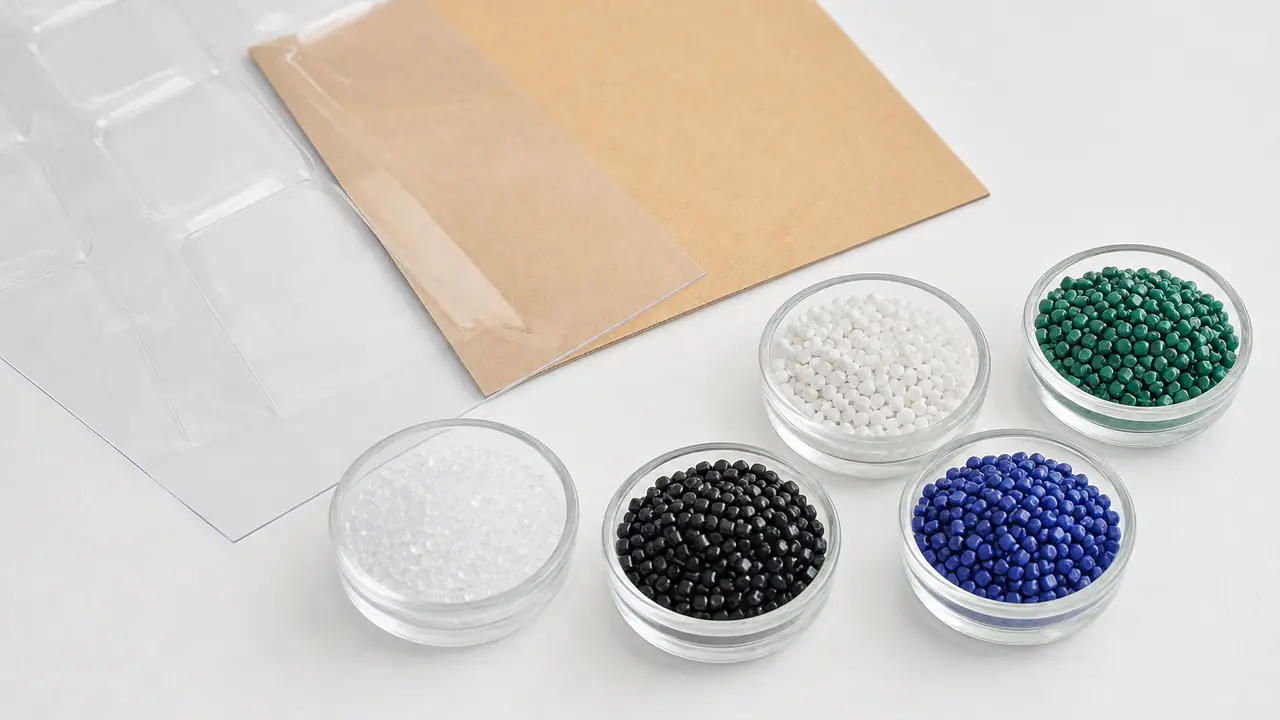
What copolyester is
Copolyesters are a family of polyester plastics modified to be clear, tough and stable in thick injection molded parts. In food storage they are used where a brand wants a container that looks close to glass, survives being dropped on a kitchen floor and stays clear after repeated washing. They carry resin identification code 7, the other category, because they are not one of the six single-resin codes. Several resin makers sell copolyester grades under their own trade names; Lidwell writes copolyester and names the grade on the specification, not the trade name on the listing.
Where copolyester fits in a storage range
Copolyester is a reusable-storage material. It is used for pantry canisters, dry food containers, vacuum food containers, fridge containers and water bottles, and it is rarely used for single-use takeout, where PP and PET are the economical choices. The typical buyer is a brand owner or DTC brand building a premium storage set, where clarity and feel justify a higher material cost.
Vacuum containers are a good example. A public listing for a 1.4 L square vacuum container in copolyester gives an outer size of 233x156x90 mm; a comparable PP model of the same 1.4 L capacity is listed at about 232x152x73 mm. Sets usually combine pieces between 0.5 and 2.0 L, such as 0.7, 1.4 and 2.0 L, with a hand or electric pump and a one-way valve in the lid. See vacuum food containers and how vacuum containers work.
Copolyester against PP and PET
| Point | Copolyester | PP | PET |
|---|---|---|---|
| Resin code | 7 | 5 | 1 |
| Clarity | Glass-like in thick walls | Translucent | Clear in thin sheet |
| Toughness | High, resists drops | Good, flexible | Stiff, can crack |
| Typical process | Injection molding | Injection or thermoforming | Thermoforming, sheet |
| Hot food and microwave | Per supplier marking and test | Per supplier marking and test | Not used |
| Typical use | Premium pantry, vacuum sets | Meal prep, takeout, storage | Cold display, fridge bins |
| Material cost | Higher | Lower | Low to medium |
The table is qualitative. Heat behaviour depends on the grade and the wall, so microwave and dishwasher instructions are stated per supplier marking for each model and checked on the sample, never assumed for the material.
Lids and seals
A copolyester body rarely works alone. Lids are often PP or a combination of PP and copolyester, locking clips are PP, and the seal is a silicone ring set into a groove in the lid. Vacuum lids add a valve and sometimes a date dial. Each of these parts is a separate material with its own food contact file, and each one can be the reason a set fails. The desk lists every part with its material in the specification: body, lid, clip, seal, valve. The lids and seals page explains fit and seal checks.
BPA wording
Copolyester is often promoted with a BPA-free claim. A claim like that is only as good as the documentation behind it: a supplier declaration for the exact grade, and a test report on the finished container where the market or retailer asks for it. Avoid broad safety words around it; say what the material is and what the documents show. The BPA and plastic food containers note explains how to read such claims.
Documents to request
For the United States, a supplier declaration that the copolyester grade and each other part comply with the relevant FDA 21 CFR 174-178 sections for the stated conditions of use; FDA does not approve finished containers. For the European Union, a declaration of compliance to Regulation 1935/2004 and Regulation (EU) 10/2011 with an overall and specific migration report on the finished item; a resin declaration covers an intermediate material, not the container. Silicone seals are not covered by 10/2011, so agree their test basis with your test lab. For China, GB 4806.7-2023 covers the plastic parts. Documents are issued to the partner plant or your brand per project and verified by the desk.
What to test on the sample
- Clarity and surface: no haze, flow lines or sink marks in thick walls.
- Lid fit and clip strength over repeated opening, with the number of cycles agreed per order.
- Tilt and inversion with liquid, reported as leak-resistant in that test, confirmed per order.
- Vacuum hold over a stated time for vacuum sets.
- Freezer check at -18 degrees C followed by opening the clips.
- Drop check on a filled container from a stated height.
- Odor, especially from the silicone ring.
Planning the set and the listing
Copolyester sets sell on presentation, so the range plan and the listing deserve as much care as the material. Keep one or two footprints across the set so pieces stack and lids share parts; a square 1.4 L piece that stacks on a 0.7 L piece of the same footprint looks tidier in a pantry and in a product photo. State outer size, usable capacity and weight per piece from the approved sample, not from the model name. Write the care instructions that the tests support: hand wash or dishwasher, top rack or not, microwave use per supplier marking or not at all, freezer use as tested. Instructions that go beyond the test results are the fastest route to returns and reviews about clouding, cracking or warped lids. Packaging also matters: clear copolyester shows every scuff, so each piece should be bagged or separated in the gift box. See container range planning.
Sourcing a copolyester range
Reusable storage ranges are mostly made in the household plastics cluster of Taizhou and Ningbo in Zhejiang, where the molds and injection plants for storage boxes sit; Huangyan in Taizhou is known as China's mold town. Copolyester parts usually need dedicated molds, because the material shrinks differently from PP. Storage lines typically start at 1,000-3,000 pieces per item depending on size and mold, and a new mold adds a sample mold and T1 trial stage, confirmed in writing per program on MOQ and lead time. Send the set composition, capacities and target market through the quote form.