
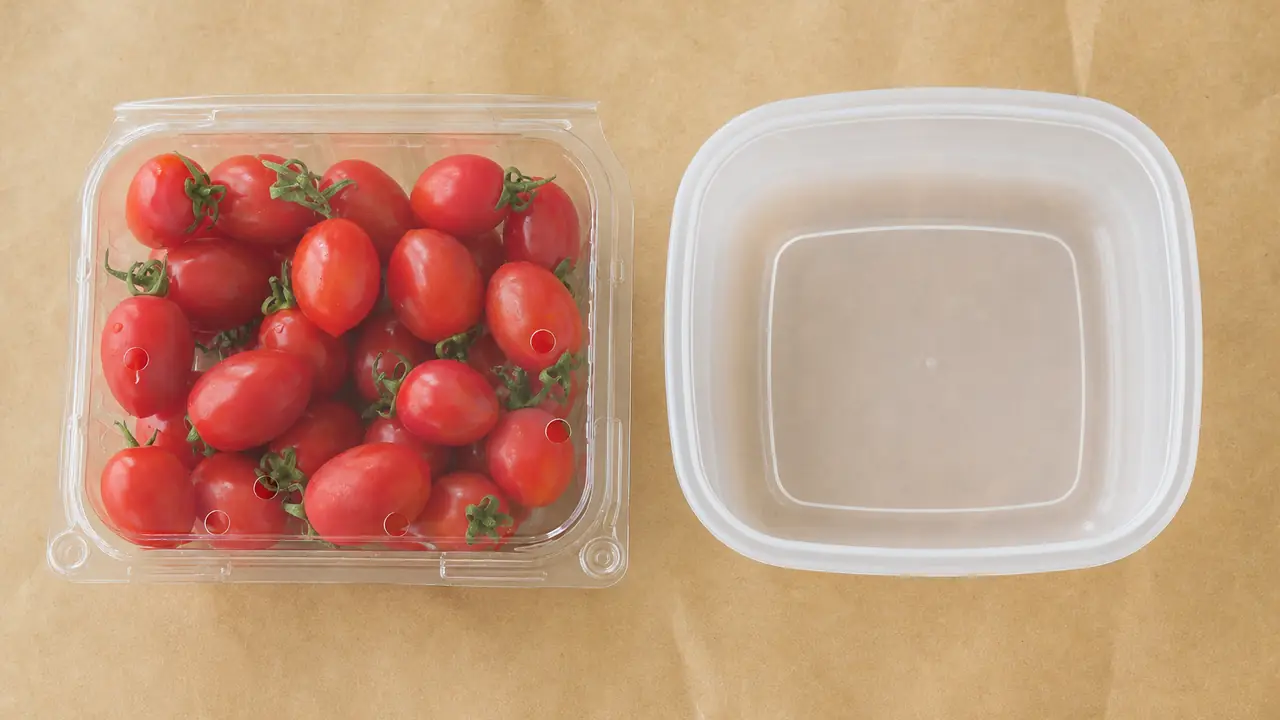
What a fruit box has to do
A fruit box in a supermarket chiller has four jobs. It has to show the fruit clearly, often through condensation; it has to close firmly so cut fruit and juice stay in during handling; it has to stack on a shelf without crushing the box below; and it has to meet the food contact rules for the market. A fruit box in a lunch or snack program adds a fifth job: it may be refrigerated, carried, opened, closed again and sometimes warmed. The choice between clear PET and PP depends on which of those jobs matter most.
Clear PET: strengths and limits
PET, resin identification code 1, is the material of most clear clamshells, punnets, fruit cups and salad bowls. It thermoforms into a crisp, glass-like part with sharp detail, stiff walls and a good surface for a label. For cold display that clarity is the main selling point: the customer sees the colour and cut of the fruit at a glance. A partner plant's PET cold range, built around a 117 mm rim, includes bowls from 230 to 700 ml, and PET cold cups ship around 1,000 pieces per carton.
The limits are heat and repeated flexing. PET is used cold only: it is not for hot food and not for the microwave. Hinges on thin PET clamshells can crack after repeated opening, and thin PET can split at sharp corners if the box is dropped cold. Clarity can be lost to scuffing in transit if the boxes rub against each other. These are specification matters, not reasons to avoid PET for cold display.
Clear PP: strengths and limits
PP, resin code 5, is less clear than PET but tolerates heat, freezing and reuse much better. A partner plant makes a clear PP divided range by thermoforming: a three-compartment box at 218x188x42 mm and 1,000 ml as the main reference, a four-compartment box at 219x188x43 mm and 1,000 ml, a large four-compartment box at 228x229x45 mm and 1,300 ml, a large five-compartment box at 232x232x47 mm and 1,500 ml, and a small five-compartment box at 240x192x40 mm and 1,100 ml, packed 200 sets per carton. The lids carry a 'Microwave safe' marking stamped by the supplier, which is checked in a heating test before it is relied on. See divided fruit containers.
The limits are clarity and stiffness. PP looks slightly milky next to PET, especially in thicker walls, and is more flexible, which a customer can read as less solid. Clear PP grades narrow the gap but do not close it. Glossy PP surfaces also show scratches.
Side by side
| Factor | Clear PET (code 1) | PP (code 5) |
|---|---|---|
| Clarity | High, glass-like | Translucent to clear depending on grade |
| Stiffness | Stiff, crisp detail | More flexible |
| Heat and microwave | Cold use only | Microwave use per supplier marking |
| Freezing and reuse | Can crack when cold and flexed | Better for freezing and repeated opening |
| Hinges | Can crack after repeated opening | Tolerates flexing well |
| Reference model | PET bowls 230-700 ml, 117 mm rim | Three-compartment box 218x188x42 mm, 1,000 ml |
| Best fit | Supermarket chilled display, fruit cups | Lunch and snack boxes, reheatable meal sets |
Cost drivers, without prices
The desk does not publish prices. Both materials are thermoformed from sheet, so the main cost drivers are similar: sheet thickness and gram weight, the number of cavities on the forming tool, trim waste and the speed of the line. Material costs move with resin markets, so the gap between PET and PP shifts over time; see resin price swings and order timing. Beyond the material, the design decides cost: a one-piece hinged clamshell saves a separate lid and a packing step, while a separate lid allows one lid across several depths. Print on the lid or a label adds a minimum, typically 10,000-50,000 pieces per item, confirmed in writing for each program.
Documents and claims
Both materials need a supplier declaration for the market. In the United States, PP sits under 21 CFR 177.1520 within the food contact rules of 21 CFR 174-178, and PET has its own section in the same rules. In the European Union, both fall under Regulation 1935/2004 and Regulation (EU) 10/2011, with migration testing against the relevant simulants; for China, GB 4806.7-2023 applies. The resin supplier's declaration covers the intermediate material only, so the finished box is verified per project. Recycled PET is a separate topic with its own rules; see recycled content in containers. Confirm the final position with your test lab or counsel.
Packing and transit
Both materials nest, so empty boxes travel compactly, typically 200-300 sets per carton for thermoformed PP trays in the partner plant range. Clarity is the asset that transit damages most. Nested clear boxes rub against each other on a long sea voyage, so the packing plan matters: interleaving sheets or a sleeve per stack, cartons that do not let stacks shift, and a carton strength matched to the pallet height. PET's stiffness helps it resist crushing in the carton, while PP's flexibility helps it survive a drop without splitting. Static can also pull dust onto clear faces; a simple packing check on the first lot catches it before the goods reach the retailer.
Testing on real fruit
The desk agrees a short test plan per order: a chill test with cut fruit to check fogging and clarity, a closed tilt test with juice, a stack test on the shelf height used by the retailer, hinge cycling for clamshells and a drop test at chiller temperature. For PP boxes sold as reheatable, a microwave test follows the supplier marking. Number of samples and pass criteria are a stated working default, confirmed per order. See supermarket produce use.
How to choose
- Chilled display only, clarity first: clear PET.
- Lunch, snack or meal sets that may be warmed or reused: PP, with a clear grade if display matters.
- Mixed range: PET for the supermarket line, PP for the meal and snack line, with matching footprints where possible.
Stock items typically start from 1-10 mixed cartons, confirmed in writing for each program; see MOQ and lead time. Send the products, shelf format and market through the quote form.