
Three routes to a private label range
Private label in containers and storage boxes rarely means a new product from scratch. Most programs start from molds that partner plants already run, and add brand identity in the places a buyer actually sees: the lid, a sleeve or label, the retail pack and the carton mark. A custom mold is the right step when the footprint, the capacity, a logo emboss or a feature such as a sauce insert cannot be found in an existing tool. The desk sets out the three routes side by side before any quotation, because the route decides the minimum quantity, the lead time and the documents more than any other choice.
| Route | What changes | Typical starting quantity | Typical timeline |
|---|---|---|---|
| Stock mold, plain or labelled | Label, sleeve, retail pack, carton mark | 1-10 cartons mixed | Samples 3-7 working days; bulk 7-15 days |
| Printed parts on a stock base | Printed lid, cup body or paper sleeve | 10,000-50,000 pieces per item | Print samples 7-15 working days; bulk 15-30 days |
| Printed paper boxes | Board grade, print, window, size | 5,000-10,000 boxes per design | Print samples 7-15 working days; bulk 15-30 days |
| Storage and organizer lines | Color, label, pack, sometimes insert | 1,000-3,000 pieces per item | Per size and mold |
| Custom mold | Footprint, capacity, emboss, features | 50,000-100,000 pieces per item | T1 trial 25-45 days; first order 45-60 days |
All figures are typical reference ranges built from partner plant carton counts and public platform terms; the quantity and timeline for your program are confirmed in writing before a deposit. See MOQ and lead time for the full tables.
Stock molds with your brand
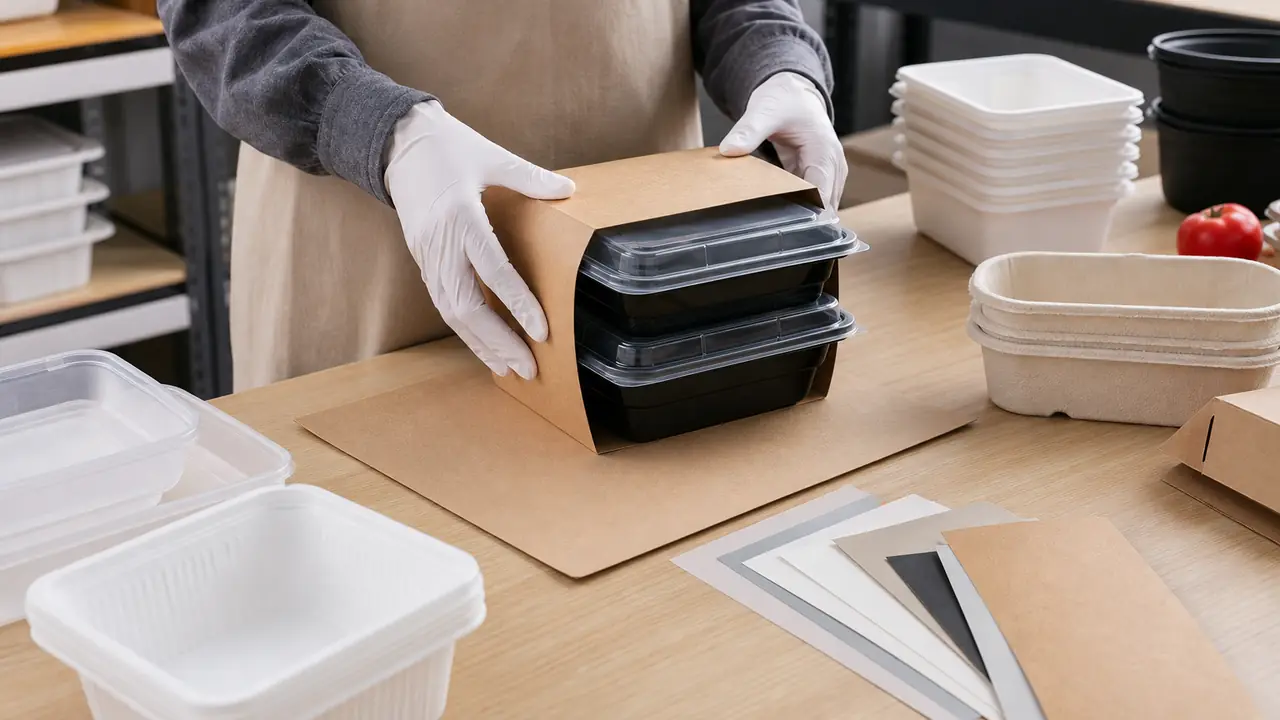
The fastest route keeps the plant's existing base and lid and moves your brand onto the parts around them. For a takeout program that means a printed paper sleeve or a lid label on a stock PP box such as the 750 ml reference model at 170x115x51 mm and 19.6 g; for a storage line it means a color choice, a printed insert card and a retail box with your barcode. Stock routes allow mixed cartons, so a new brand can test several capacities on one footprint before committing to a printed lid. The trade-off is that the product itself is not exclusive: the same base may be sold under other names, so differentiation sits in the pack, the set and the content.
Printed lids, bodies and sleeves
Printing on the molded part is where most food packaging brands land. Lids are printed by offset dry printing or carry an in-mold label; cup bodies are printed on round tubs and soup cups; sleeves and wraps are printed in the paper cluster around Longgang near Wenzhou. Each method has its own minimum, ink system and color tolerance, and inks on food contact parts need their own declaration for the outside surface. The desk agrees a print sample against a color reference and an adhesion and rub check before bulk, as set out in printing and labeling.
Custom molds
A custom mold makes sense when volume justifies it and the product needs to be your own: a footprint that fits your delivery bags, a capacity series sized to your menu, a logo emboss on the lid, a vent tab or a sauce insert. Injection molds for storage boxes and vacuum containers are often built in the Huangyan mold cluster in Taizhou; thermoforming tools for takeout boxes are lighter and faster to build. The steps are a drawing, a sample mold or T1 trial, corrections, a golden sample signed by both sides, and then the first order. Mold ownership, storage, maintenance and the number of cavities are written into the program terms. Injection molding explains what drives tooling cost and output.
Materials stay honest under your brand
A private label does not change what a part is made of, and your label carries the claim. The desk names the material of every part on the specification: PP for hot food and reheating, PET for cold display, PVC only in non-heated packaging such as clear gift box windows and organizer cases, paperboard for boxes, and starch blended with PP for starch-based ware. Microwave use is stated per supplier marking, leak resistance is described from a tilt test confirmed per order, and compostable wording is used only where a named EN 13432 or ASTM D6400 certificate exists. The container materials page sets out each option.
Documents issued to your brand
Food contact documents follow the product, not the logo. For the United States, a supplier declaration to FDA 21 CFR 177.1520 for PP; for the European Union, a declaration of compliance to Regulation 1935/2004 and Regulation (EU) 10/2011 backed by a migration report from a third-party lab; for China, GB 4806.7-2023. Where a brand wants the report in its own name, the test is commissioned on samples from the production lot and issued to the brand. Lidwell does not hold certificates; documents are verified per project. Labelling and claim wording should be confirmed with your test lab or counsel. See compliance and certifications.
Starting a private label brief
A good brief lists the products, the capacities or sizes, the destination market, the channel, the parts to be branded and an annual volume estimate. With that, the desk returns matched reference models with real sizes and gram weights, the route per item and the documents to expect. Send it through the quote form.