
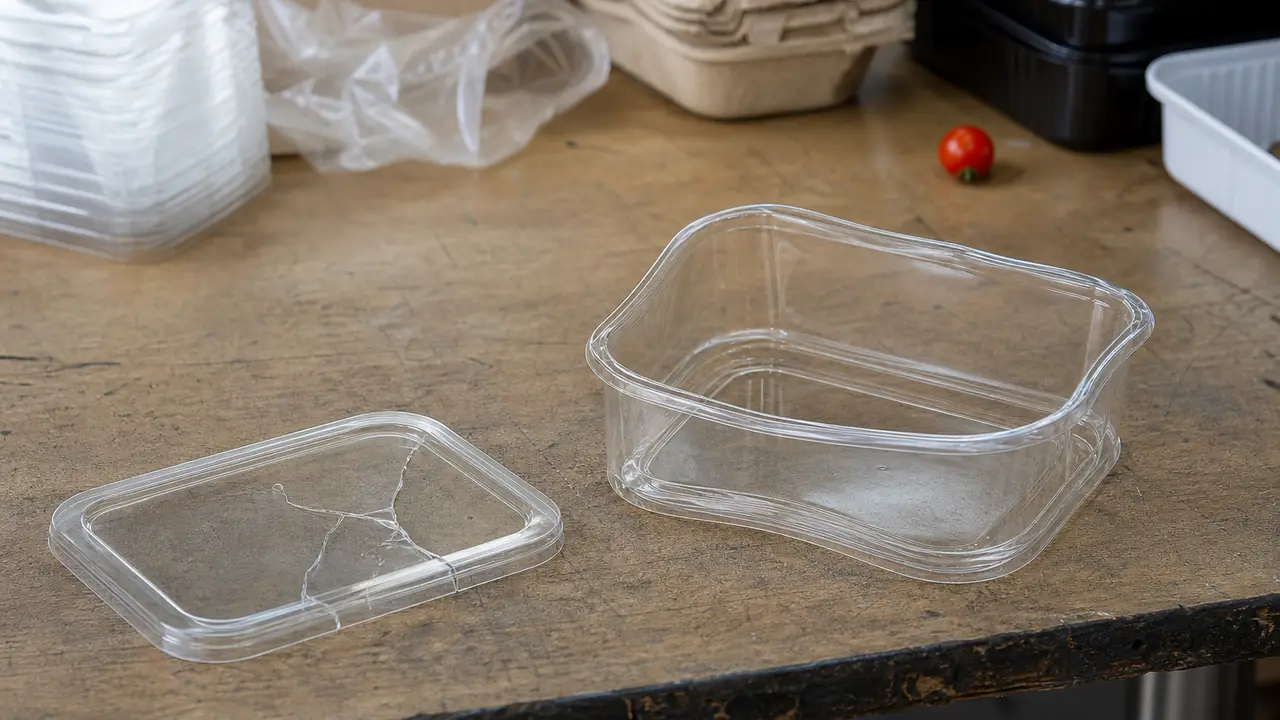
What warping looks like
Heat warping shows up in three ways. The base bows or the side walls lean outward when hot food is filled, so the lid no longer sits flat. The rim distorts after microwave reheating, and the lid that fitted before no longer snaps on. Or containers arrive already deformed, with nested stacks that have fused slightly or bases that rock on a table, because the cartons sat in a hot container or warehouse for weeks. Each of these has a different cause, and each needs a different fix.
The first question the desk asks is simple: what temperature does the food reach in the container, and for how long? Hot soup ladled from a pot, a rice dish reheated in a microwave and a cold salad kept in a fridge put very different demands on the same box.
Resin choice: the main cause
Most warping complaints come from a material that was never meant for heat. Clear PET clamshells and fruit boxes give the best clarity for chilled display, but PET in this form is for cold and room temperature use only. Filled with hot food, it softens and distorts. PVC, used in this range only for windows on paper boxes and for non-heated storage, should never meet hot food or a microwave. PS and similar clear plastics belong in organizers and cold use, not in a hot takeout line.
PP is the material for heat in food containers. US rules for olefin polymers in 21 CFR 177.1520 describe PP with a melting point in the range of 160-180 C, far above serving temperature. One partner plant states a working range of -10 C to 120 C for an injection molded PP cup and says it can take boiling water; that is the supplier's own statement and is confirmed by testing on the order, not assumed. Soup cups from a thermoforming partner plant carry the PP code 5 and a microwave marking molded into the base by the supplier. The container materials page sets out the heat and clarity trade-off by resin.
Thin walls and low gram weight
Even the right resin warps if the wall is too thin. A PP box softens slightly at hot fill temperature; a thick wall holds its shape, a thin one leans. Reference models on a 170x115 mm footprint from a partner plant in Huizhou run from 17 g for 500 ml to 22 g for 1,000 ml, and larger roast meat boxes on a 217x149 mm footprint weigh 35-39 g. When a lighter version of the same box appears in a quotation, the buyer should ask what it will do with hot food before choosing it on unit cost.
Thermoformed parts are thinnest in the corners and at the bottom edges, which is where warping usually starts. Injection molded parts have more even walls but can carry molded-in stress if they were cooled too fast, and that stress releases when the part is heated again. Both processes are explained on the thermoforming and injection molding pages.
Microwave reheating
A microwave heats the food, and the food heats the container. Fatty and sugary foods can get much hotter than water, and the container wall in contact with them can soften even when the box is PP. That is why supplier markings often say to remove or vent the lid and to reheat for a limited time. The site describes microwave use as per supplier marking, lid removed where marked. A container should never be sold with a heating instruction the supplier has not given and a test has not confirmed.
Lids are often the first part to warp in the microwave, because they are thinner than the base and sit closest to steam. Some ranges pair a PP base with a PET lid for clarity; in that case the lid must come off before heating, and the label has to say so clearly.
Hot transit and storage
Containers can warp before they are used. A sea container crossing hot regions can get far hotter inside than the outside air, and cartons at the top of the load feel it most. Nested thin-wall containers under a heavy stack can deform slowly in that heat, and stacks can stick together. Shipping times to the US West Coast typically run 15-25 days and to Europe 30-45 days, which is a long time in a hot box. Strong cartons, sensible stack heights and not loading heavy goods on top all help; see packaging and palletizing.
Diagnosis table
| Symptom | Likely cause | Check | Fix |
|---|---|---|---|
| Walls lean when hot food is filled | PET or other cold-use resin | Resin code and supplier declaration | Switch to PP for hot food |
| PP box bows at hot fill | Wall too thin, low gram weight | Weigh against golden sample, hot water fill | Heavier gauge or thicker model |
| Rim distorts after reheating | Fatty food overheats the wall, lid left on | Microwave test per supplier marking | Clear heating instruction, lid removed where marked |
| Lid warps, base is fine | Thin lid or PET lid on PP base | Identify lid resin and weight | PP lid or label to remove lid before heating |
| Parts warp on reheating only | Molded-in stress | Heat a sample and check flatness | Plant adjusts cooling and cycle |
| Containers arrive deformed | Hot transit, heavy stacks | Inspect top and bottom cartons | Carton strength, stack limits, load plan |
Writing heat use into the specification
- Name the use: hot fill, reheating, chilled display, frozen storage or a mix.
- Name the material of each part: base, lid and any insert.
- Record gram weight of base and lid on the approved golden sample, with a tolerance.
- Agree the tests: hot water fill, microwave heating per the supplier marking, and freezer at -18 C where relevant.
- Agree the wording on the pack and the base, using only what the supplier marks and the test confirms.
- Repeat the key checks at pre-shipment inspection on random cartons.
Test counts and pass criteria are a stated working default and are confirmed per order. The testing and inspection page lists the checks the desk can arrange.
Next step
If a current container warps, send the model, photos and a short description of the food and heating through the quote form. The desk will check whether a heavier version, a different resin or a different stock model fits the job, and what the starting quantity looks like; typical ranges are on MOQ and lead time.